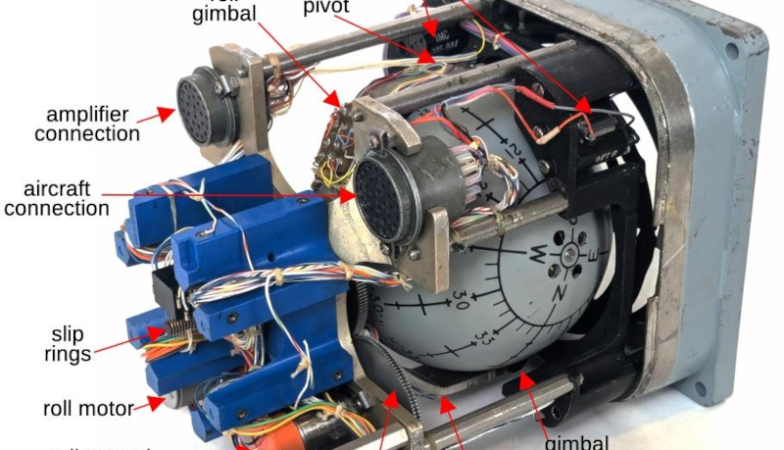
[Ken] recently obtained an attitude indicator—sometimes called an artificial horizon—from an F-4 fighter jet. Unlike some indicators, the F-4’s can rotate to show pitch, roll, and yaw, so it moves in three different directions. [Ken] wondered how that could work, so, like any of us, he took it apart to find out.
With the cover off, the device is a marvel of compact design. Then you realize that some of the circuit is inside the ball, so there’s even more than it appears at a quick glance. As you might have guessed, there are two separate slip rings that allow the ball to turn freely without tangling wires. Of course, even if you don’t tangle wires, getting the ball to reflect the aircraft’s orientation is an exercise in control theory, and [Ken] shows us the servo loop that makes it happen. There’s a gyroscope and synchros—sometimes known by the trade name selsyn—to keep everything in the same position.
You have to be amazed by the designers of things like this. Sophisticated both electrically and mechanically, rugged, compact, and able to handle a lot of stress. Good thing it didn’t have to be cheap.
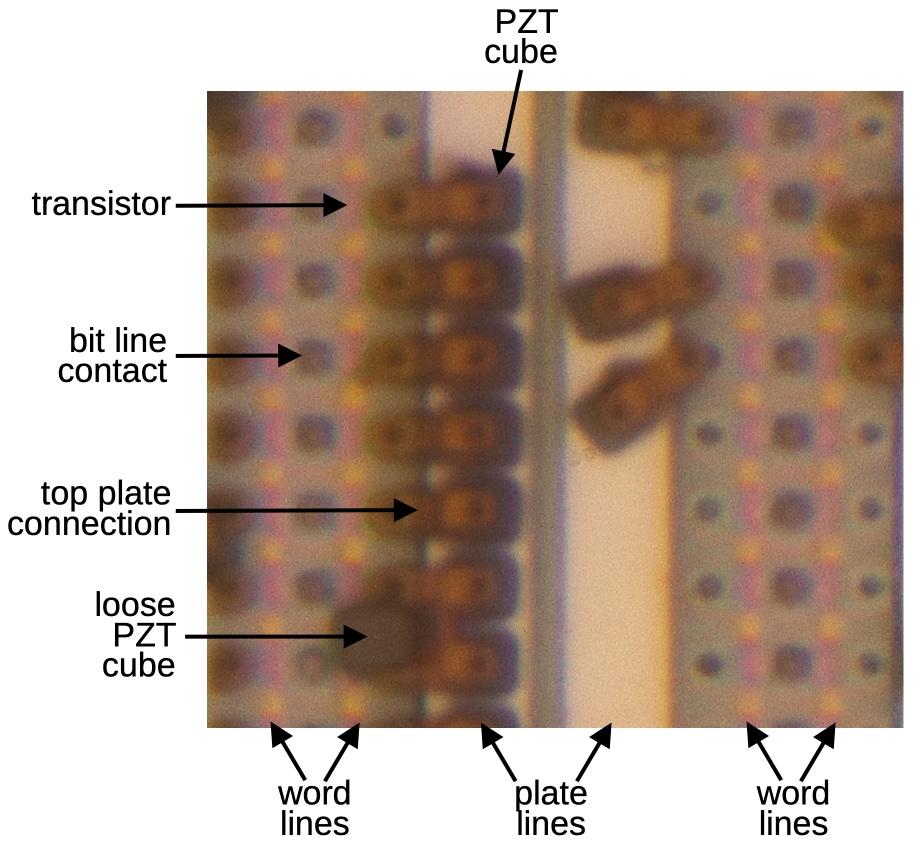
Structure of the Ramtron FeRAM. The image is focus-stacked for clarity. (Credit: Ken Shirriff)
Although not as prevalent as Flash memory storage, ferroelectric RAM (FeRAM) offers a range of benefits over the former, mostly in terms of endurance and durability, which makes it popular for a range of (niche) applications. Recently [Ken Shirriff] had a look inside a Ramtron FM24C64 FeRAM IC from 1999, to get an idea of how it works. The full die photo can be seen above, and it can store a total of 64 kilobit.
One way to think of FeRAM is as a very small version of magnetic core memory, with lead-zirconate-titanate (PZT) ferroelectric elements making up the individual bits. These PZT elements are used as ferroelectric capacitors, i.e. the ferroelectric material is the dielectric between the two plates, with a positive voltage storing a ‘1’, and vice-versa.
In this particular FeRAM chip, there are two capacitors per bit, which makes it easier to distinguish the polarization state and thus the stored value. Since the distinction between a 0 and a 1 is relatively minor, the sense amplifiers are required to boost the signal. After a read action, the stored value will have been destroyed, necessitating a write-after-read action to restore the value, all of which adds to the required logic to manage the FeRAM. Together with the complexity of integrating these PZT elements into the circuitry this makes these chips relatively hard to produce and scale down.
You can purchase FeRAM off-the-shelf and research is ongoing, but it looks to remain a cool niche technology barring any kind of major breakthrough. That said, the Sega Sonic the Hedgehog 3 cartridges which used an FeRAM chip for save data are probably quite indestructible due to this technology.
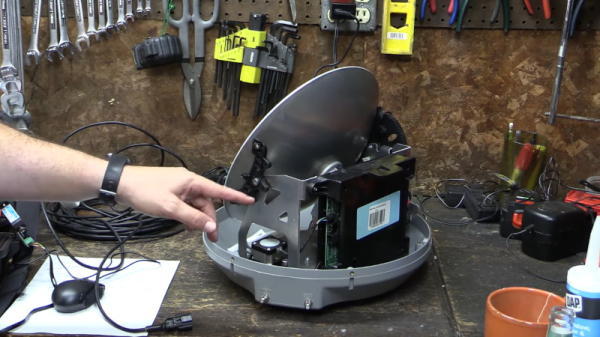
Like many of us, [Gabe] has things he just can’t stop buying. In his case, it is portable satellite dishes. You’ve seen these. They look like a dome or maybe a hard hat on some kind of motorized base. What’s in them? What can you do with them? Watch the video below and find out.
As [Gabe] points out, you can often find these on the surplus market for very little money. You can sometimes find them on the side of the road for free, too. Although we’ve never been that lucky.
The video shows three generations of Winegard antennas. It shows what’s inside and how to command them. Of course, the obvious use for these is as an antenna. But we also were thinking they’d make a fair motion base for something, too.
Some of the antennas lack any limit switches. On startup, the system spins until it grinds the plastic gears to find its travel limits. We expect that’s not good for the gears, but it does work. [Gabe] mentions it might be a bit of planned obsolescence, but we imagine it is more of a cost-saving measure.
Machines that automate the various tedious tasks that come with being a servant in a cat’s household — like feeding and cleaning Mr. Fluffles’ litter box — are generally a godsend, as they ensure a happy cat and a happy human. That is, unless said litter box-cleaning robot kills said cat. That’s the gruesome topic that [Philip Bloom], also known as the bloke of the One Man Five Cats channel on YouTube, decided to investigate after coming across a report about a certain Amazon-bought unit.
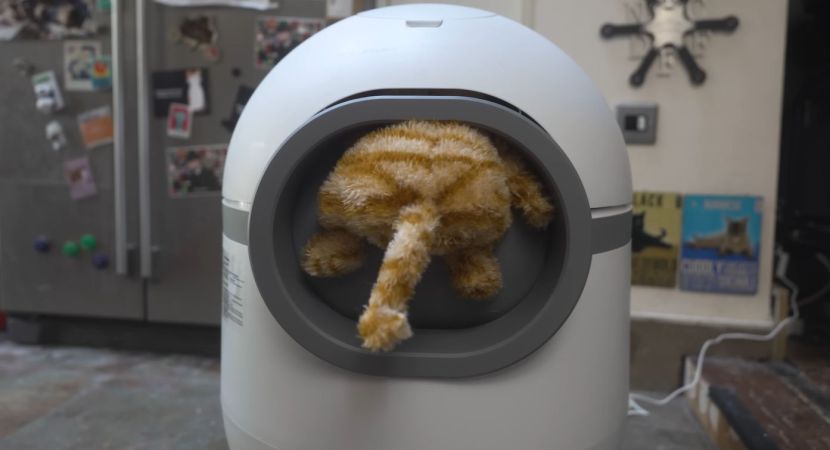
The theory of a self-cleaning litter box: a happy Mr. Fluffles.
Although he was unable to get the (generic & often rebranded) unit off Amazon UK, he did get it via AliExpress for £165 + £80 shipping. Although this version lacks the cute ears of other variants, it’s still effectively the same unit, with the same moving components and mechanism. An initial test with a cat plushie gave the result that can be observed in the above image, where the inner part with the opening will move upwards, regardless of whether a cat is currently poking through said opening. Once the victim is stuck, there is no obvious way to free the trapped critter, which has already led to the death of a number of cats.
The other self-cleaning litter boxes which [Philip] owns have a number of safety features, including a weight sensor, an infrared sensor above the opening to detect nearby critters, a top that will pop off rather than trap a critter, as well as a pinch sensor. During a test with his own hand, [Philip] managed to get injured, and following a banana test, he had a nice banana smoothie.
What takes the cake here is that after [Philip] connected the mobile app for the litter box, he found that there was a firmware update that seems to actually change the machine to use the pinch and infrared sensors that do exist in the litter box, but which clearly were not used properly or at all with the shipped firmware. This means that anyone who buys any of these self-cleaning litter boxes and does not update the firmware runs the significant risk of losing their pet(s) in a gruesome incident. In the video a number of such tragic deaths are covered, which can be rather distressing for any cat lover.
Of note here is that even with the improved firmware, any issue with the sensors will still inevitably lead to the tragic death of Mr. Fluffles. If you do want to obtain a self-cleaning litter box, make sure to for example get one of [Philip]’s recommendations which come with a paw stamp of approval from his own precious fluff balls, rather than a random unit off Amazon or AliExpress.
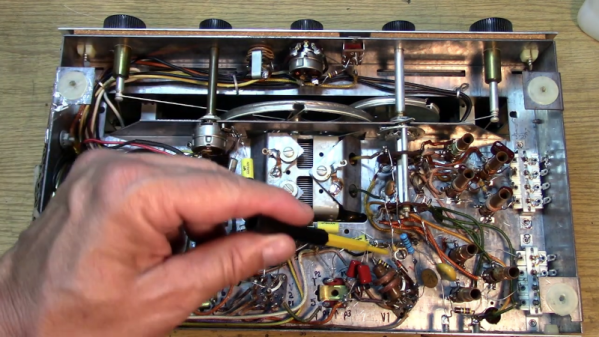
[MIKROWAVE1] claims he’s not a radio repair guy, but he agreed to look at a malfunctioning Hallicrafters S-120 shortwave receiver. He lets us watch as he tries to get it in shape in the video below. You’ll see that one of his subscribers had done a great job restoring the radio, but it just didn’t work well.
Everything looked great including the restored parts, so it was a mystery why things wouldn’t work. However, every voltage measured was about 20V too low. Turns out that the series fuse resistor had changed value and was dropping too much voltage.
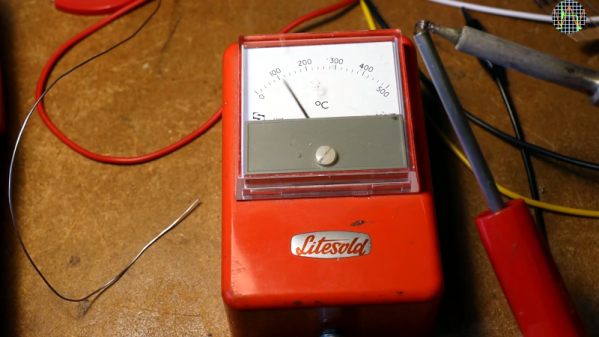
It is common these days to have a soldering iron where you can set the temperature using some sort of digital control. But how accurate is it? Probably pretty accurate, but [TheHWCave] picked up a vintage instrument on eBay that was made to read soldering iron temperature. You can see the video below, which includes an underwhelming teardown.
The device is a J thermocouple and a decidedly vintage analog meter. What’s inside? Nearly nothing. So why did the meter not read correctly? And where is the cold junction compensation?
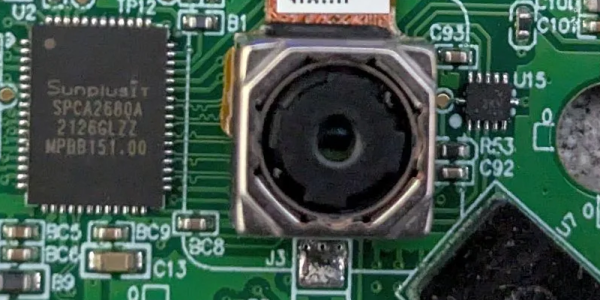
Over at EDN, [Brian Dipert] has been tearing down web cameras. A few months ago, he broke into a bargain basement camera. This time, he’s looking into a premium unit. Although we have to admit from some of what he reports, we are a little surprised at some of the corners cut. For example, it’s a 4K camera that doesn’t quite provide a 4K image. Despite a Sony CMOS sensor, [Brian] found the low-light performance to be poor. However, it does carry a much larger price tag than the previous camera examined.
The interesting part is about half way down the page when he tries to open the unit up. It seems like it is getting harder and harder to get into things and this camera was no exception. The device finally gives up. Inside is a relatively unremarkable board with a host of unknown ICs. One interesting item is a gyro chip that determines if the camera is upside down.
[Brian] managed to get the camera back together with no harm. It is interesting to compare it to the $15 camera he took apart earlier.