Ossmann Talks About Ubertooth At Schmoocon

[Michael Ossmann’s] talk from Schmoocon about his open source Bluetooth test tool called Ubertooth is now available to watch online. The video really fills in the gaps from the first time we looked at the project, as he covers why he took on the challenge, and what has happened since. He talks about how his work with the IM-ME helped in choosing hardware along the way, and the choices he made while developing the USB dongle. His hardware considerations included parts that didn’t require a nondisclosure agreement (keeping it open source) and that were available in single quantities so that individuals could build and populate their own boards quite easily.

We’ve embedded the talk after the break. The project is coming along great, and his Kickstart funds have almost doubled the original goal.

Continue reading “Ossmann Talks About Ubertooth At Schmoocon”

Logisim: Open Source Digital Logic Simulator

[Spi Waterwing] wrote in to make sure that we were aware of Logisim, a Java-based open source digital logic simulator. We’ve used Atanua quite a bit in the past but hadn’t heard of this program. It seems to have a pretty big educational following and right off the bat it’s got a feature we’ve always wanted, the ability to build your own ‘black box’ logic devices. That is to say you can build your own circuit out of logic gates and then package it into a part to be plopped into your next design. What it doesn’t have is the series logic chips that we’re used to with Atanua, but you can build your own with the black box feature if you really need that kind of functionality.

So grab a copy and try building that binary calculator project from last month.

Mixed I/O Testing Module

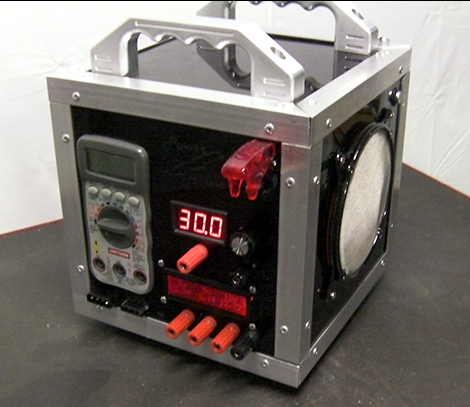
Needing to test the display interface for a multitude of different sensors [Fileark] built himself this analog and digital input/output simulator. Along the bottom is a double row of trimpots that adjust analog voltages. Each voltage is measured by the Arduino inside and its value is displayed on the graphic LCD screen to confirm that the hardware you’re testing is making correct measurements. There’s also digital I/O in two different forms. To the upper left are momentary push buttons but the DIP switch bank below that allows the same connections to be toggled on and off. It’s not an automated test bed, but if you’ve got a lot of I/O, or a lot of hardware to test this will save you some real time.

Don’t miss the demonstration video after the break.

Continue reading “Mixed I/O Testing Module”

Rotary Wall Plug From Scrap

Rotary tools such as a Dremel are useful to have around for all sorts of tasks in a workshop, including cutting, polishing, and grinding. [Konstantin] sent us in his home made wall mount rotary tool based off of parts from a blender and an old bench top jigsaw. Unlike a Dremel where the motor is in the hand held part of the tool, this setup hides the blender motor (which provides the power) behind a wall panel, and is controlled via the blender’s speed settings buttons. We could see this configuration allowing for more delicate work due to the reduction of weight in hand, as well as the added bonus of a near impossibility of losing this tool. Overall an excellent re-purposing of leftover parts, be sure to check out [Konstantin]’s blog for more build info and photos.

More 555 Projects To Enjoy

We love all of the projects that are coming out for the 555 design contest, so we thought we would share a couple more that have caught our collective eye.  Have a 555 project of your own? Be sure to share it with us, and keep an eye out for the contest submission dates. Read on for a few of our project picks.

Continue reading “More 555 Projects To Enjoy”

Versaloon Ported To STM8 And STM32 Discovery Boards

[Bingo] did some work porting Versaloon for STM8 and STM32 discovery boards. Versaloon is a multiple-architecture programmer that we saw a few weeks back. At its center is an STM32 microprocessor, which greatly simplifies the work necessary to use the two discovery boards instead. Flashing the firmware to the boards will zap the ST-link firmware and [Bingo] doesn’t know of a way to restore that so be warned. This hack is still pretty fresh off the bench, but so far it looks like vsprog and OpenOCD both work just fine with the new hardware.

10 µm Scanning Electron Microscope From Vidicon Tube

[Segelfam] built his own scanning electron microscope. He based the machine around an old Vidicon tube, a video recording technology that was used in NASA’s unmanned space probes prior the Galileo probe in the late 1970’s. We struggle a bit with the machine translation of [Segelfam’s] original build log, but it seems that he filled the tube with helium in order to convert it for use as a microscope. But don’t worry, if you’re interested in this hack the information is all there – between the forum thread and build log – it’s just a matter of putting it all together to fill in the details.

In case you were wondering, the image to the upper right has been colored using Photoshop; the rest are straight from the SEM.

[Thanks Jerry]