LEGO Jukebox Choses From Different CDs

lego-jukebox

Music used to be delivered on round plastic sheets called Compact Discs. [Ralph] still has some of them lying around which he used in his latest project. It’s a CD changer built out of LEGO pieces. It reminds us of the mid-century jukeboxes that changed out 45s on a record player.

You can’t tell from this image, but the entire disc changer build is shaped to sit atop a computer case. The system is built in two parts. There is a transport arm which moves left and right along the rack of CDs. It uses that black and white strip as an encoder to track its movement. It can reach in, grab a disc, and take it all the way down to the right where it drops it off in a staging area. The second part of the build now takes over, grabbing the disc from the staging holder and rotating it down into the CD tray of the PC. All of this is demonstrated after the jump.

If you’re like us you prefer digital delivery for your music. We haven’t crossed that watershed with video games yet and that’s why we still love this Xbox 360 disc changer hack.

Continue reading “LEGO Jukebox Choses From Different CDs”

Measuring The Lifespan Of LEGO

lifespan-of-LEGO

How many times can you put two LEGO pieces together and take them apart again before they wear out? The answer is 37,112. At least that’s the number established by one test case. [Phillipe Cantin] was interested in this peculiar question so he built the test rig above to measure a LEGO’s lifespan.

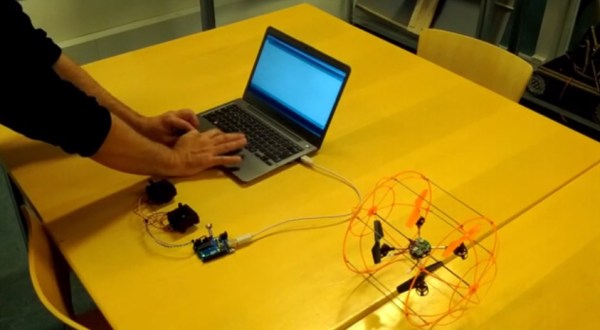
The hacked together apparatus is pretty ingenious. It uses two servo motors for testing, each driven by the Arduino which is logging the count on an SD card. One of the two white LEGO parts has been screwed onto an arm of the upper servo. That servo presses down onto the mating piece which is sitting inside that yellow band. Look close and you’ll realize the yellow is the handle end of an IC puller. When the post on the lower servo is moved toward one arm of the puller it grips the lower LEGO piece tightly so that the upper servo can pull the two apart. In addition to the assembly and disassembly step there’s a verification step which raises the mated parts so that a reflectance sensor can verify that they’re holding together. [Phillipe] let the rig run for ten days straight before the pieces failed.

Don’t miss his video description of the project after the break.

Continue reading “Measuring The Lifespan Of LEGO”

Hacked Interactive R2D2 Controlled By Raspberry Pi

hacked-R2D2-controlled-by-raspberry-pi

Ah R2D2. Probably one of the most recognized little robots on the planet. There have to be a hundred different toys of R2 out there, but one of the more impressive is the 30th Anniversary Interactive edition. Complete with all kinds of bells and whistles, it’s about as realistic as they come. One Star Wars fan found himself in possession of a broken Interactive R2, and with his girlfriend’s birthday coming up, decided to do a little droid surgery to create the ultimate gift.

Giving Anakin a run for his money, all the controls for this R2 unit were custom built.  A Raspberry Pi running Rasbian acts as the brain. Facial recognition was implemented using OpenCV. Voice commands in either English or Chinese were made possible by PocketSphinx. Some of the other features he included are: message recording and playback, ultrasonic distance detection, motion detection, wifi, and a rechargeable battery. Many of those features were included in the original toy, but since this unit was broken, had to be rebuilt from scratch.

In the end, it must have impressed his girlfriend – she’s now his wife. Good work Jedi. Check out some build photos and a video demonstration after the break.

Continue reading “Hacked Interactive R2D2 Controlled By Raspberry Pi”

Futaba 10C Radio Modified For Spektrum Module Compatibility

futaba-radio-modified-to-fly-spektrum

The Futaba 10C radio (non-module version) is [Tom]’s transmitter of choice. Unfortunately,  it isn’t compatible with the Spektrum DSM2 technology modules he wanted to use. So, being the crafty guy he is, he decided to hack it so it was.

Upon opening the Futaba transmitter, he realized that the non-module version of the 10C didn’t really seem that different than a module version. His transmitter just has a pcb hardwired in place where the modules would otherwise go. He soldered a 4 conductor audio jack to the unused pins on the pcb in the transmitter, then mounted it in the case with some J.B. Weld. He then wired and mounted the receiving jack in the module case. A small 6 inch audio cable bridges the two devices, and velcro holds them neatly together.

He discovered that certain modules have problems with the channels being out of order. Unless someone comes up with a firmware hack, there’s no way to remap the controls. So, some modules are just not compatible. [Tom] gives a very nice video walkthrough after the break. Check it out.

Continue reading “Futaba 10C Radio Modified For Spektrum Module Compatibility”

DIY Arduino Pro Mini Quadcopter

[execUc] took a stock V929 quadcopter and started making some crafty customizations. The main change – the control electronics were replaced by an Arduino Pro Mini (16Mhz model). He soldered all the modules on a prototyping board and, although admittedly a bit heavy, the little guy takes flight with no problem.

Among other details, an HMC5883L (magnetometer) and MPU6050 (accelerometer / gyroscope) are used as sensors. A LiPo 7.4V battery pack supplies the power. The brushed motors are controlled by pulse-width modulation from SI2302 MOSFET with added diodes. He plans to swap out the micro-controller for an ARM7 stm32F103 for extra computing power, and needs to play with the PID values to correct a slight problem he seems to be having when rotating.

Check out a test flight video after the break. [execUc] has a thorough list of all the alterations he made in the video description, so be sure to read it.

[via Hacked Gadgets]

Continue reading “DIY Arduino Pro Mini Quadcopter”

Sonic Screwdriver Meets TV-B-Gone

sonic

[furrysalamander] has a friend that is a really big Doctor Who fan. It happens that this friend has a birthday coming up, and [furrysalamander] wanted to get her something amazing. A Sonic Screwdriver is always a great gift, but [furrysalamander] wanted to put his personal touch on it. He ended up adding a TV-B-Gone to [10]’s screwdriver, turning a fictional deus ex machina into a functional device.

The body of the Sonic comes from this replica of [10]’s screwdriver from Think Geek. Inside, the screwdriver has space for a battery a circuit board to control the lights and sound normally expected of a sonic screwdriver. [furrysalamander] added a freeform circuit composed of an ATtiny85, a transistor, LED, and a few resistors to add the ability to turn just about any TV off.

Of course [furrysalamander] needed to program the ATtiny with the TV-B-Gone firmware, and lacking any AVR development tools he used a Raspberry Pi’s GPIO pins to write the firmware to the microcontroller. That’s something we’ve seen before, but [furrysalamander] is a champ for including the process in his Instructable.

The end result is a Sonic Screwdriver that doesn’t work on wood and can’t break a deadlock seal. It turns off TVs just fine, though, and looks great to boot. You can check out a demo of [furrysalamander]’s sonic in action after the break.

Continue reading “Sonic Screwdriver Meets TV-B-Gone”

Launching A Glider From Space

We get a ton of tips about weather balloon launches taking hobby electronics into space. But every once in a while one of them stands out from the rest. This project does send an electronic payload into space, but it also lets [David] fly his hardware back from near-space using an RC airplane.

The return vehicle is unpowered, but that shouldn’t be a problem as launching from a weather balloon will provide plenty of altitude for the flight. Because the temperature experienced in that part of the atmosphere is so cold [David] had to take several things into account. Obviously you want your batteries and control electronics to be insulated from the cold. But something that doesn’t usually pop into mind are issues with the servo motors which run the glider’s flaps. They usually have some white grease on the gears. At temps as low as -50C that grease will harden and make the servo stop working so he made sure to clean the gears thoroughly before the flight.

Unfortunately [David] had several problems capturing images and recorded video from the ground station. But his write up is still a fun read and the clip after the break gives a general overview of the entire project from the nose camera of the glider.

Continue reading “Launching A Glider From Space”