A photo of the old mechanical and new digital altimeters

Ben Eater Explains How Aircraft Systems Communicate With The ARINC 429 Protocol

Over on his YouTube channel the inimitable [Ben Eater] takes a look at an electronic altimeter which replaces an old mechanical altimeter in an airplane.

The old altimeter was entirely mechanical, except for a pair of wires which can power a backlight. Both the old and new altimeters have a dial on the front for calibrating the meter. The electronic altimeter has a connector on the back for integrating with the rest of the airplane. [Ben] notes that this particular electronic altimeter is only a backup in the airplane it is installed in, it’s there for a “second opinion” or in case of emergency.

Continue reading “Ben Eater Explains How Aircraft Systems Communicate With The ARINC 429 Protocol”

PLA Gears Fail To Fail In 3D Printed Bicycle Drivetrain

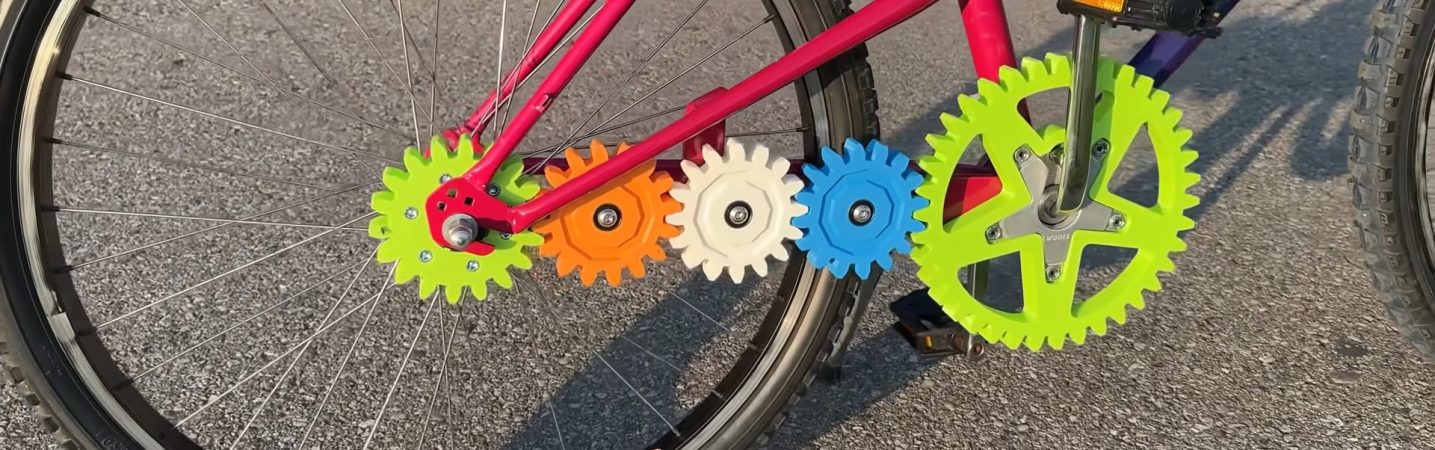
Anyone who has ever snapped a chain or a crank knows how much torque a bicycle’s power train has to absorb on a daily basis; it’s really more than one might naively expect. For that reason, [Well Done Tips]’s idea of 3D printing a gear chain from PLA  did not seem like the most promising of hacks to us.

Contrary to expectations, though, it actually worked; at the end of the video (at about 13:25), he’s on camera going 20 km/h, which while not speedy, is faster than we thought the fixed gearing would hold up. The gears themselves, as you can see, are simple spurs, and were modeled in Fusion360 using a handy auto-magical gear tool. The idler gears are held in place by a steel bar he welded to the frame, and are rolling on good old-fashioned skateboard bearings–two each. (Steel ones, not 3D printed bearings.) The healthy width of the spur gears probably goes a long way to explaining how this contraption is able to survive the test ride.

The drive gear at the wheel is steel-reinforced by part of the donor bike’s cassette, as [Well Done Tips] recognized that the shallow splines on the freewheel hub were not exactly an ideal fit for PLA. He does complain of a squeaking noise during the test ride, and we can’t help but wonder if switching to helical gears might help with that. That or perhaps a bit of lubricant, as he’s currently riding the gears dry. (Given that he, too, expected them to break the moment his foot hit the pedal, we can’t hardly blame him not wanting to bother with grease.)

We’ve seen studies suggesting PLA might not be the best choice of plastic for this application; if this wasn’t just a fun hack for a YouTube video, we’d expect nylon would be his best bet. Even then, it’d still be a hack, not a reliable form of transportation. Good thing this isn’t reliable-transportation-a-day!

Continue reading “PLA Gears Fail To Fail In 3D Printed Bicycle Drivetrain”

Building A Diwheel To Add More Tank Controls To Your Commute

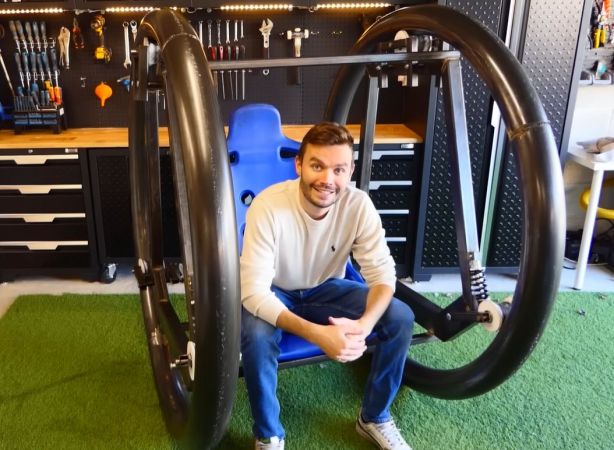
It’s often said that one should not reinvent the wheel, but that doesn’t mean that you cannot change how the use of said wheel should be interpreted. After initially taking the rather zany concept of a monowheel for a literal ride, [Sam Barker] decided to shift gears, did a ‘what if’ and slapped a second monowheel next to the first one to create his diwheel vehicle. Using much thicker steel for the wheels and overall much more robust construction than for his monowheel, the welding could commence.

It should be said here that the concept of a diwheel, or dicycle, isn’t entirely new, but the monowheel – distinct from a unicycle – is much older, with known builds at least as far back as the 19th century. Confusing, self-balancing platforms like Segways are also referred to as ‘dicycles’, while a diwheel seems to refer specifically to what [Sam] built here. That said, diwheels are naturally stable even without gyroscopic action, which is definitely a big advantage.

The inner frame for [Sam]’s diwheel is built out of steel too, making it both very robust and very heavy. High-tech features include suspension for that smooth ride, and SLS 3D-printed nylon rollers between the inner frame and the wheels. After some mucking about with a DIY ‘lathe’ to work around some measurement errors, a lot more welding and some questionable assembly practices, everything came together in the end.

This is just phase one, however, as [Sam] will not be installing pedals like it’s an old-school monowheel. Instead it’ll have electrical drive, which should make it a bit less terrifying than the Ford Ka-based diwheel we featured in 2018, but rather close to the electric diwheel called EDWARD which we featured back in 2011. We hope to see part two of this build soon, in which [Sam] will hopefully take this beast for its first ride.

Continue reading “Building A Diwheel To Add More Tank Controls To Your Commute”

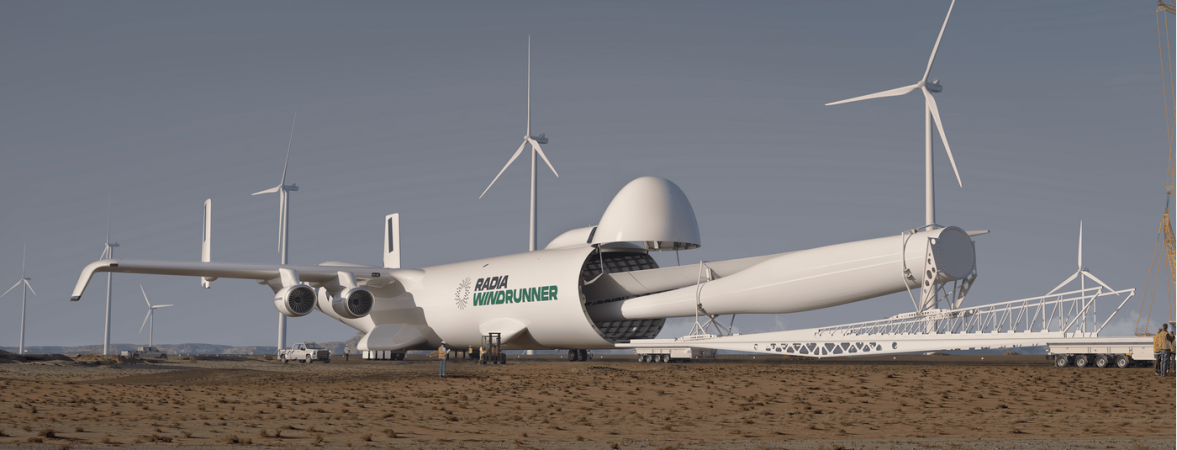
The WindRunner unloading a blade, image Radia.

Giant Airplane Goes Long On Specialization

While not everyone agrees on the installation of wind turbines in their proverbial back yards, one thing not up for debate is that there is a drive to build them bigger, and bigger. Big turbines means big blades, and big blades need to be transported… somehow. If air freight is going to stay relevant to the industry, we’re gonna need a bigger airplane.

A startup called Radia has a plan for that plane, and it is a doosie. The “WindRunner” would clock in at a massive 108 meters (354 feet) long, but with a wingspan of just 80 m (262 ft). That’s very, very long, but it might not be the largest airplane, depending how you measure it. Comparing to the 88 m wingspan for the late, lamented An-225 Mriya, you can expect a lower payload capacity, but heavy payloads aren’t the point here. Wind turbine blades really aren’t that heavy. They’re big, or they can be — the WindRunner is designed to fit a single 105 m blade within its long fuselage, or a pair of 90 m blades.

Continue reading “Giant Airplane Goes Long On Specialization”

A forest green kei truck sits in an actual forest. In its bed is a dark grey box with a small window, wood trim, and a solar panel tilted on its roof. The headlights are on, hinting at the onset of twilight. You have a sudden urge to go glamping now.

Kei Truck Becomes Tiny RV

Tent camping lets you explore places on foot you could never reach another way, but sometimes you want to camp with a bit more luxury. [Levi Kelly] decided to see how small you could make an RV. [via Autopian]

While we won’t argue one way or another on his claim to world’s smallest, as that likely depends on your definition of an RV, starting with a kei truck certainly puts you in a more compact format than something built on a bus chassis. With four wheel drive and a small footprint, this could be better for overlanding than the Rivian bed camper we featured recently.

The 21 sq. ft. (1.95 m2) camper portion itself is framed in 2 x 2s (38 x 38 mm) to save weight and uses foam board insulation. A working faucet uses a pump to draw drinking water from a 5 gallon (19L) refillable jug and empties into a 7 gallon (26L) grey water tank. A solar panel on the roof charges the battery that drives the pump, ventilation fan, and can also be used to run other devices like a hot plate for cooking.

A teeny tiny wood stove can be used for heat, although [Kelly] is using a different fuel source to reduce unpredictability from a wood fire in such a small space. A faucet-mounted sprayer can be routed to the outside of the camper to create a makeshift shower and is run from the sink water system. There’s even a small cabinet above the foot area of the bed to house a portable toilet and a bubble window to observe your surroundings while you do your business.

We’ve seen some even smaller campers, like this vintage-inspired bike camper, or this more streamlined version. If you want the most efficient RV ever then check out this solar-powered one.

Continue reading “Kei Truck Becomes Tiny RV”

Electric Surfboard Gets Thrust Vectoring Upgrade

The internet has already taught us that an electric surfboard is a great way to get around on the water while looking like an absolute badass. [RCLifeOn] is continuing to push the boat forward in this regard, however, adding thrust vectoring technology to his already-impressive build.

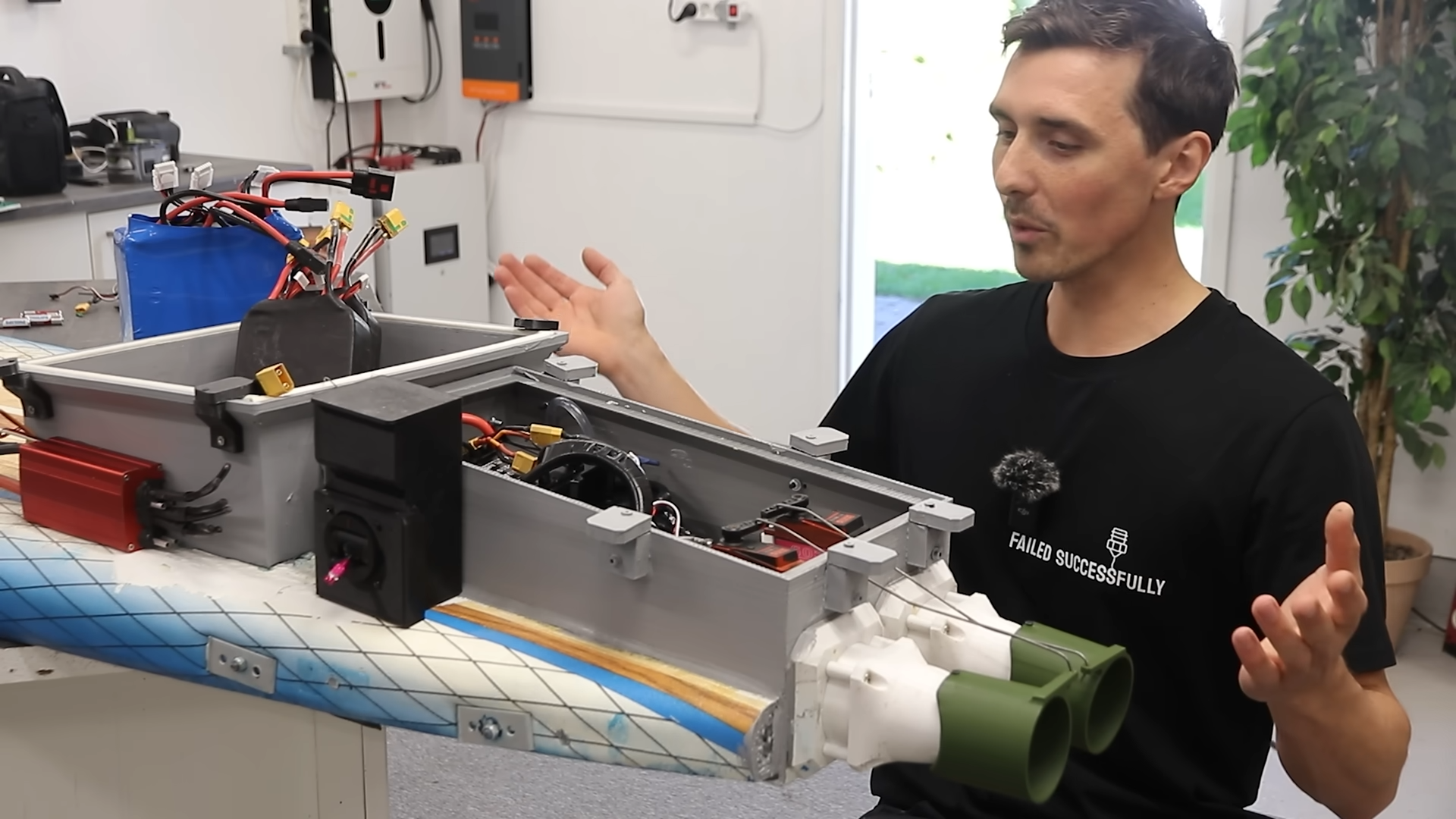
If you’re unfamiliar with the world of electric surfboards, the concept is relatively simple. Stick one or more electric ducted fan thrusters on the back, add some speed controllers, and power everything from a chunky bank of lithium-ion batteries. Throw in a wireless hand controller, and you’ve got one heck of a personal watercraft.

Traditionally, these craft are steered simply by leaning and twisting as a surfer would with a traditional board. However, more dynamic control is possible if you add a way to aim the thrust coming from the propulsion system. [RCLifeOn] achieved this by adding steerable nozzles behind the ducted fan thrusters, controlled with big hobby servos to handle the forces involved. The result is a more controllable electric surfboard that can seriously carve through the turns. Plus, it’s now effectively an RC boat all on its own, as it no longer needs a rider on board to steer.

We’ve covered various developments in this surfboard’s history before, too. Video after the break. Continue reading “Electric Surfboard Gets Thrust Vectoring Upgrade”

A suitcase made of two rectangular plastic crates latched together sits prone on a concrete floor. The top shell is a beige-ish grey with a navy check and the word "JerseyMaid" on it updside down. The navy bottom crate is navy with the letters "lsen" in large cursive font ant the letters "ORATION" in smaller print below it. Much of the text is covered by a large latch and a power tool battery mount. Bright pink tape affixes a blue tarp skirt to the bottom of the hover suitcase.

Hovercraft Suitcase Gives Your Luggage A Smooth Ride

The wheels on roller suitcases are one of their primary failure points. After the destruction of the wheel mount on her DIY suitcase, [Laura Kampf] wondered if it would be better to dispense with wheels altogether.

To give her suitcase a lift, [Kampf] decided to turn it into a hovercraft so it couldn’t be stopped by pavement or puddles. The first task was finding an appropriate fan, and a compact leaf blower donated it’s body to makerdom for the project. After reducing the blower to it’s constituent components and finding a secret turbo switch, work began on the momentum curtain.

“Nose-holing” the arrangement and size of the holes to pipe air through the stapled tarp and tape skirt seemed to be the bulk of the trial-and-error in this one. Based on other hovercraft designs [Kampf] found, keeping the holes near the center of the inflated portion gave better lift. In the end, the carry-on is able to lift a decent amount even on its lowest setting, resulting in a suitcase that is “not embarrassing” for travel. No word yet on what TSA thinks.

If you’re looking for another unexpected lift off, how about a full-sized flying Delorean replica? We’ve also covered some of the reasons why we don’t see more of these all terrain wonders.

Continue reading “Hovercraft Suitcase Gives Your Luggage A Smooth Ride”