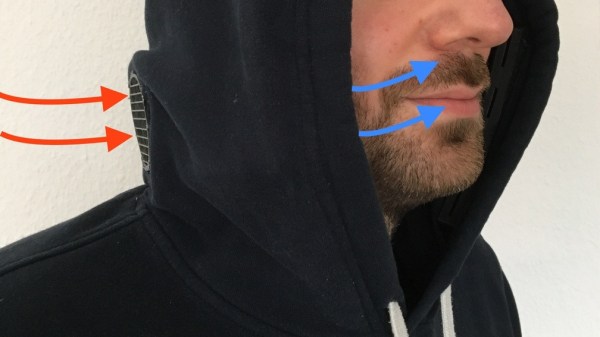
Hoodies are great, and rightfully a hacker’s favorite attire: they shield you from the people around you, keep your focus on the screen in front of you, and are a decent enough backup solution when you forgot your balaclava. More than that, they are also comfortable, unless of course it is summer time. But don’t worry, [elkroketto] has built a solution to provide the regular hoodie wearer with a constant breeze around his face, although his Clean Air Bubble is primarily tackling an even bigger problem: air pollution.
Wanting to block out any environmental factors from the air he breathes, [elkroketto] got himself a thrift store hoodie to cut holes in the back, and attach two radial fans that suck in the air through air filtering cloths. A 3D printed air channel is then connected to each fan, and attached on the inside of the hood, blowing the filtered air straight into his face. Salvaging a broken drill’s battery pack as power supply and adding a 3D printed clip-in case for the step-up converter, the fans should provide him a good 5 hours of fresh air. Of course, one could also add a solar charging rig if that’s not enough.
Keep in mind though, while a wearable air filter might sound particularly useful in current times, [elkroketto] specifically points out that this is not for medical use and won’t filter out any airborne diseases.