DIY Filament: The Filabot Wee

filabotwee

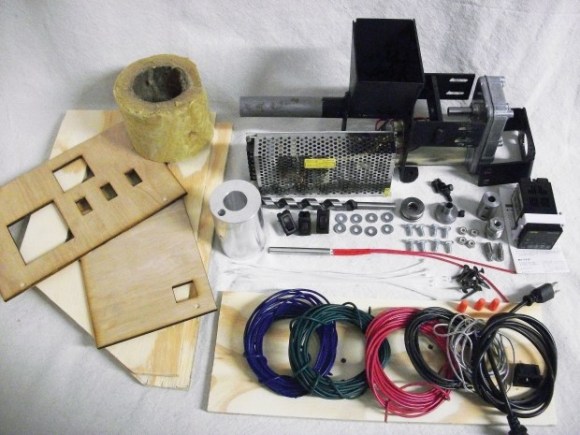
Now there’s yet another option for making your own 3D printer filament: the Filabot Wee. It looks like their once open source model that they pulled from Thinigiverse earlier this year has received a significant makeover, though we aren’t sure what parts may have changed. (EDIT: Filabot says the Wee is still open source, and that once they’ve updated the files they will be available again.)

As you would expect, the Wee has a PID temperature controller and is capable of extruding both ABS and PLA pellets into either 1.75mm or 3mm-diameter filament. Speed varies depending on materials and thickness, but can reach 5 to 20 inches per minute of filament extrusion. Though the Filabot gang is selling the extruder as a kit, you can probably save a few bucks if you have access to a laser cutter and some other basic materials.

You should expect to spend more for Filabot parts ($649) than you would for the original Lyman extruder, though perhaps a more fair comparison would be the new third version of the Lyman extruder, whose bill of materials approaches $900. Considering Lyman’s recent comments that indicate an extrusion rate of 40-50 inches per minute, the extra bucks may be worth it. You can check out a demonstration video of the Filabot Wee after the break.

Continue reading “DIY Filament: The Filabot Wee”

A Killer Arcade Cabinet For Halloween

slaughterhouseArcade

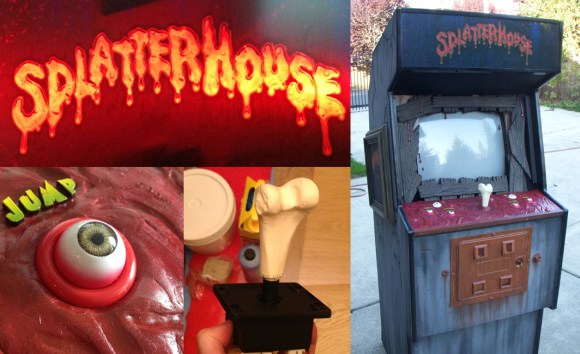
It’s already pretty cool that [Clay] co-owns an Arcade, but he’s really impressed us with his custom-made Splatterhouse cabinet built to get his patrons in the Halloween spirit! A Namco brawler title from 1988, Splatterhouse came in an unadorned and otherwise forgettable cabinet. [Clay] salvaged an old Williams Defender, coating the sides with a cocktail of drywall compound, sand, and paint to achieve a stone texture. He then carved up some pink insulation foam into a tattered “wooden” frame and used it as a monitor bezel. For accents, he fashioned strips of latex to resemble torn flesh and placed them among the boards. The control panel is yet another work of art: [Clay] 3D printed a life-size human femur for the game’s joystick, and converted the buttons to look like eyeballs.

[Clay] decided to go beyond the stunning cosmetics, though, and tapped into the game’s CPU with a custom daughterboard that detects different in-game events and state changes such as player health. An ATMega165 uses four PWM outputs connected to a number of LEDs inside the cabinet and around the monitor bezel to react to the different events. If a player takes damage, red lights flash around the monitor. Inserting a coin or dying in the game causes a different set of LEDs behind the marquee to go nuts.

Check out his detailed project page for more information and see a video overview below. If building a full-scale arcade machine is out of your budget, you can always make a tiny one.

Continue reading “A Killer Arcade Cabinet For Halloween”

3D Printer Looks Factory Made

[Richard Sum] came up with a great looking 3D printer and put his project up as a campaign on IndieGoGo.

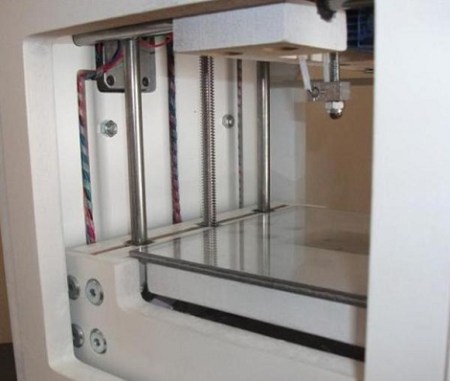
[Richard]’s ‘SUMPOD’ is based off the reprap like a lot of other 3D printers, but the SUMPOD has a look of professionalism to it; the printer looks like something that would come from a factory. We think a lot of thought went into the design and fabrication of this printer.

The specs of the machine aren’t too bad either. It’s build area is 150x150x100 mm, or nearly 2 inches than the Makerbot Thing-O-Matic. We asked [Richard] about the drive system of the machine, and he told us there is a linear bearing/belt setup for the x and y axes with a screw drive for the z axis. The electronics are standard NEMA 17 motors and reprap RAMPS fare, so everything electrical is tried and true.

[Richard] plans on adding a Dremel attachment for pcb and lithophane milling. We hope that some design files of the SUMPOD released, but in the mean time we’re really looking forward to seeing the progress of this project.

Printing Your Own Guitar Parts

The white parts that make up the body contours of this guitar have been 3D printed to meet [Bård S D’s] personal specifications. He started designing the pieces last year to add to his Zoybar guitar. Each of the three parts has its own function. The tail piece serves as a floor stand, as well as a hook for hanging the instrument upside down. The wide piece at the top gives the player a place to rest the forearm, and the piece at the bottom serves as a cradle to place on your leg, and contains the jack for the guitar’s pickup. You can see him playing the instrument in the video after the break.

We looked for more information on the Zoybar system but it’s a bit hard to get the facts from that website. We know that the 6-string kit comes standard without frets, and it’ll cost you a pretty penny at around $700. But if it performs as a quality instrument the price isn’t too far out of line.

Continue reading “Printing Your Own Guitar Parts”