Encase Yourself In Carbonite With Kinect

kinect_plastic_renders

There never seems to be a lull in the stream of new and novel hacks that people create around Microsoft’s Kinect. One of the more recent uses for the device comes from [Interactive Fabrication] and allows you to fabricate yourself, in a manner of speaking.

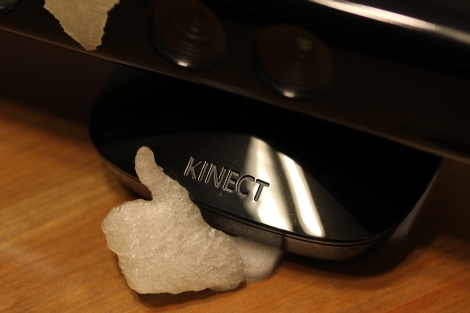
The process uses the Kinect to create a 3D model of a person, which is then displayed on a computer monitor. Once you have selected your preferred pose, a model of the image is rendered by a 3D plastic printer. Each scan results in a 3cm x 3cm plastic model complete with snap together dovetail joints allowing the models to be combined together. A full body scan can be constructed with three of these tiles, resulting in a neat “Han Solo trapped in Carbonite” effect.

Currently only about 1/3 of Kinect’s full resolution is being used to create these models, which is pretty promising news to those who would try this at home. Theoretically, you should be able to create larger, more detailed images of yourself provided you have a 3D printer at your disposal.

Keep reading for a quick video presentation of the fabrication process.

Continue reading “Encase Yourself In Carbonite With Kinect”

RepRapped Transistors

[Mr. Kim] and [John Sarik] made a presentation(pdf) at last weekend’s Botacon conference on how they made organic field-effect transistors (OFETs). A wooden RepRap, the fancifully named Unicorn from Makerbot (or printed from Thingiverse), hacked felt pen, a handful of chemicals, and a couple of pieces of lab equipment were needed to print (plot) out transistors. We were unable to attend the conference, so this is what we inferred from the slides. Silver ink is printed onto a glass slide to form the gate regions, cured and partially masked-off. A layer of CP1 Resin is spin-coated onto the slide to form the dielectric barrier between the gate and the semiconductor, the drain, and source regions. Silver ink is once again used, this time to print out the drain and source regions. The last thing printed is P3HT dissolved in toluene to form the semiconductor region. It would be interesting to see this process modified so that all coatings and curing can be done without removing the slide from the printer.

3D Printed MakerBot

[Webca] has made a 3D printed MakerBot with his MakerBot. Using five pounds of plastic, the design replaces all of the plywood used to create a regular MakerBot. This complements the existing designs for the 3D printed extruders, dinos, and other parts already on Thingiverse. An interesting mile marker in the history of 3D printing. We might make one after we make a Mendel and tons of Hack a Day Badges. We also look forward to improvements people will contribute to the design such as using less plastic or a parameterized design to make a really big (or small) MakerBot.

Open3DP Looks At 3D Printing In Common Materials

[Buddy Smith] sent us a link to Open3DP which he calls “REAL 3d printing hacks”. Open3DP showcases the projects of the Solheim Rapid Prototyping Laboratory at the University of Washington. They’re working on 3D printing in materials that can be commonly acquired and to that end they publish recipes for powder printing in materials such as sugar, ceramic, and glass. Take a look through their archives. We found the post on microwave kilns interesting, as well as the writeup about Shapeways glass printing which is seen above. We’ve also embedded a short video on Open3DP’s work after the break.

Update: [Mark Ganter] dropped us a line to clarify that Open3DP was the first to develop printable glass about a year ago, called Vitraglyphic. They’ll also be presenting papers at Rapid2010 and announcing a new printable material.

Continue reading “Open3DP Looks At 3D Printing In Common Materials”

CES Update: CES Badges

In a previous post we had given one of our badges out to [Bre Pettis] at the MakerBot booth. We have been called the “Skull Guys” around CES and were stopped multiple times by people that did not know of this site. [Bre] got an extra of the size we are wearing around. [Leo Laporte] received the very first prototype which he promptly placed in his mouth. The badges are made from natural ABS plastic in [Devlin]’s CupCake CNC machine. There will be a post-CES follow-up with the release of the STL files to make the badge on Thingiverse as well as a step-by-step breakdown of the build process.

Printing Circuits On The RepRap

reprappcb

[Rhys Jones] has been working with the RepRap team to develop a way to print circuit boards. The machine first prints the plastic substrate with channels for the metal to be deposited into. They adapted their pinch wheel feeder to work with solid core solder (flux creates a mess). The extruded solder’s specific heat isn’t hot enough to melt the plastic. They made a video (embedded below) of their test piece: an optical endstop. The team has also been experimenting with decoupling the feed mechanism from the extruder.

Continue reading “Printing Circuits On The RepRap”