Reverse Engineering An LG Cell Phone Display

andy-cell

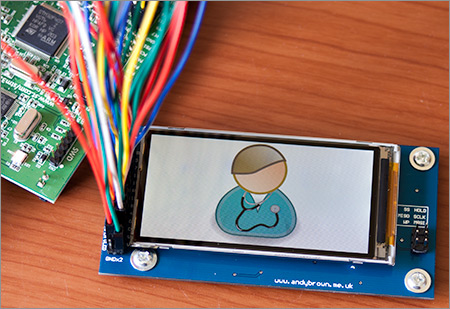
[Andy] has done a great job reverse engineering the LG KF700 cell phone display. LG’s KF700 is a 2008 era cell phone — that’s about 300 years old in cell phone years. The phone was somewhat novel in that it used a 3” diagonal 2:1 480×240 widescreen format. While the phone itself may be a memory, its screen lives on through the magic of Ebay.

Obtaining the LCD is the easy part – the hard part is figuring out how to interface to it. LG is very helpful in that regard by publishing detailed service manuals and schematics on their cell phones. We’re not sure if these manuals are supposed to be public domain, but Google is your friend here. With the help of the service manual, [Andy] was able to determine the LCD has an on board controller (Himax HX8352), making it much easier to interface to. He was also able to find out information about the LCD connector pin out, and even a connector part number.

Continue reading “Reverse Engineering An LG Cell Phone Display”

Why Kickstarter Projects Are Always Delayed

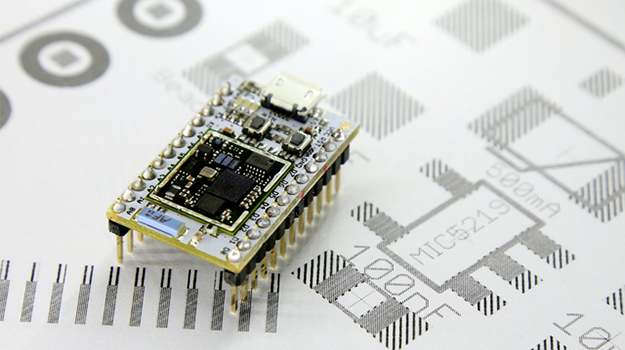
Most Hackaday readers may remember the Spark Core, an Arduino-compatible, Wi-Fi enabled, cloud-powered development platform. Its Kickstarter campaign funding goal was 10k, but it ended up getting more than half a million. The founder and CEO of Spark [Zach Supalla] recently published an article explaining why Kickstarter projects are always delayed as the Spark core project currently is 7 weeks behind schedule.

[Zach] starts off by mentioning that most founders are optimistic, making them want to embark in this kind of adventure in the first place. In most presentation videos the prototypes shown are usually rougher than they appear, allowing the presenters to skip over the unfinished bits. Moreover, the transition from prototype to “manufacturable product ” also adds unexpected delays. For example, if a product has a plastic casing it is very easy to 3D print the prototype but much harder to setup a plastic injection system. Last, sourcing the components may get tricky as in the case of Spark core the quantities were quite important. Oddly enough, it was very hard for them to get the sparkcore CC3000 Wifi module.

Tre: When Arduino Meets Beagle Bone

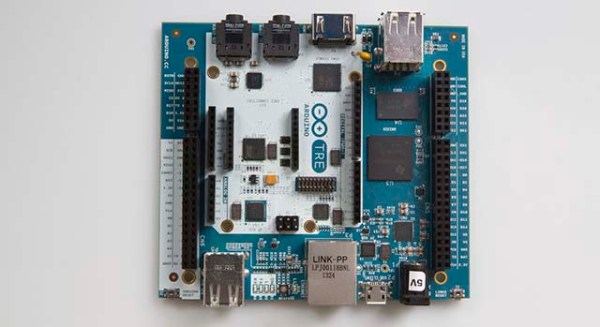
Although yesterday saw the announcement of an x86-based Arduino powered by an Intel chip. This may have not been the big story to come from [Massimo] at Maker Faire Rome. Announced along with the x86 Arduino Galileo was the Arduino TRE, a collaboration between Arduino and the BeagleBoard foundation.

The TRE is really two Arduinos in one: in the center is basically an Arduino Leonardo with the standard Arduino headers and an ATmega32u4. Elsewhere on the board is a TI Sitara ARM Cortex A-8 processor running at 1GHz with 512 MB of RAM, 10/100 Ethernet, HDMI out, USB host and device ports, and a bunch of connectors intended for an LCD and a ZigBee.

There is, of course, the obvious comparison between the TRE and Raspberry Pi. Hardware-wise, the TRE is very close to the BeagleBone Black, a bit more powerful than the Raspberry Pi, and able to do some very cool stuff (i.e. OpenCV) the Pi just can’t handle.

There is – I think – no official price for the Arduino TRE quite yet. It will be available in spring, 2014, though. You can check out all the press release photos in the gallery below.

Continue reading “Tre: When Arduino Meets Beagle Bone”

VU Meter Prom Dress

vu meter prom dress

[Kyle] has just put the finishing touches on this VU Meter Prom dress, and it looks great!

The dress makes use of 70 feet of aquamarine EL wire, a 2600mAh li-on battery, a repurposed DB9 cable, an Arduino knock off, an Adafruit microphone pre-amp, and features eight addressable triac channels through an EL Escudo Dos by Sparkfun. Each loop of EL wire was sewn into the dress using clear thread. The separate segments were then daisy chained together near the zipper in the back using ribbon cables. To top it all off, [Kyle] has a cheap thermoforming setup utilizing a toaster oven which he used to make an acrylic case for the electronics.

The dress is for his lucky friend [Diane] and we think it will make for quite a memorable prom! To see this awesome VU Meter in action, stick around after the break for the video.

Continue reading “VU Meter Prom Dress”

Fail Of The Week: EPROM Reading And Erasing

It may be a failure but it sure does look cool. [Scott Lawrence] had a fair number of EPROM chips on hand and decided to get rid of the traditional eraser and programmer in order to play around with the concepts using his own hardware. He was met with disappointment at several steps in the process. No worries though, each of these upsets sent him back to the drawing board and he learned way more than he ever would have if it had actually worked. It’s fair to say this failure was highly successful.

Continue reading “Fail Of The Week: EPROM Reading And Erasing”

The Intel-powered Arduino

Dev boards based on microcontrollers and ARM System on Chips are everywhere, but finding a small pocketable computer based on an Intel processor has been difficult to find. [Massimo] of Arduino just unveiled a new Intel architecture Arduino-compatible board at the Rome Maker Faire. It’s called the Galileo, and it has everything you’d expect from a juiced-up Arduino running x86.

The main chip is an Intel Quark SoC running at 400MHz with 256 MB of DRAM. On board is a Mini-PCIe slot, 100Mb Ethernet port, Micro SD slot, RS-232, and USB host and client ports. Here’s the datasheet for the Galileo with all the applicable information.

The Galileo can be programmed with the standard Arduino IDE, but from the getting started guide, it looks like this board is running Yocto, a stripped down Linux for embedded environments.

Realistically, what we have here is a board with about the same processing power as a Raspberry Pi, but with Arduino compatibility, and a Mini PCIe port for some really fun stuff. It will be interesting to see what can be made with this board, but if you have any ideas on what to do with a Galileo before it’s released in two months, drop a note in the comments.

Android Controlled RGB Lights

ScreenShot032

Here’s a handy hack for an Android controlled, Arduino driven, RGB light setup.

[Kerimil] recently wrote up this project on the Arduino.cc, and is sharing all of the source code and plans. While many of our seasoned Arduino-lovers can easily throw together the code for an RGB LED circuit in their sleep, [Kerimil] also threw in the Android app, and the source file to be modified in App Inventor, an Android app development program originally released by Google, but now maintained by MIT.

We’ve seen many commercial versions of this product, but it’s nice to see one that can be easily hacked to our liking. Next up is writing an app to use the phone’s camera to identify colors and reproduce them with the LED! While you’re at it, why not mix it with an easy to build infinity mirror!

To see the board and app in action, check out the video after the break.

Continue reading “Android Controlled RGB Lights”