Securing Your Keurig With RFID

keurig-hacking

[Andrew Robinson] and his co-workers are lucky enough to have a Keurig coffee maker in their office, though they have a hard time keeping track of who owes what to the community coffee fund. Since K-Cups are more expensive than bulk coffee, [Andrew] decided that they needed a better way to log everyone’s drinking habits in order to know who needs to cough up the most cash at the end of the month.

He started by tearing down the Keurig B40, making note of the various PCBs inside while identifying the best way to go about hacking the device. The coffee maker is controlled by a PIC, and rather than try to re-engineer things from the bottom up, he left the core of the machine intact and focused on the control panel instead.

He disconnected all of the unit’s buttons from the control board, routing them through an Arduino before reconnecting them to the machine. This essentially rendered the machine inoperable unless triggered by the Arduino, giving [Andrew] control over the brewing process. He wired in an RFID reader from SparkFun, then got busy coding his security/inventory system. Now, when someone wants coffee, they merely need to swipe their office access card over the machine, which enables the use of its control panel.

As you can see in the video below the system seems to work well. If we were to offer some constructive criticism, we would suggest ditching the laptop and rolling the RFID reading/verification into the Arduino instead – other than that, we think it’s great.

Continue reading “Securing Your Keurig With RFID”

Zombie [Jackson] Bot Dances To Thriller

[Marc Cryan] built this little bugger which he calls Wendell the Robot. But what good is an animatronic piece like this unless you do something fun with it? That’s why you can catch the movements matching [Michael Jackson’s] choreography from the music video Thriller in the clip after the break.

This is a ground-up build for [Marc]. He started by designing templates for each of the wood parts using Inkscape. After printing them out, he glued each to a piece of 1/4″ plywood and cut along the lines using a band saw. We don’t have a lot of adhesive spray experience, but he mentions that the can should have directions for temporary adhesion so that the template can be removed after cutting.

During assembly he makes sure to add servo horns for easy connection when adding the motors. All together he’s using five; two for the wheels, two for the arms, and one for the neck. A protoboard shield makes it easy to connect them to the Arduino which is used as a controller.

Continue reading “Zombie [Jackson] Bot Dances To Thriller”

dinos-new-years-ball-drop

Build Your Own Mini Ball Drop For New Year’s Eve

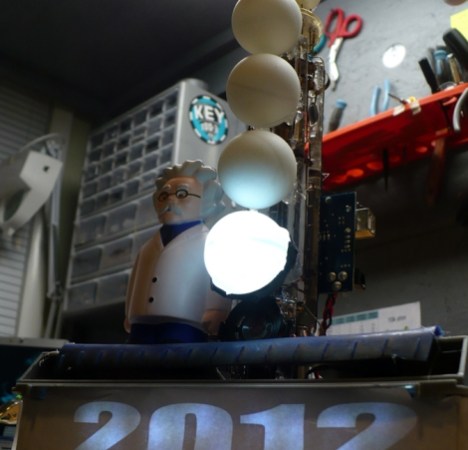
[Dino] wanted to make this New Year’s celebration a bit more interesting, but he can’t make it to New York for the ball drop. Instead, he decided to make his own mini display in his workshop. Obviously he’s working with a slightly smaller budget than the folks at Times Square, but we think his display is pretty neat. If anything, [Dino] can at least guarantee that his New Year’s is 100% Seacrest-free.

The ball drop is made up of five ping pong balls, each backlit by a 10mm LED. The LEDs and ping pong balls were mounted on the electron gun from a broken oscilloscope, giving it a cool look. The balls are lit one at a time by an Arduino, which illuminates each one for 15 seconds while the final minute of 2011 is counted down. Once midnight hits, a flashing “2012” sign illuminates while Auld Lang Syne plays from a tiny speaker.

The musical part of this build is something that [Dino] spent a lot of time on. He thoroughly explains how he translated the song from sheet music into its digital form, a process that would be helpful for beginners to watch.

Continue reading to see how the display was built, and if you’re just antsy to see the ball drop in action, a short demo can be found at 12:13.

Continue reading “Build Your Own Mini Ball Drop For New Year’s Eve”

One Way To Reuse Your Christmas Lights Post-holiday

[Andrew] shows us one way to reuse all those strands of Christmas lights you used for decoration this year. He had a friend that was helping with stage props for a local musical and ended up using his skills to build a lighted sign with some animation capabilities.

The original plan was to cut out letters for a sign by hand and ring them with white Christmas lights. It is possible to hand cut parts reasonably well, but [Andrew] knew he could get a much better result in less time using a CNC ShopBot to make them. He didn’t know the spacing for the lights so waited and drilled holes for them by hand. Each strand is connected to a relay, then driven by an Arduino. They turned out great as you can see in the clip after the break.

This is a timely hack, because it uses plain old while incandescent bulb strands which will be going on sale in the next few days. Usually you can get them on clearance for a dollar or less so plan ahead and hit the big box store early. Continue reading “One Way To Reuse Your Christmas Lights Post-holiday”

Reduced-cost Braille Display For Use With Computers

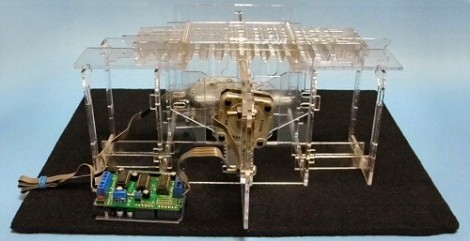
Apparently a Braille computer display can cost several thousand dollars. That’s why [David Pankhurst] is working on a low-cost alternative. His offering is an open source version he calls the Audrey Braille Display.

The concept is quite good. This prototype has one line of six Braille characters. Each character is made of two sliding strips containing eight arrangements of bumps. These can make up any character when positioned correctly. Two motors do all the work, one engages a single strip to reposition it, the other moves the first motor to select which strip should move. This is explained quite well in [David’s] most recent post. Or you can get a preview of the physical build here.

The concept is sound, but the refresh rate must be very slow. We wonder if there’s a way to keep one motor stationary and use solenoids to engage a drive shaft on the individual slide rods? This way, every row could be changed at the same time, disengaging when the appropriate slot is reached.

This hardware is much needed until developing Braille technologies actually come to market.

[via Dangerous Prototypes]

Digital Synth For The Non-chiptune Inclined

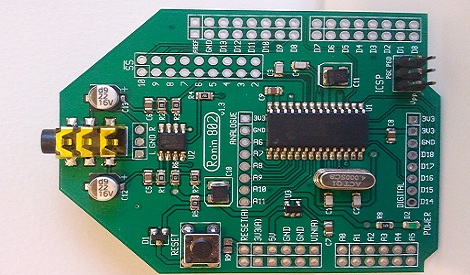
Chiptunes are great, and we can’t imagine a world without the Mega Man 2 soundtrack, but sometimes we all like a more 70’s style synth. This is where the Roninsynth steps in. It’s an Arduino shield that puts the basic components of a wall of synth into your pocket.

Unlike the analog oscillators of yore, the Roninsynth is based on a single dsPIC33F chip. It has all the waveforms we would expect from its big brother – sine, saw, triangle, square, and noise – and a couple modulation options.  What’s really interesting is the GUI the Roninsynth team put together. Instead of going with the knobs and buttons approach of the MIDIbox SID, the Roninsynth does everything with software. Think of it as a hardware-based softsynth.

Of course, there isn’t support for looping and phrases like what we saw yesterday, but there’s a ton of neat sounds that can be made and the capability for analog input. If you’ve ever wanted to sound like Radiohead, we can’t think of an easier way to build an Ondes Martenot.

Arduino Notebook Cover Makes It Easy To Tinker Anywhere

arduino-notebook-cover

[Erv] was putting his holiday shopping list together and decided that instead of buying his friends something from the store, he would give them something a bit more useful. A former Electrical Engineer by trade, [Erv] typically prefers PIC microcontrollers, but he says that Arduinos are just so convenient to use for prototyping that he likes to always have one on hand.

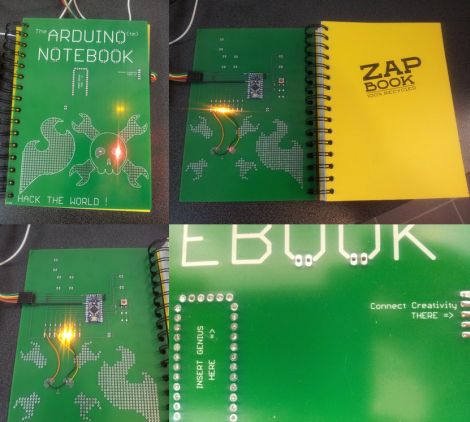
He figured that his friends might enjoy having easy access to an Arduino as well, so he made them some slick ZapBook covers which enable them to have a prototyping platform on hand at all times. The cover is made from a PCB and includes a socket for an Arduino Pro Mini, along with a handful of built-in LEDs. He has extended a few other I/O pins from the Arduino as well, but he says that the small solder bridges connecting the LEDs can be removed in a pinch, freeing up 8 additional pins with ease. We are pretty keen on the idea of an easily portable prototyping setup, though it doesn’t hurt that [Erv] incorporated a Hack a Day skull with light up eyes into his design either!

We’re not sure if he’s planning on releasing the schematics for the board, but the notebooks would be pretty useful for any hackerspaces hosting beginner Arduino programming classes.