Adding A Tachometer To The SX2 Mini Mill

sx2_mill_tach

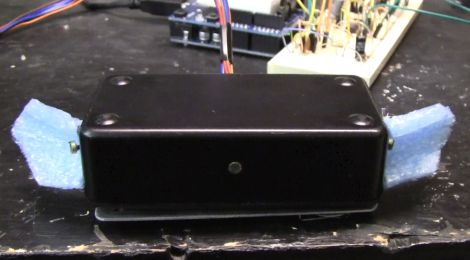
[Jeff] recently bought an SX2 mini milling machine with plans to eventually automate it for use as a CNC mill. After paying nearly $700 for the mill, he decided there was no way he was willing to pay for the $125 tachometer add on as well. Instead, he reverse-engineered the mill and constructed a tachometer of his own.

He opened the control box and started looking around. After identifying most of the components, he got sidetracked by a 3-pin header that didn’t seem to have any particular function. That is, until he realized that a lathe by the same manufacturer uses the same components, and figured that the header might be used for reversing the motor. Sure enough he was right, and after adding a reverse switch, he got back to business.

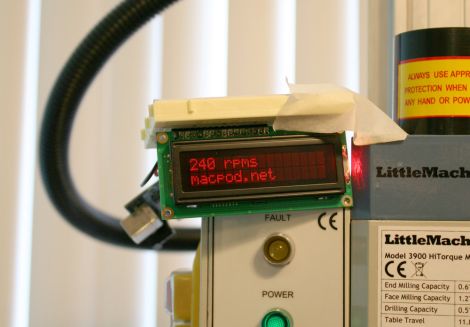
He probed the 7-pin socket with his logic analyzer and quickly picked out the mill’s data line. He hooked the line up to an Arduino and in no time had the RPM displayed on an LCD screen.

[Jeff] says that this little experiment is the first of many, since the mill is so hacker friendly. We definitely look forward to seeing a CNC conversion tutorial in the near future.

Official Android Open Accessory Development Kit – It’s An Arduino

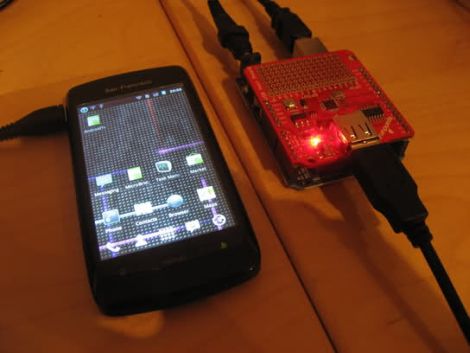
A new development kit for android was unveiled at the Google I/O 2011 developer conference that officially supports the Arduino.

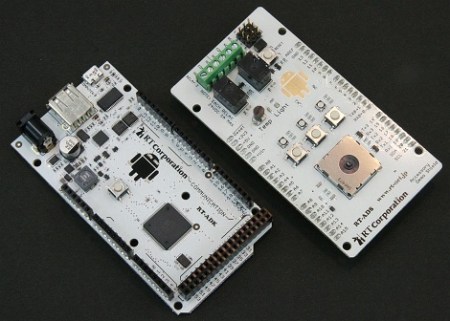
It looks like Google took a cue from Circuits@Home, because the interesting part of this dev kit is the fact that the shield can be put into USB Host mode. That’s great for phones and tablets that can’t act as a USB host themselves. Google will also release the APIs for this Android/Arduino mashup for 3.1, but it will thankfully be backported to Gingerbread.

We covered the IOIO breakout board for Android last month, but the Google board will be based off of the Arduino Mega 2560, a far more capable device. Interestingly, it appears this board is available now for about $400 USD. We’re not so sure a hobbyist will be buying it at that price.

While this board doesn’t do anything you couldn’t do before with a bluetooth shield, it’s great to see a company supporting all the builders out there.

Arduino Magnetic Core Memory Shield

mag_core_memory

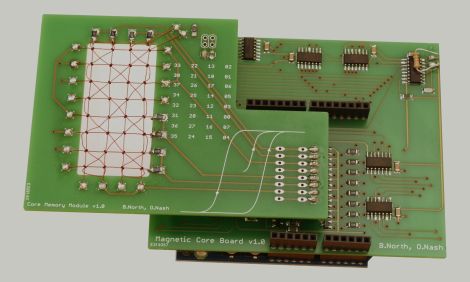
Magnetic core memory turns 60 years old today, and as a tribute [Ben North and Oliver Nash] have created a 32-bit magnetic core memory board for the Arduino.

Magnetic core memory was used from the 1950s through the 1970s, and provided a non-volatile means for storing data, as each magnetic core retained its orientation, even when the power was cut. While it sounds a lot like a modern hard drive, these devices were used in the same fashion as RAM is utilized today.

While the pair used surplus ferrite cores manufactured just before magnetic memory stopped being produced, they did allow themselves to use some modern components. Items such as transistors and logic gates were not available to the first magnetic core memory manufacturers, but the use of these items helped them complete the project in a reasonable amount of time.

Their final result is a magnetic memory board which can be used by any USB-enabled device and is reliable enough to withstand billions of read/write transactions.

DIY Sound Localization Sensor

sound_localization_sensor

Sound localization is very popular in law enforcement circles due to its accuracy and ability to quickly separate gunshots from other similar noises. These systems don’t come cheap, and after trying to build one himself, [Fileark] knows why.

He thought it would be neat to build a sound localization sensor based on how the human ear determines a sound’s source. Once he got started however, he realized just how hard it was to do localization just right.

He used an LM324N op-amp as a volume comparator, which he says works decently enough though he figures there are ICs out there that can do a better job. [Fileark] reports that the sound detector works well when the source is within about a foot of the sensors, but performance deteriorates at greater distances. He may consider using an ARM Cortex-M3 as his sound processor if he builds a second version, since the Arudino he used just doesn’t have enough power to sample and run calculations within the 10-50 microsecond window he requires.

Keep reading to see a video of his sound localization sensor in action.

Continue reading “DIY Sound Localization Sensor”

A Friendly Spiderbot Named Chopsticks

chopsticks_the_spiderbot

After seeing his fair share of hexapod-style bots on the Internet, [Russell] decided he wanted to build one of his own. One of the downsides to building these robots is the cost. He often saw them constructed from laser cut parts and very expensive servos. Rather than blow hundreds upon hundreds of dollars on the bot, [Russell] decided he could a lightweight bot on the cheap using chopsticks and polymorph modeling plastic.

His octopod robot is aptly called “Chopsticks” and utilizes 28 different servos to control its motions. 24 servos are used for its legs, 3 more are reserved for head movements, while a single additional servo manipulates the robot’s mandibles. The robot’s legs and main structure are composed of chopsticks, while the polymorph is used for feet, servo mounts, and pretty much anywhere else chopsticks just wouldn’t do.

[Russell] even added a set of eye stalks to complete the spider theme, arming them with IR compound eyes for object tracking. The robot is quite interactive as you can see in the video below.

Keep reading to see a video of Chopsticks, or swing by his Let’s Make Robots site if you get a chance – he has a pretty detailed construction journal as well as plenty of videos showing his spider bot in action.

Continue reading “A Friendly Spiderbot Named Chopsticks”

Learning Electronics Concepts Step By Step

arduino

We realize that not everyone out there holds a degree in electrical engineering or has the ability to tell NPN transistors apart from PNP transistors by taste alone, so we occasionally like to mention things that appeal to the beginners in the crowd. While there is a clear division between Arduino supporters and detractors, it is hard to deny that the devices have their place, and can be quite useful when exploring certain electronics concepts.

For the supporters out there, [John Boxall] has put together a site jam-packed with Arduino tutorials covering a wide array of concepts and techniques. We have covered his work before in relation to specific topics, but we felt that his site deserved mention as a whole. His tutorials cover some of the most basic concepts such as lighting LEDs with the Arduino, and work their way to more advanced subjects, lesson by lesson.

He is not satisfied with simply introducing a concept and handing out a sketch that does the work. He takes the time to expand on the concepts, giving the reader enough detail to use their new-found knowledge in later projects. If you were to follow his tutorials from beginning to end, you would be exposed to LCD screen control, shift registers, real-time clocks, I2C bus communications, and more. These skills and concepts can be carried on to future projects as well as other micro controllers, making his tutorials a very valuable learning tool worth checking out.

Rebecca Black Running Accessory Also Promotes Running For Everyone Within Earshot

Last Friday, Friday we caught wind of [gvillenave]’s running accessory inspired by Rebecca Black, and we we we so excited, we so excited to bring this to you on Saturday, which comes after Friday.

[gvillenave] came up with the idea of using a song on the annoyance level of “Friday” to encourage a runner into keeping up a good pace. The concept is simple: if the wearer is running fast, the song will speed up. If the wearer is slowing down, the song will slow down and extend the agony.

The build uses an Arduino and [ladyada]’s wave shield coupled to an accelerometer. [gvillenave] included the code, and also wired up some LEDs to a pair of sunglasses that blink more often as the runner’s speed increases. The wave shield has a 3.5mm jack for headphones, but [gvillenave] graciously wired a speaker in, “so that you can annoy people around you, and not just yourself.” All this is packaged in a very nice 3D printed enclosure making for a great looking project.

There’s no word on the effectiveness of the negative reinforcement aspect of [gvillenave]’s build, but we suspect it will help her get down to the bus stop a little faster every morning.