Foam Board Servo Driven Arm

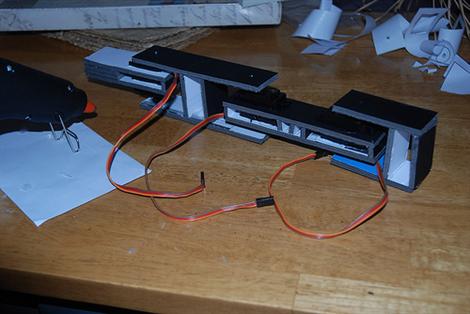
[Lucky Larry] posted some pictures to the Hack a Day flickr pool that caught our eye. He made a quick and cheap servo driven arm. Constructed from foam board and some hobby servos, he’s using an Arduino for the brains. You can download the pattern for the arm pieces as well as the code on his site.

He ultimately finds that he has positioning issues that he blames on the cheap servos. You can see in the video on his site that the circles it is drawing are drifting one direction.

Great Interactive LED Puzzle

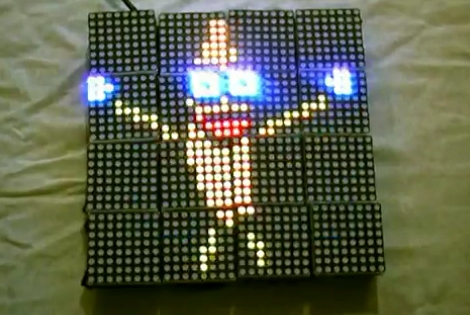
The GLIP project takes the delight of blinking LEDs and combines it with the ingenuity of modular communications. This takes the Puzzlemation concept a few steps further. In that project the modules were programmed through a base station and could be removed and used as a puzzle from there. The GLIP project uses a master block that you can see tethered in the photo. But the blocks communicate with each other via an infrared protocol. This way they can be continuously updated as they are place next to each other. Each module includes an STM32F105 ARM Cortex-M3 processor, quite a punch for the little blocks. Take a look at what they can do after the break.

Continue reading “Great Interactive LED Puzzle”

Gaming System For Less Than Three Bucks

[youtube=http://www.youtube.com/watch?v=r-Mdt6uzmOg]

[Rossum’s] latest project just hit and as usual, he doesn’t disappoint. Using an ARM cortex M0 he built a gaming system for less than $3 in parts. The M0 is a bit underpowered for this but at $1 it can’t be beat in price. He worked some video generation voodoo to get the signal he wanted but also mentions that upgrading to a bit more expensive chip like the Cortex M3 would solve this problem. The other part of the gaming system is an analog stick (again for about $1) that is the only input for the system.

Can’t say that you remember hearing about [Rossum] before? Go back and check out his Wikipedia reader, AVR media player, and AVR iPod touch killer.

Linux Tablet Built Around A BeagleBoard

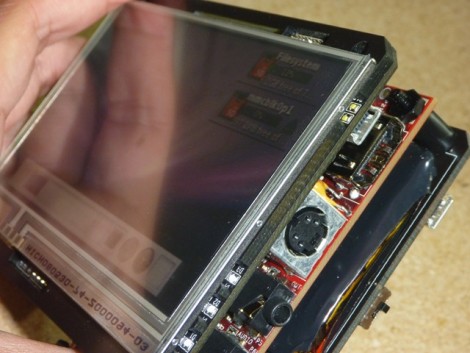
[Justin] shows us how to make a Linux tablet out of a BeagleBoard. You may remember [Justin’s] work at liquid cooling an Arduino. For this one he moved past the AVR hardware but took the idea of shields along for the ride. The device above is something of a Linux tablet, with a touchscreen shield on top of the BeagleBoard, and one below it for power. He’s selling these as kits which include the 480×272 OLED display as long as you can handle the fine-pitch soldering for those headers. We’re not sure our hands are steady enough for the challenge.
[Thanks Will]

HDSPs And Playstation 2 Controllers On Arduinos

There were a couple short Arduino tips in the mailbox this morning. We’ve combined them in this post since both are fairly short and sweet.

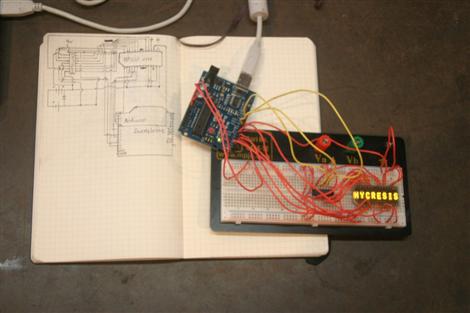
Over at Evil Mad Scientist Laboratories, they’ve posted a quick breakdown of how to interface those neat little HDSP LED displays with an Arduino. This specific instance is for Mr. Stabby. Source code and schematic are included.

For those who would like a nice familiar input device for their Arduino, how about a Playstation2 controller? [Bill Porter] has written up the code and shown how to wire it up. This even includes the ability to read the analog stick correctly. Source code and schematic are available on the project page.

[via Littlebird electronics]

32-bit ARM7 Gaming rig

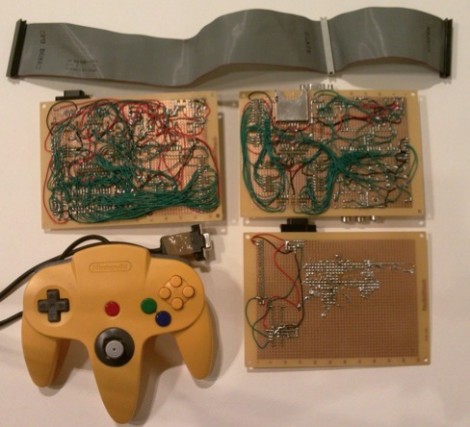
Are you hardcore enough to build your own 32-bit ARM powered gaming console AND use point-to-point soldering to accomplish this? [Craig Bishop] did just that when building his GameSphere console project. First thing’s first, click through the jump and watch the game play video. He wrote that game in the C language in less than a day which in itself is quite remarkable. On the hardware side of things he’s got an interesting mix; an Ateml AT91R40008 chip drives this system with PIC 18F4682 for VGA signal generation and a PIC 18F2685 to interface with the N64 controller. We like what he’s done so far and would love to see this end up in its own game cabinet. Continue reading “32-bit ARM7 Gaming rig”

Maple R3 Now Shipping

Leaf Labs is now shipping the Maple R3 boards. [Phil Burgess] gave the platform a look just before launch last fall and the high-powered prototyping board is now even better. New features come in both hardware and software varieties. The bootloader can now be upgraded without additional programming hardware, there’s hardware SPI and I2C interfaces, and a newly-polished IDE for Linux and Windows. At $50 it’s a good way to get access to the power of the ARM Cortex M3 processor at the center of the board. We’ve seen several projects that use the mbed, which is in the same class as the Maple, but we’re waiting to see what you’ve accomplished with this little devil.