Modular Security System Is Portable Too

diy_security_system

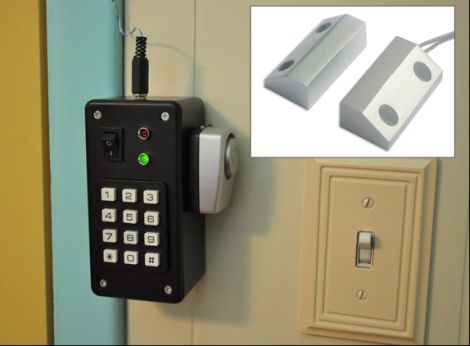
Hackaday reader [Oneironaut] wrote in to share a modular, portable security system he built for himself.

He likes visiting the Caribbean, but his favorite vacation spot is apparently rife with cat burglars. He enjoys sleeping with the windows open and wanted to find a way to scare off ne’er do wells. At home, there are a few different buildings on the property he owns, and he was looking to keep curious trespassers away.

The alarm system was built using a matrix keypad that interfaces with an ATMega88 micro controller. The micro controller handles all the logic for the system, triggering an attached “pocket alarm” when ever the sensor is tripped. Like most household alarms, it is armed and disarmed via the keypad, giving the user 60 seconds to enter the disarm code if the alarm has been mistakenly tripped. A wide array of trigger methods can be used, from mercury switches to motion detectors, since his alarm uses a simple plug interface that accepts any two-wire sensor.

Now, no one is claiming that this is high security by any means – the alarm addresses a couple of specific scenarios that apply to [Oneironaut], which may also be applicable to others out there. At the end of the day, the alarm is more meant to scare an intruder into fleeing than anything else, and in that respect, it works perfectly.

Continue reading to see a quick video demonstration of his alarm system in action.

Continue reading “Modular Security System Is Portable Too”

Simple AVR Based GPS Tracker

The latest project from Lucidscience.com is a simple AVR based GPS tracker. As usual, the instructions here are quite in-depth including schematics and step by step procedures all the way down to modifying cables when necessary. What we found interesting is that the GPS module he’s using is so simple. It only requires 3 wires, one for power, one for serial communication, and one for a heartbeat.

For the microprocessor, he’s using an ATMega 324, which is a bit of processing overkill but he needed the SRAM for the GPS point storage. You could obviously expand to external storage but the goal here was to keep it extremely simple. Actually, there just isn’t a whole lot here other than the microprocessor, the GPS module, and a level converter. After wrapping up the circuit he goes on to explain how to get the data into Google Earth for display. After a few trips around the block you can see the results are quite nice.

Laser Camera Sees Around Corners

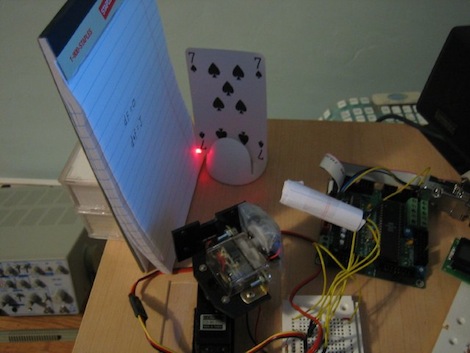
After reading over the proceedings of the 2005 SIGGRAPH, [Dan] realized he could reproduce one of the projects with $50 worth of equipment and some extreme cleverness.

[Dan]’s dual scanning laser camera operates by scanning a laser across an object. The light reflected from the object illuminates a flat surface, and this light is measured by a photocell. After measuring the resistance of the photocell, an image can be reconstructed from the light reflected off the flat surface. The result is quite ingenious, and we’re very grateful [Dan] gave us a great walkthrough with the code and theory of operation.

The project was covered in this Slashdot story a from a few years ago, and we’re surprise no one has bothered to cobble this project together. It’s a very simple build – two servos to control the x and y axes of the laser scanner, a photocell, and an ATMega board. Dan says the microcontroller isn’t even necessary, and this ‘remote imaging’ could be done with an ADC hooked up to a parallel port.

[Dan] was kind enough to to give us a video of his contraption in action. A very nice build from a very accomplished guy.

Open Hacker Conference Badge Project Needs Your Help!

[Aestetix] writes in to tell us that the OpenAMD (Attendee Meta-Data) project is working on a new revision of their hardware, to be debuted at CCC Camp this fall.

For the uninitiated, OpenAMD combines an Active RFID tracking system with social networking, and is completely open-source. You walk into the conference, put on the OpenAMD badge, and suddenly you can see yourself as a dot moving around on a map. Or you can log into the social networking site, create a profile, and watch as your personal information is pulled into the mesh, which then tells you talks you might like, people you might like, where those people are, and more. There’s even an open API where you can create your own ‘killer’ apps, which may include games or other interesting aggregates of the attendee information.

Continue reading “Open Hacker Conference Badge Project Needs Your Help!”

build_status_board

LED Build Monitor Helps Keep An Eye On Your Servers

In his line of work, Hackaday reader [Pedantite] often has to monitor the build status of several continuous integration servers throughout the day. One afternoon, he got the idea to install a set of stop lights in the office in order to monitor the status of the servers, but filed it away as a “wouldn’t it be cool if…” project.

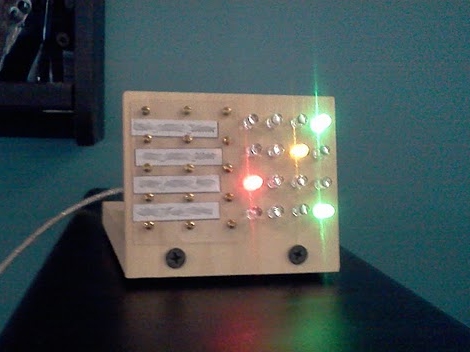
After some time had passed, he was bitten by the idea bug again and decided he would build a physical device to display the status of his build processes. This time around, he brainstormed on a smaller scale and the result is the “Indictron” you see above.

He built a simple LED board made up of four rows of four LEDs to display the build processes. Different LEDs are lit depending on the project’s current build status as well as the results of the previous build. The board uses an ATmega88, and interfaces with a compiler watchdog application using a virtual USB package made specifically for AVR micro controllers.

The end result is a simple, yet useful status board that “just works”. He does not seem to have code or schematics posted on his site at the moment, but we’re pretty sure he would share them upon request.

If you’re interested in a bit more of [Pedantite’s] work, check out his “Good Times” parental timer we featured last week.

Compost Heap Temperature Logger Helps Keep Things Hot

compost_temp_logger

HackHut user [lackawanna] is looking to start his own compost pile, but as many urban composters discover, things can get quite smelly if you don’t manage it properly. The process of composting is broken up into two phases, aerobic and anaerobic decomposition. The former is the first stage to occur and produces plenty of heat, but should be scentless. The latter gives off less heat and is more of a stink due to putrefaction. Carefully monitoring the temperature of the pile and restarting the aerobic phase when necessary helps to keep the process “healthy” and scent-free.

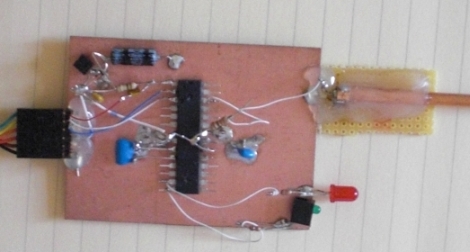
[lackawanna] built a simple temperature monitor that he plans on using to track the status of his compost pile once he gets started. It uses an ATmega328 as the brains of the operation and an old metal can transistor as his temperature sensor. Using relative measurements of the compost pile taken in 10 minute intervals, he can determine when the aerobic phase is underway, as well as when things begin turning anaerobic. At that point, the sensor alerts him that the pile needs to be turned.

The build is pretty simple, but leaves plenty of room for expansion. It should be relatively easy to add a more friendly notification interface as well as install multiple sensors to the pile for obtaining aggregate temperature data.

Atmega Analog Two Pack

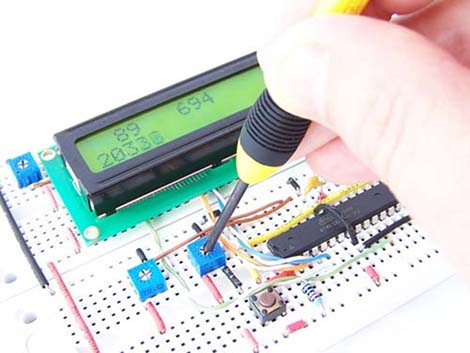
Back in February, [ProtoStack] posted a pretty good tutorial on how to do Analogue to Digital Conversion on an Atmega168. Based on a bread board, the tutorial also shows the often forgotten low pass filter on the AVCC lines to ensure an extra stable reference and an analog input connection to a simple voltage divider as a study point.

Moving on into the micro controller, the registers you’re going to need to twiddle are laid out and explained in detail. Finally you’re shown how to put it all together in a software project that outputs the analog reading onto a standard character LCD.

But hold on! There is more. Just released is a follow up to that tutorial which adds on Analogue to Digital Conversion Interrupts on an Atmega168A. So if you’re sitting there looking at an Arduino and want to know more about what’s going on under the hood, these are a good place to start.