Lithium-Ion Battery Circuitry Is Simple

By now, we’ve gone through LiIon handling basics and mechanics. When it comes to designing your circuit around a LiIon battery, I believe you could benefit from a cookbook with direct suggestions, too. Here, I’d like to give you a collection of LiIon recipes that worked well for me over the years.

I will be talking about single-series (1sXp) cell configurations, for a simple reason – multiple-series configurations are not something I consider myself as having worked extensively with. The single-series configurations alone will result in a fairly extensive writeup, but for those savvy in LiIon handling, I invite you to share your tips, tricks and observations in the comment section – last time, we had a fair few interesting points brought up!

The Friendly Neighborhood Charger

There’s a whole bunch of ways to charge the cells you’ve just added to your device – a wide variety of charger ICs and other solutions are at your disposal. I’d like to focus on one specific module that I believe it’s important you know more about.

You likely have seen the blue TP4056 boards around – they’re cheap and you’re one Aliexpress order away from owning a bunch, with a dozen boards going for only a few bucks. The TP4056 is a LiIon charger IC able to top up your cells at rate of up to 1 A. Many TP4056 boards have a protection circuit built in, which means that such a board can protect your LiIon cell from the external world, too. This board itself can be treated as a module; for over half a decade now, the PCB footprint has stayed the same, to the point where you can add a TP4056 board footprint onto your own PCBs if you need LiIon charging and protection. I do that a lot – it’s way easier, and even cheaper, than soldering the TP4056 and all its support components. Here’s a KiCad footprint if you’d like to do that too.

Continue reading “Lithium-Ion Battery Circuitry Is Simple”

Thank Magnesium For Water-Activated Batteries

Most of the batteries we use these days, whether rechargeable or not, are generally self-contained affairs. They come in a sealed package, with the anode, cathode, and electrolyte all wrapped up inside a stout plastic or metal casing. All the reactive chemicals stay inside.

However, a certain class of magnesium batteries are manufactured in a dry, unreactive state. To switch these batteries on, all you need to do is add water! Let’s take a look at these useful devices, and explore some of their applications.

Continue reading “Thank Magnesium For Water-Activated Batteries”

Lithium-Ion Batteries Are Easy To Find

In the first article, I’ve given you an overview of Lithium-Ion batteries and cells as building blocks for our projects, and described how hackers should treat their Lithium-Ion cells. But what if you don’t have any LiIon cells yet? Where do you get LiIon cells for your project?

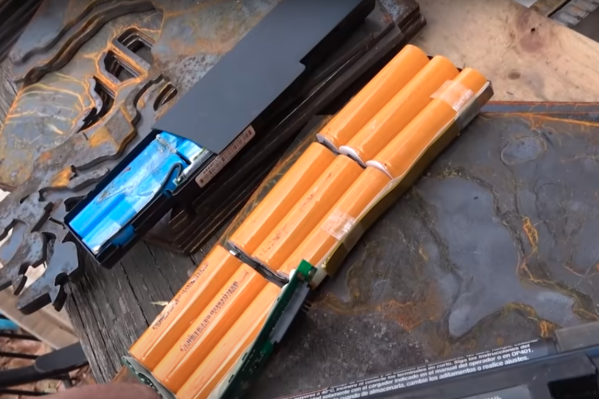
Taking laptop batteries apart,  whether the regular 18650 or the modern pouch cell-based ones, remains a good avenue – many hackers take this road and the topic is extensively covered by a number of people. However, a 18650 cell might not fit your project size-wise, and thin batteries haven’t quite flooded the market yet. Let’s see what your options are beyond laptops. Continue reading “Lithium-Ion Batteries Are Easy To Find”

Lithium-Ion Batteries Are Your Friends

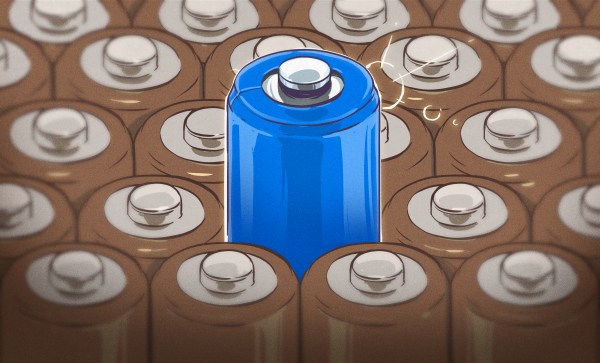
Need some kind of battery for a project? You can always find a few Lithium-Ion (LiIon) batteries around! They’re in our phones, laptops, and a myriad other battery-powered things of all forms – as hackers, we will find ourselves working with them more and more. Lithium-Ion batteries are unmatched when it comes to energy capacity, ease of charging, and all the shapes and sizes you can get one in.

There’s also misconceptions about these batteries – bad advice floating around, fearmongering videos of devices ablaze, as well as mundane lack of understanding. Today, I’d like to provide a general overview of how to treat your LiIon batteries properly, making sure they serve you well long-term.

What’s A Battery? A Malleable Pile Of Cells

Lithium-Ion batteries are our friends. Now, there can’t be a proper friendship if you two don’t understand each other. Lithium-Ion batteries are tailored for human needs by the factory that produced them. As for us hackers, we’ll want to learn some things.

First thing to learn – a single LiIon “unit” is called a cell. An average laptop contains three or six Li-Ion cells, a phone will have one, a tablet will have from one to three. What we refer to as “battery” is typically one or multiple cells, together with protection circuitry, casing and a separate connector – most of the time all three of these, but not always. The typical voltage is 3.6 V or 3.7 V, with maximum voltage being 4.2 V – these are chemistry-defined, the same for most kinds of cells and almost always written on the cell. Continue reading “Lithium-Ion Batteries Are Your Friends”

A Wireless Headphone Charger Without The Wireless

We’re all used to the idea of wireless charging, usually in the form of an induction coil on which a mobile phone or other appliance can be placed for a top-up. Not every battery-powered appliance has a built-in wireless charging coil though, meaning that despite the tech being available we all still have a jumble of wires.

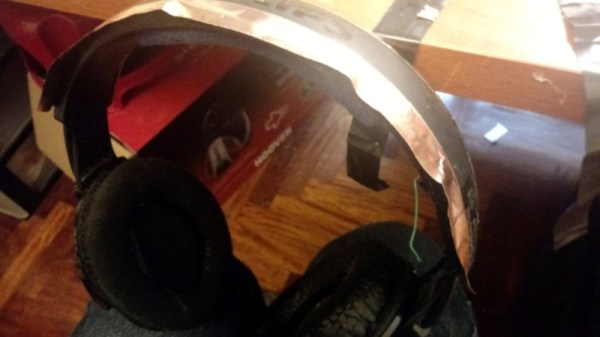
[Sergio Costas] has a simple solution to conjuring wireless charging from thin air in his headphone stand, which conceals a set of charging contacts. It’s by no means a new idea and it might seem like an obvious hack, but it undeniably does away with the wires and we like it. After all, if it were that obvious, none of us would have that mess of chargers.

The headphones in question are a Bluetooth wireless pair, and the charging contacts have been brought out via a voltage regulator and a bridge rectifier to a pair of copper tapes along the sides of the headband. These mate with matching contacts in a 3D printed holder to which 12 VDC has been applied. Perhaps he’s just reinvented the springy contacts you’ll find on any cordless home phone, but it’s unquestionably a charger without wires.

Meanwhile if you have a conventional wireless charger, how do you know it’s working?

SV Seeker Is Recycling Batteries

SV Seeker is a home-made boat currently being built by [Doug Jackson] just north of Tulsa, Oklahoma. It’s a bit different than what you might imagine as a typical DIY boat, though. You see, Seeker is a 75 ft steel boat, intended to work as a research vessel. Doug and his crew proudly refer to Seeker as “The boat the internet built”, and he’s our kind of people. We’ve covered them before, the first time way back in 2013. Doug’s Youtube channel does double duty, both teaching the rest of us all the skills he’s learned while building, and also serving as the eventual user and repair manual for the boat.
Continue reading “SV Seeker Is Recycling Batteries”

Increasing The Resolution Of The Electrical Grid

As a society in the USA and other parts of the world, we don’t give much thought to the twisting vines of civilization that entangle our skies and snake beneath our streets. The humming electrical lines on long poles that string our nations together are simply just there. Ever-present and immutable. We expect to flick the switch and power to come on. We only notice the electrical grid when something goes wrong and there is a seemingly myriad number of ways for things to go wrong. Lighting strikes, trees falling on lines, fires, or even too many people trying to crank on the A/C can all cause rolling blackouts. Or as we found out this month, cold weather can take down generation systems that have not been weatherized.

We often hear the electrical grid described as aging and strained. As we look to the future and at the ever-growing pressure on the infrastructure we take for granted, what does the future of the electrical grid look like? Can we move past blackouts and high voltage lines that criss-cross the country?

Continue reading “Increasing The Resolution Of The Electrical Grid”