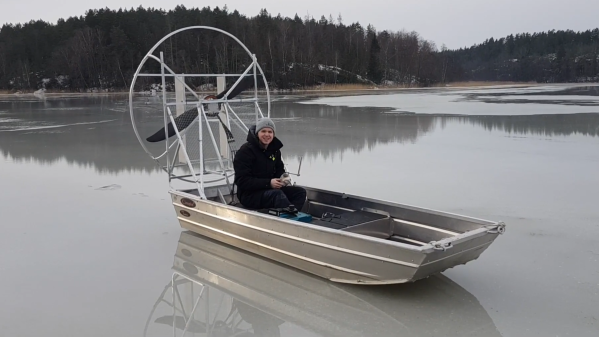
Electric Airboat For Getting You Across Thin Ice

Even with all the technological progress civilization has made, weather and seasons still have a major impact on our lives. [John de Hosson] owns a cabin on an island in a Swedish lake, and reaching it involves crossing 500 m of water. In summer this is done with a conventional boat, and in winter they can simply walk across the thick ice, but neither of these is an option on thin ice in the spring or fall. To solve this [John] built an electric airboat, and it looks like a ton of fun in the video after the break

The construction is simple but functional. A 3.3 m flat-bottomed aluminum boat has used a base, and an aluminum frame was bolted on for the motor and propeller. The motor is an 18 kW brushless motor, with a 160 cm/63-inch carbon fiber propeller. Power comes via a 1000 A ESC from a 100V 3.7 kWh Lipo pack mounted in a plastic box. Steering is very similar to a normal airboat, with a pair of air rudders behind the propeller, controlled by a steering lever next to the driver’s seat. The throttle is an RC controller with the receiver wired to the ESC.

Performance is excellent, and it accelerates well on ice and slush, even with two people on board. [John] still plans to make several improvements, with a full safety cage around the propeller being at the top of the list. He is also concerned that it will capsize on the water with the narrow hull, so a wider hull is planned. [John] has already bought a large steering servo to allow full remote control for moving cargo, with the addition of an FPV system. We would also add an emergency kill switch and waterproofing for the electronics to the list of upgrades. It looks as though the battery box is already removable, which is perfect for getting it out of the cold when not in use.

Continue reading “Electric Airboat For Getting You Across Thin Ice”
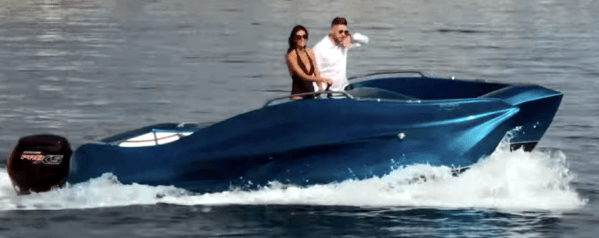
3D Printing A Full Scale Fiberglass Speedboat

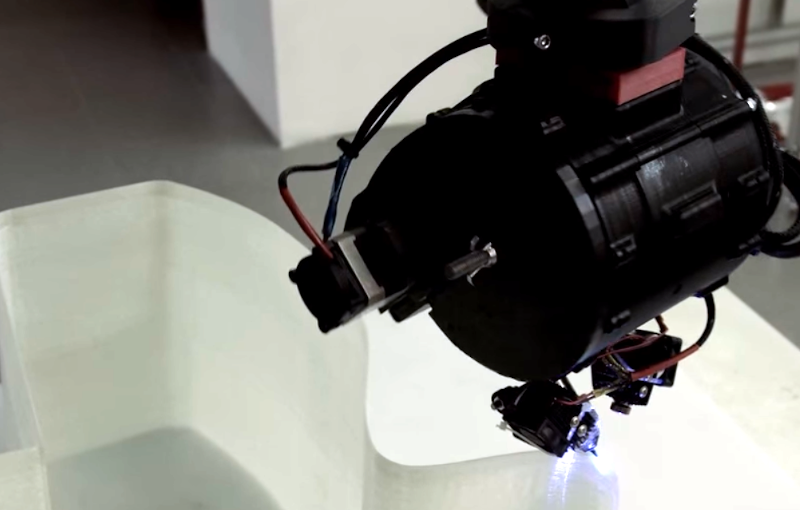
It’s an age-old problem. You draw up a nice 6.5-meter long motorboat and then discover the shape won’t allow for a fiberglass mold. What do you do? If you’re [Moi], you grab a few Kuka robots and 3D print it using thermoplastic with embedded glass fibers. A UV light cures the plastic and you wind up with printed fiberglass. That’s the story behind the MAMBO, a 3D printed powerboat.

Despite the color, the fiberglass isn’t blue out of the gate — the boat is painted. Still, it looks nice with lines inspired by [Sonny Levi]’s Arcidiavolo design from 1973. MAMBO stands for Motor Additive Manufacturing BOat. It has a dry weight of about 800 kg and is fitted with a cork floor, white leather seats, and an engine. We presume none of those things were 3D printed.

Although it wasn’t fiberglass, we’ve seen a 3D printed boat before. In particular, the University of Maine’s giant 22,000 square foot printer cranked one out. We’ve also seen boats printed in standard PLA filament, which then had fiberglass cloth and resin applied after printing. True that one was only RC, but there’s no reason the concept couldn’t be scaled up if you had the patience.

Tracking Boats And Ships In Real Time At The Same Time

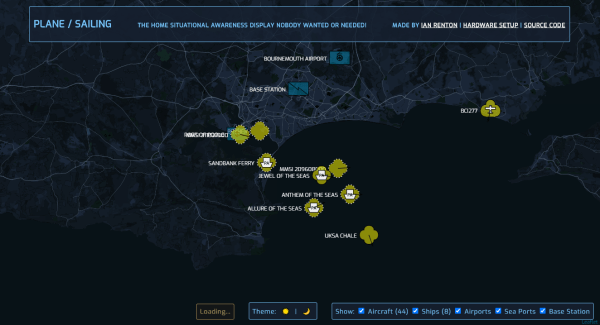
Software-defined radio came on the hacker scene in a big way less than a decade ago thanks to the discovery that a small USB-based TV tuner dongle could be used for receiving all kinds of radio transmissions. Two popular projects from that era are tracking nearby airplanes and boats in real time. Of course, these projects rely on different frequencies and protocols, but if you live in a major port city like [Ian] then his project that combines both into a single user interface might be of interest.

This project uses an RTL-SDR dongle for the marine traffic portion of the project, but steps up to a FlightAware Pro dongle for receiving telemetry from airplanes. Two separate antennas are needed for this, and all of the information is gathered and handled by a pair of Raspberry Pis. The Pis communicate with various marine and air traffic databases as well as handles the custom user interface that knits both sets of information together. This interface was custom-built from a previous project of his and was repurposed slightly to fit the needs of this one.

This is a great project that goes into a lot of interesting detail about how the web traffic moves and how the UI works, so even if you’re not into software-defined radio it might be worth a look. However, it’s also worth noting that it hasn’t been easier to set up a system like this thanks to the abundance and low price of RTL-SDR dongles and the software tools that make setting them up a breeze.

Tesla Turbine Boat Uses Lily Impeller

Typically in the RC community, radio control boats rely on small nitro engines or electric motors to get around. Fitted with traditional propellers, they’re capable of great speed and performance. Of course, there’s more than one way to skin a cat, as [Integza] shows with his latest build.

As far as the boat side of things is concerned, it’s a basic 3D printed single hull design. The innovation comes in the drivetrain, instead. The boat uses compressed air for propulsion, stored in a battery of four soda bottles, pressurized to 6 bar. The compressed air is used to drive a Tesla turbine of [Integza]’s design, which is 3D printed on a resin printer. Rather then driving a propeller, the Tesla turbine instead turns a Lily impeller, which pulls the boat through the water rather than pushing it along. The impeller uses a nature-inspired design, hence the name, and was also 3D printed, making producing its complex geometry a cinch. The guts of a toy radio control car are then used to control the boat.

Understandably, performance is less than stellar. The limited reserves of compressed air can’t propel the boat long, and the combination of the high RPM Tesla turbine and Lily impeller don’t provide a lot of thrust. However, the boat does move under its own power, demonstrating these oddball technologies while doing so.

[Integza] has been working with these technologies for a while; we featured an earlier Tesla turbine build back in 2018. Video after the break.

Continue reading “Tesla Turbine Boat Uses Lily Impeller”

It’s A Boat? It’s A Duck? It’s A DIY Plastic Wrap Kayak!

Only few cinematic moments were as traumatically heartbreaking as [Mufasa]’s death in The Lion King and [Wilson]’s demise in Cast Away. To think, if only [Tom Hanks]’ character had found a role roll of stretch wrap in the washed up cargo content, he could have built a vessel with enough room to safely store his faithful companion. Sounds unlikely? Well, [sg19point3] begs to differ, and has a kayak to prove it.

It’s as brilliant as its construction materials are simple: tree branches, packing tape, and of course the stretch wrap. [sg19point3] used two different types of branches, one that bends just enough to shape the kayak in its length, and a more flexible variety to form the rings that hold it all together. After removing the bark, he shaped the branches as needed using some pegs in the ground, and let it dry for a few days. Once ready, he put them together and stabilized the construct with packing tape until it was ready for the grand finale of wrapping the entire thing in several layers of plastic wrap. To prove he trusts his own construct, he took it for a ride to the nearest water and lived to tell the tale — and to make a video about it, which is embedded after the break.

Admittedly, putting it together all by yourself on a remote island may be a bit laborious after all, so good thing [sg19point3] had some friends to help with the wrapping. Whether you’d want to take it beyond your local, shallow pond is maybe another story — you’d definitely want to steer clear of sharp rocks. For something more sturdy, check out the 3D-printed kayak from a few years ago. But in case you prefer wood, here’s a beautiful canoe.

Continue reading “It’s A Boat? It’s A Duck? It’s A DIY Plastic Wrap Kayak!”

DIY Plastic Speedboat For One

Coroplast (short for corrugated plastic) is an interesting material. It has a structure similar to cardboard, but since it’s plastic it’s waterproof and can be used for a unique set of applications. It’s typically used for political yard signs, but there are more fun things to do with this lightweight material than advertise. [Paul Elkins], for example, uses it to make speedboats.

The boats that [Paul] builds make use of a piece of coroplast which he cuts and folds into a basic hull shape. From there he begins to assemble the other things needed to finalize the boat, including strengthening the shape with wood, adding a steering wheel, building a transom to mount the motor to, and placing controls in the cockpit such as throttle and steering. The entire build is enough to propel a single person on a body of water at about five knots, which is impressive.

To make one of these yourself you’ll need a small outboard motor, but all of the other details of the build are outlined clearly in his series of videos. If you want to build your own boat but don’t like the idea of a noisy two-stroke motor right behind you, you can also look into building a boat with a silent mode of propulsion.

And if you’ve got a good supply of Coro, definitely check out [Paul]’s other projects, including a tiny house.

Continue reading “DIY Plastic Speedboat For One”

An Open Source Shipboard Computer System

We’re not sure how many of you out there own a boat large enough to get its own integrated computer network, but it doesn’t really matter. Even if you can’t use this project personally, it’s impossible not to be impressed with the work [mgrouch] has put into the “Bareboat Necessities” project. From the construction of the hardware to the phenomenal documentation, there’s plenty that even landlubbers can learn from this project.

In its fully realized form, the onboard computer system includes several components that work together to provide a wealth of valuable information to the operator.

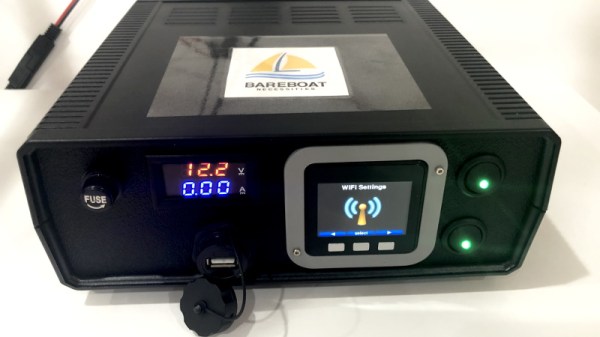
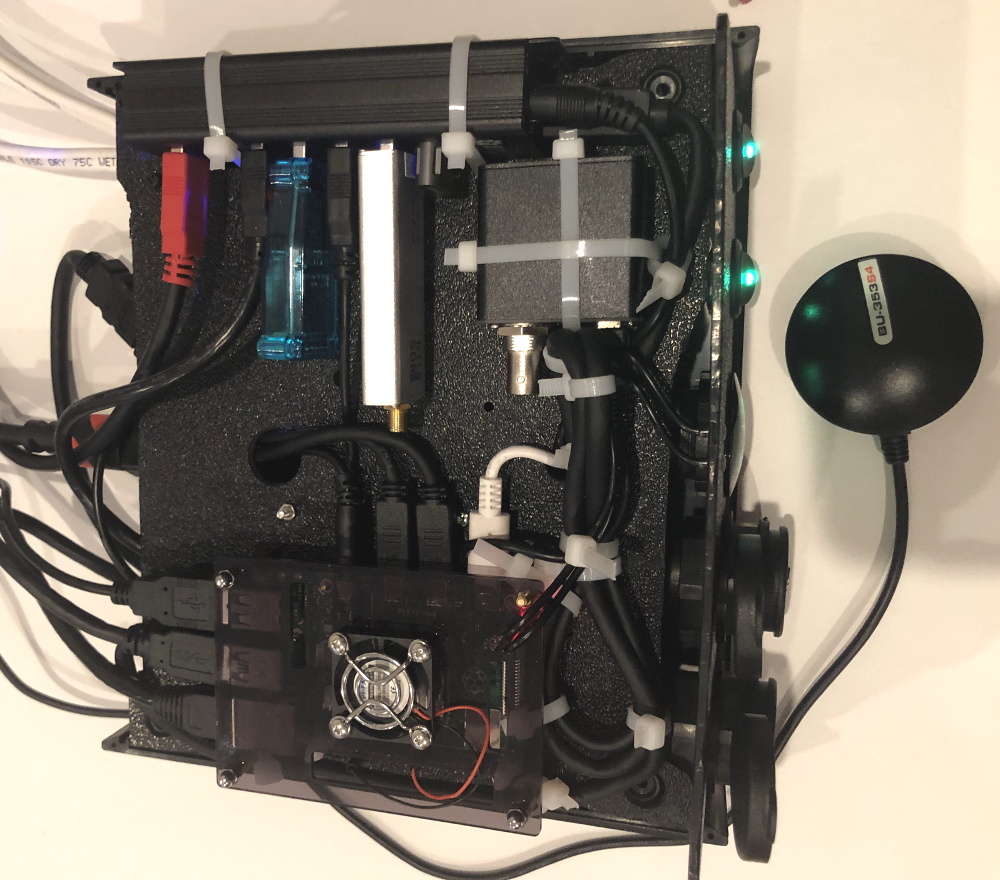
Inside the Boat Computer module

What [mgrouch] calls the “Boat Computer” contains a Raspberry Pi 4, a dAISy AIS receiver, an RTL-SDR, a GPS receiver, serial adapters, and the myriad of wires required to get them all talking to each other inside a weatherproof enclosure. As you might expect, this involves running all the connections through watertight panel mounts.

Combined with a suite of open source software tools, the “Boat Computer” is capable of interfacing with NMEA sensors and hardware, receive weather information directly from NOAA satellites, track ships, and of course plot your current position on a digital chart. The computer itself is designed to stay safely below deck, while the operator interacts with it through an Argonaut M7 waterproofed HDMI touch screen located in the cockpit.

For some people, that might be enough. But for those who want to do big, [mgrouch] further details the “Boat Gateway” device. This unit contains an LTE-equipped WiFi router running OpenWrt and all the external antennas required to turn the boat into a floating hotspot. Of course it also has RJ45 jacks to connect up to the other components of the onboard system, and it even includes an M5Stack Core with LAN module so it can display a select subset of sensor readings and navigational data.

If you’d like to do something similar on a slightly smaller scale, we’ve seen sailing computers that pushed all the data to a wearable display or even a repurposed eReader.