HHH: Sniffing Proprietary CNC To Hack In G-Code Support

hhh-proprietary-g-code-hack

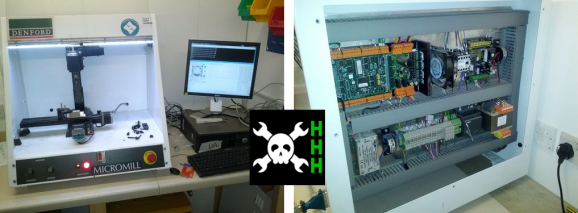
Here’s a beautiful desktop CNC mill which had one big drawback: it used a proprietary interface for driving it. To increase the flexibility of the tool it was hacked to work with G-Code.

The project is a Hackaday Hackerspace Henchmen submission from rLab, the Reading Hackspace in the UK. [Barnaby] explains the entire project after the break. The machine itself wasn’t altered, but a translator script was written in Python after capturing a bunch of packets and working out the protocol. This script listens for G-Code and does the translation into the type of commands the machine is expecting to receive.

If you know of a CNC hack from your own hackerspace send us the story for a chance to win some loot.

Continue reading “HHH: Sniffing Proprietary CNC To Hack In G-Code Support”
Converting A Mill To CNC

traces

Have a mill that you’d like to automate? Perhaps you can gets some ideas from the work [James] recently finished. Using familiar NEMA 23 stepper motors (the same motors used in the RepRap), he hacked his Proxxon MF-70 mill for CNC control. Adding a Sanguino and the stepper controllers from other projects, [James] got a working machine for minimal investment. You can tell that [James] is a fan of Polymorph, because he uses it liberally for most of the project, even using it to create some Oldham couplings (Google cache).

After completing the build initially, he managed to burn out the spindle motor by milling steel too quickly. We found it interesting that he was able to use a TURNIGY 2217 860kv 22A Outrunner (for R/C airplanes) as a new spindle motor. Not only is it a low-cost solution, but pairing it with a traditional brushless ESC can give your CNC software direct control over the motor speed.

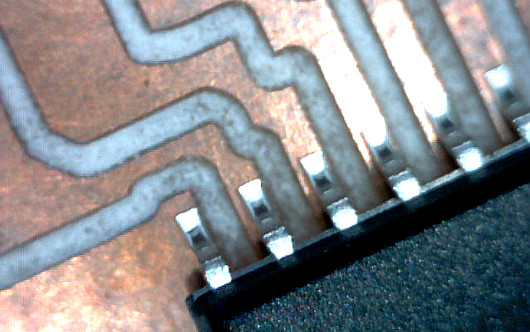
The image above is an example of what [James’] machine is capable of. Overall, it’s a very accessible project for most of us. Not every mill needs to be capable of 10 mil traces. If you’ve got the urge, you can probably put one together yourself. Of course, if you do, please let us know!

A Very Professional Homemade CNC Router

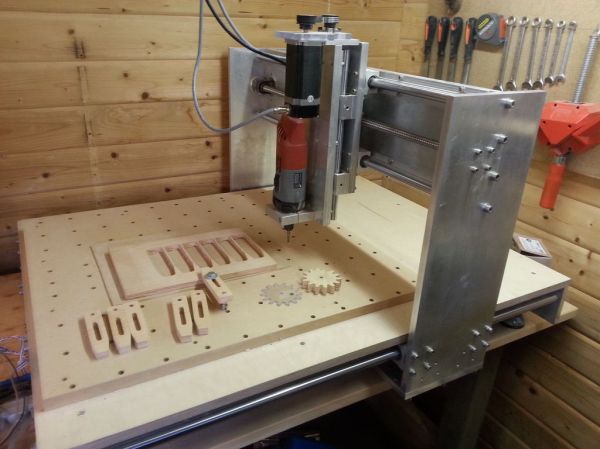
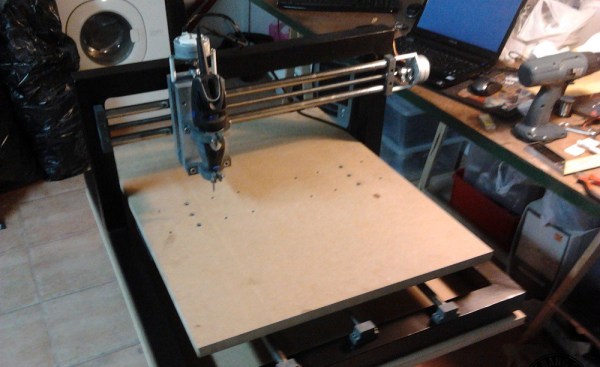
[Benne] has a small workshop at home so he decided to make a very versatile CNC router for his final project at school. It took him around 6 months to arrive at the result you can see in the image above and what is even more impressive is that he was only 17 years old at the time.

[Benne] used the free cad program Google Sketchup to draw the different parts he needed around the linear rails and ball screws he already had lying around. The CNC’s travel is 730x650x150mm, uses Nema 23 (3Nm) steppers, 15mm thick aluminum plates and 30x60mm aluminum extrusions. In his article, [Benne] gives great advice to those who would like to design their CNC like his, providing very useful links to manufacturers. He estimated the cost of his CNC to be around 1500 euros (about $2000). We’ll let you browse the many lines of his very detailed build log, which makes us wish to be as talented as him even at our age…

Unorthodox Home-made CNC Machine

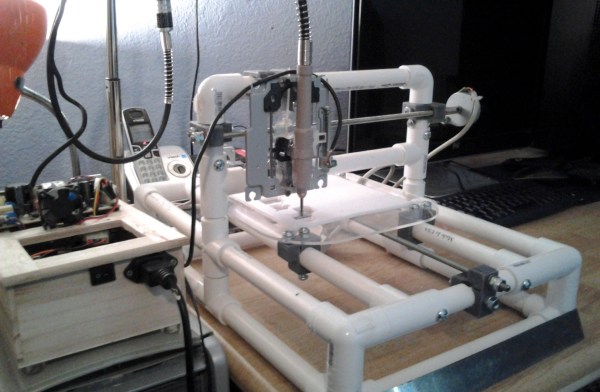
Here’s a rather unorthodox home-made CNC machine we haven’t seen before!

[ModHappy] recently accepted a challenge to design and build a CNC machine out of cheap and readily available components from a hardware store.

Wandering around the store he noticed the plumbing isle and he started playing around with PVC pipes on the floor, greatly confusing the store employees. He had a frame constructed, but still needed a way to achieve linear movement. His calls were answered in the electrical isle, where he made use of conduit wall-mounts! They only required a minor modification to go from gripping the pipe, to sliding along it. A few fasteners later, some stepper motors from a broken scanner, a CD-ROM drive for the z-axis, some hacked together couplers using set screws, and the mechanical build was complete.

On the controls end, he made use of a cheap Chinese TB6560 CNC driver board off eBay, which he modified slightly to increase reliability. The whole thing runs off LinuxCNC (which is free) on his old laptop — good to note, it can also be run live if you aren’t yet enlightened with a Linux OS.

Stick around after the break to see it in action, drawing out an awesome site’s logo!

Continue reading “Unorthodox Home-made CNC Machine”

CNC Software Toolchain Using Only Open Source Software

For hobbyists, there are two types of machines that can make parts at home. The first type is matter-adding machines (3D printers) and the other is matter-subtracting machines (like CNC milling machines).  [Mario] recently tipped us about an article he made detailing which free software can be used to design and produce parts on CNC machines.

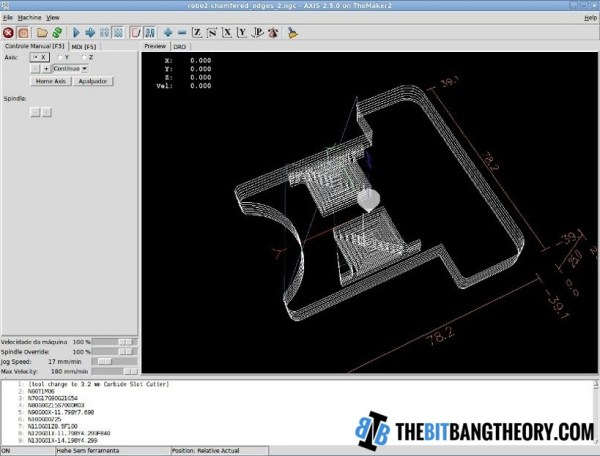
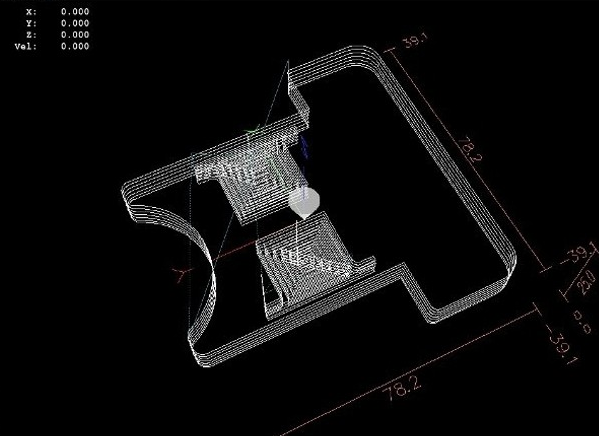
The first step of the process is obviously designing the part you want to make using a Computer-Aided Design (CAD) application. [Mario] suggests Heeks or Freecad for which you can find plenty of tutorials on YouTube. The next step consists in converting the part you just designed to machine tool paths using a Computer-Aided Manufacturing (CAM) application. Fortunately, Heeks can do both so it may be the best option for beginners. [Mario] also mentions the pcb2gcode  application, which allows you to manufacture printed circuit boards at home for the prototypes you may want to produce. Finally, the well known LinuxCNC (previously Linux EMC2) software is used to control the CNC machine using the GCode that the CAM software produced.

At Hackaday, we’d really like knowing what our readers currently use for their CNCs so don’t hesitate to leave us a comment below.

Hackaday Hackerspace Henchmen == Free Stuff For You

2013-10-01_Hackaday_Hackerspace_Henchmen_banner-580x200

Are you a member of your local Hackerspace? Do you want some free stuff? Then you need to become one of the Hackaday Hackerspace Henchmen.

Hackerspaces are amazing places full of smart people pulling off delightful hacks. But often the outside world doesn’t hear about them. When a member completes a project they show it to the other members, quenching the need to share the awesomeness and ridding them of the drive which normally prompts someone to publish a post about it. We want to see what you’ve been up to at your Hackerspace, and making it public will help in sharing ideas between Hackerspaces. Send us the details and we’ll thank you with some swag in return, and with a few special rewards for the most exception hacks. Keep reading for prize details and how this is all going to work.

Continue reading “Hackaday Hackerspace Henchmen == Free Stuff For You”

Home Made CNC Reuses Printer Parts

Do it yourself CNC machines can be never ending projects. Once you get one machine done, you want another. [Mario] found this out when he started work on his second CNC machine, TheMaker2. As its name implies, TheMaker2 is the successor to TheMaker1. It seems that [Mario] was trying to walk the fine line of precision at minimal cost. He wanted a rigid frame, so he chose to go with a moving table, rather than the moving gantry of TheMaker1. The frame is made up of galvanized steel stock, which makes it much stronger than many DIY CNCs out there. [Mario] had a friend weld the steel up for him, we hope he took the proper precautions when welding galvanized material.

Standard threaded rod was used as lead screws, with some very well made anti backlash nuts. Acme thread would have been a better choice here, however [Mario] doesn’t say if acme stock was available to him. Most of the mounts and small parts are made from easily worked PVC sheet stock. Precision rails were scavenged from old Ricoh copiers. Epson printers provided the tubing which became motor couplers.

One negative in this build are the stepper motors. [Mario] used NMB PM55L-048 motors he had pulled from HP printers. These motors have both a wide step angle (7.5 degrees) and a rather anemic torque. Thankfully [Mario] mentions upgrading NEMA 23 motors in the comments of TheMaker2’s instructables page.