This Go-Kart Rides On A Pallet

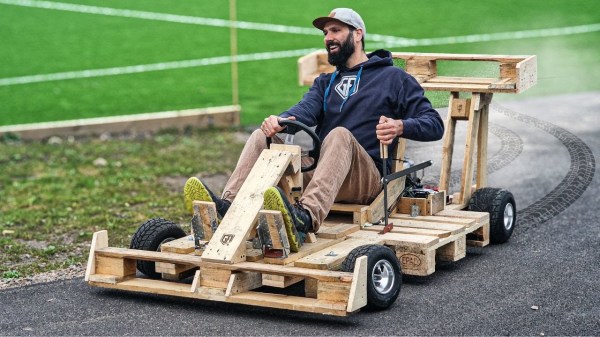
Many beginner woodworkers, looking to offset the introductory costs of starting a hobby, will source their wood from pallets. Generally they’re easily found and can be low or no cost, but typically require a bit of work before they’re usable in a project. [Garage Avenger] is looking to do something a little outside of the box with his pallet project, though. He’s using raw pallets as a chassis for a four-speed go-kart, partially for the challenge and excitement and also to one-up a Pinterest post.

Almost immediately, though, the other major downside of working with pallets arose which is that they’re generally built out of low-grade pine which is soft and flexible. Flexibility is generally not a good thing to have in a vehicle frame so plenty of the important parts of this build were strengthened with steel tubing including the rear axle, steering mounts, and a few longitudinal supports to strengthen the overall frame. After working out some kinks with ordering a few of the wrong parts, and mounting the steering box backwards, it was time to test out the four-speed engine (and brakes) on the the go-kart, making it nearly ready for the road.

To complete the build, some tidying of wiring and fuel lines was done, along with improving some of the non-critical parts of the build like the bucket seat. Of course, adding pallet spoilers and body kit puts the finishing touches on the build and the go-kart is finally ready to tear up the local go-kart track and the less-inspiring Pinterest projects. [Garage Avenger] is no stranger to strange vehicle builds, either. Although it’s a bit out of season for most of our northern hemisphere readers now, his jet-powered street sled is still worth a view.
Continue reading “This Go-Kart Rides On A Pallet”

Giant 3D Printer Aims To Produce Life-Sized Boat

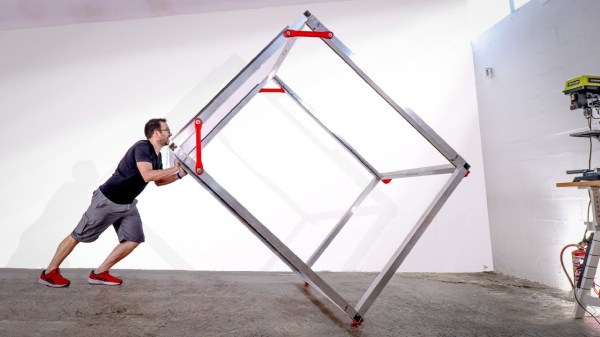
As 3D printers become more ubiquitous, the number of custom designs and styles of printers has skyrocketed. From different printing materials and technologies to the movements of the printing head, we’ve seen all kinds of different takes on these tools. But one thing that has been largely limited to commercial and industrial use has been large print sizes —  leaving consumer level prints to be split into several pieces to fit together later. Not so with this giant 3D printer from [Ivan], though.

The design goals for this build are to print an entire boat that [Ivan] can captain himself, and additionally an entire go kart chassis in a single piece. It’s part of a contest between him and another YouTuber and as far as we can tell he’s well on his way to completing the challenge. The printer will be able to churn through 4 kg of filament per day, and has a printable volume of 1000x1000x1420 millimeters, or just shy of 1.5 cubic meters.

While this video is just the first step of building the frame and the printer guides, we can’t wait to see the next steps in the process. It’s one of the largest 3D printers we’ve ever seen, at least outside of printers designed for building entire houses out of concrete.

Continue reading “Giant 3D Printer Aims To Produce Life-Sized Boat”

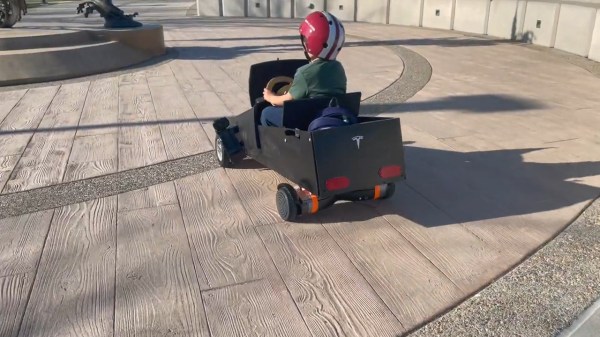
Mahmut's kid in a helmet, riding the go-kart outside on pavement

Hoverboard Go-Kart Build Is A Delight To Watch

Hoverboards have been an indispensable material for hackers building their own vehicles in the last few years. [Mahmut Demir] shows how he’s built a hoverboard-powered go-kart for his son. Unable to hack the board’s firmware, he instead set out to reuse the hoverboard without any disassembly, integrating it into the go-kart’s frame as-is. This build is completely mechanical, distinguished in its simplicity – and the accompanying six minute video shows it all.

This go-kart’s frame is wood and quite well-built, with the kind of personal touch that one would expect from a father-son gift. Building the vehicle’s nose out of a trashcan gave us a chuckle and earned bonus points for frugality, and the smiley face-shaped wheel is a lovely detail. As for the ‘hoverboard reuse’ part, the board is pivoted backward and forward, just as it normally would be. Rather than feet, the kart uses a lever that’s driven with two pedals through a pulley-string arrangement, giving granular speed control and the ability to reverse. It’s a clever system, in fact we don’t know if we could’ve done it better. You can see [Mahmut]’s son wandering in the background as [Mahmut] goes through the assembly steps — no doubt, having fun doing his own part in the build process.

[Mahmut] tells us he’s also added a remote off switch as a safety feature, and we appreciate that. We’ve seen hoverboards in go-kart builds before, as well as rovers, e-bikes, robot vehicles, and even mobility platforms. Truly, the hoverboard is a unicorn of hacker transportation helpers.
Continue reading “Hoverboard Go-Kart Build Is A Delight To Watch”

Go-Kart Reverse Without The Pain

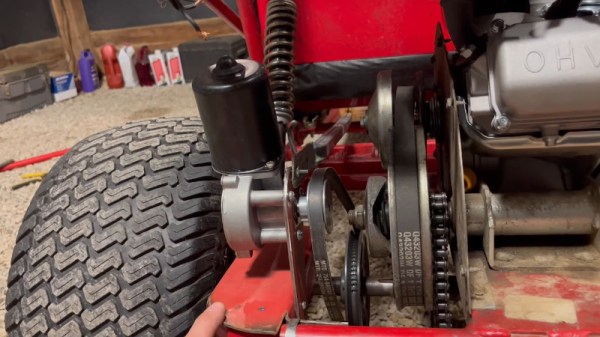
Go-karts are a huge amount of fun, but often lack the most basic of mechanical conveniences such as a reverse gear. You can’t start a small four-stroke engine in reverse, so their simple chain drive transmissions lack the extra cogs to make it happen. Enter [HowToLou], who has given his go-kart a reversing option by the addition of an electric motor.

It’s an extremely simple arrangement, the motor is a geared 12 V item which drives a V-belt to the axle. The motor is mounted on a pivot with a lever, such that normally the belt isn’t engaged, thus reverse can be selected by pulling the lever. A simple button switch applies power to the motor, meaning that the machine can travel sedately backwards on electric power.

We’re not entirely convinced by the integrity of some of his fixings and it would be interesting to see how much the V-belt wears under the influence of the pulley when not engaged, but as an alternative to a full gearbox we can see the point. But then again as regular readers may know, we’re more used to full electric traction.

Continue reading “Go-Kart Reverse Without The Pain”

Fail Of The Week: Alternator Powered Electric Go-Kart Doesn’t Go

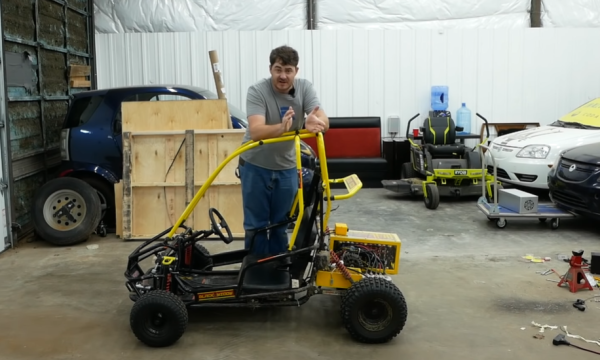
What do you give a six-year-old who loves going fast but doesn’t like loud noises? Convert a gas go-kart to electric of course! (Video, embedded below.) That goal started [Robert Dunn] of Aging Wheels down a long path toward a go-kart that almost, but doesn’t quite… work.

If you’ve watched any of [Robert’s] videos, you know he doesn’t take the easy path. The man owns a Trabant and Reliant Robin after all. Rather than buy a battery pack, he built his own 5S24P pack from individual LiFePO4 cells. Those cells generally are spot welded, so [Robert] built an Arduino-controlled heirloom-quality spot welder. Now while the welder could handle thin nickel strips, it wasn’t up the task of welding high current nickel-plated copper. When attempts at a solution failed, [Robert] built a system of clamped copper bus bars to handle the high current connections for the batteries.

If batteries weren’t hard enough, [Robert] also decided he wasn’t going to use an off-the-shelf motor for this project. He converted a car alternator to operate as a brushless motor. We’ve covered projects using this sort of conversion before. Our own [Jenny List] even wrote a tutorial on it. [Robert] unfortunately has had no end of trouble with his build.

Continue reading “Fail Of The Week: Alternator Powered Electric Go-Kart Doesn’t Go”

Lego Go-Kart Scores Radio Control

LEGO has always been an excellent toy for both play and learning, and the Technic sets are a great starting point for any budding engineer. Not content to rest on their plastic, blocky laurels, LEGO introduced more advanced parts over the years, such as motors and battery packs to allow builders to propel their creations. Combine this mechanical philosophy with [Matt]’s Giant Lego Go-Kart and you have one heck of a project.

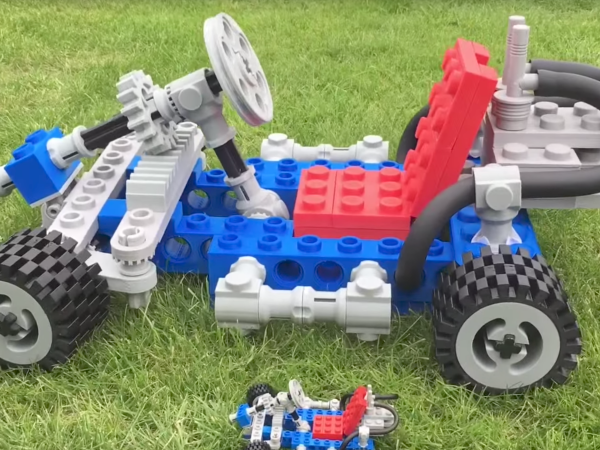
It all started months ago, when [Matt] built his original Giant Lego Go-Kart, a 5-times scaled up model of the original kit #1972-1. Achieved through the wonder of 3D printing, he had sized it up based off the largest parts he could fit on his printer. The Youtube video led to commenters asking – could it be driven?

He decided that radio control was definitely a possibility. Not content to simply bolt on a series of motors to control the drive and steering, he took the effort to build scaled up replica LEGO motors, even taking care to emulate the old-school connectors as well. A particularly nice touch was the LEGO antenna, concealing the Orange RX radio receiver.

There were some hiccups – at this scale & with [Matt]’s parts, the LEGO force just isn’t strong enough to hold everything together. With a handful of zipties and a few squirts of glue, however, the giant ‘kart was drifting around the carpark with ease and hitting up to 26km/h.

In the end, the build is impressive not just for its performance but the attention to detail in faithfully recreating the LEGO aesthetic. As for the next step, we’d like to know what you think – how could this be scaled up to take a human driver? Is it possible? You decide.

Quintuple-Sized LEGO Go-Kart

[Matt Denton] was inspired by [James Bruton]’s scaled up LEGO and decided to create his own giant LEGO project. He found a classic model that he wanted to scale up.  1985’s Technic Go-Kart (set #1972) contained 98 pieces and seemed manageable.

He wanted to create something his 8yo nephew [Ruben] could sit in, but had to rule out a fully kid-sized go-kart. It had also to be (at least somewhat) economical with regards to plastic and printing time. [Matt] settled on sizing the largest piece—the 2×8 plate—to fit diagonally on the 11”x11” bed of his Lulzbot Taz5.

It took 168 hours to print all 98 parts (some of them in a series of smaller pieces), 5 kilos total of filament at mostly 20% infill. The resulting car can be assembled and disassembled just like LEGO—no glue! The rack and pinion steering actually works and the Ninjaflex-tired wheels roll as one would expect. So, pretty much the same as the real model only five times bigger. The only non-LEGO components are threaded rods down the middle of his cross axles as well as the hose, just Neoprene hosing from a hardware store.

[Matt] is well-known to Hackaday readers, being one of the original BB-8 builders as well as co-creator of the Mantis walking robot. He’ll be on hand this weekend in Maker Faire Hannover to share this project, Mantis, and others. Continue reading “Quintuple-Sized LEGO Go-Kart”