Portable Tow Rope Batman Would Be Proud Of

Out of all of Batman’s massive array of tools which turn a relatively ordinary person into a superhero, perhaps his most utilitarian is his grappling gun — allowing him the ability to soar around his city like Spiderman or Superman. [John Boss] isn’t typically fighting crime, but he did develop his own grappling gun of sorts which gives him another superpower: the ability to easily scale snowy hills to quickly get back to the top.

The grappling gun takes inspiration from a commonly used tool called a power ascender, which is often used in industry applications where climbing is required. This one is held in the hand and uses a brushless motor with a belt-driven 3:1 reduction for increased torque. The pulley system, bearings, and motor are all housed in a 3D printed enclosure and are powered by rechargeable Milwaukee power tool batteries. During prototyping the rope intake and output feed locations had to be moved to increase the pulley’s grabbing ability, and with a working prototype he swapped a lot of the plastic 3D printed parts out for metal to increase the sturdiness of the device.

The grappling gun was originally designed for a smaller child to get hoisted up a hill on a sled, but when stress testing the device [John] found out that it actually has more than enough capability to haul even an adult up a hill on skis. As an added bonus, the outfeed for the rope can be put into a bag and used to automatically coil the rope up when he’s done at the hill. Although this is a great solution for a portable rope tow, for something more permanent and more powerful take a look at this backyard rope tow that was built from spare parts.

Continue reading “Portable Tow Rope Batman Would Be Proud Of”
See What You’re In For When Buying And Moving A Lathe

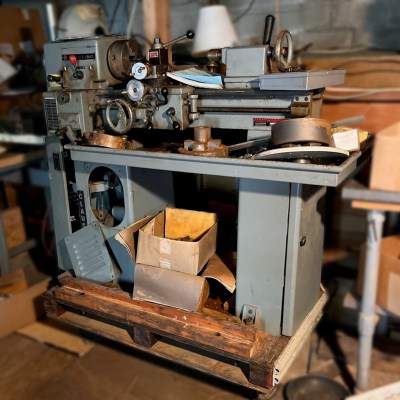
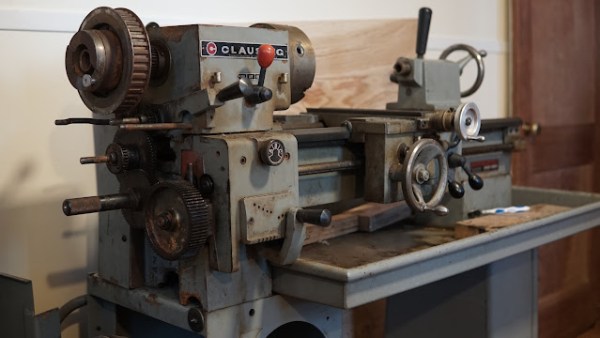
Sometimes, with patience and luck, one can score a sweet deal on machinery. But for tools that weigh many hundreds of pounds? Buying it is only the beginning of the story. [Ben Katz] recently got a lathe and shared a peek at what was involved in moving a small (but still roughly 800 pound) Clausing 4901 lathe into its new home and getting it operational.

The lathe had sat unused in a basement, but was ready for a new home.

Moving such a stout piece of equipment cannot simply be done by recruiting a few friends and remembering to lift with the legs. This kind of machinery cannot be moved and handled except with the help of other machines, so [Ben] and friends used an engine hoist with a heavy-duty dolly to get it out of the basement it was in, and into the bed of a pickup truck. Separating the lathe from its base helped, as did the fact that the basement had a ground-level egress door which meant no stairs needed to be involved.

One also has to consider the machine’s ultimate destination, because not all floors or locations can handle nearly a thousand pounds of lathe sitting on them. In [Ben]’s case, that also meant avoiding a section of floor with a maintenance trapdoor when moving the lathe into the house. Scouting and knowing these things ahead of time can be the difference between celebratory pizza and deep dish disaster. Pre-move preparation also includes ensuring everything can physically fit through the necessary doorways ahead of time; a task that, if ignored, will eventually explain itself.

With that all sorted out, [Ben] dives into cleaning things up, doing function checks, and in general getting the lathe up and running. He provides some fantastic photos and details of this process, including shots of the 70s-era documentation and part diagrams.

Watch the first chips fly in the short video embedded below. And should you be looking at getting a lathe of your own? Check out our very own buyer’s guide to lathe options.

Continue reading “See What You’re In For When Buying And Moving A Lathe”

Build Your Own Custom Elevator

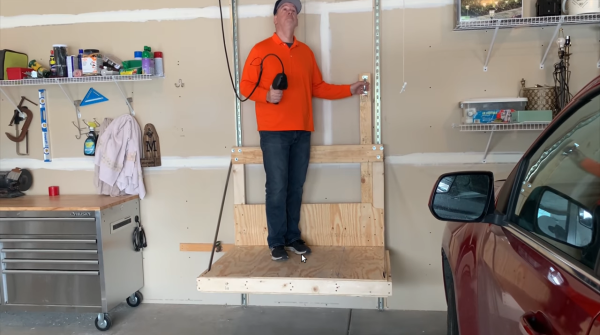
There are a lot of things in our everyday life that are holdovers from an earlier time that we continue to use simply because of inertia even if they don’t make a lot of sense in modern times. Examples include a 60 Hz power grid, the spacing between railroad tracks, and of course the self-contained attic ladder which is made to fit in between standard spaced ceiling joists. It’s not wide enough to get big or heavy stuff into an attic, and building standards won’t change just for this one inconvenience, so if you want to turn that space into something more usable you’re going to need to build a custom elevator.

This attic elevator comes to us from [Brian] who recently moved into a home with about half the square footage as his previous home, but still needed to hold all of his stuff. That means clever ways of using the available space. For the elevator he constructed a platform out of 2x lumber held together with bolts and steel supports. The carriage runs up and down on a track made out 1 5/8″ super strut and is hoisted by a winch motor rated for 550 pounds, which is more than enough to hoist up most household items including a large toolbox.

The only thing that we would have liked to have seen in the video is how the opening was made. Presumably this would have involved cutting into a ceiling joist to make the opening wider than the standard attic ladder, and care would have needed to be taken to ensure the ceiling/floor wasn’t weakened. Either way, this is a great solution to a common problem, and could perhaps be made to work on more than two levels with a custom controller. Continue reading “Build Your Own Custom Elevator”

Hoisting A Laser Cutter To The 3rd Floor (and Other Fun You’ll Probably Never Have)

The folks at Null Space Labs bought a 40W CO2 laser tube in order to build their own laser cutter. Unfortunately nobody really wants to build a laser cutter; they just want to play with a laser cutter. So they ended up biting the bullet and ordering a $4000 model from China. That’s it hovering in midair. This is the story of acquiring the unit and playing around with it once it arrived.

Check out those orange cones in the picture. Hackerspace members put them out to keep the parking spots clear so no damage was caused in the event of an accident. But since they’re located in Los Angeles some of the road warriors didn’t really care and just moved the cones anyway. Luckily the crane hoist to the third floor (they removed one of the windows) ended up going rather well.

So what do you do with a laser cutter like this one? Crack it open and make some improvements. The manufacturer says it can’t cut through steel. Well that’s only if you don’t add some O2 to the cutting process. And the stock mirrors… they’ve got to go. Turns out a simple upgrade boosted the power by about 20% (we’re wondering how they measured that). While we’re talking about optics, might as well upgrade the lens as well. You can see where they’re going with this, and [CharlieX] tells us it is just the first in a series of posts he’ll be working on.