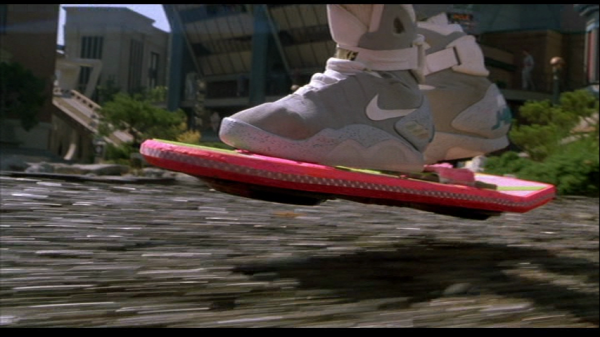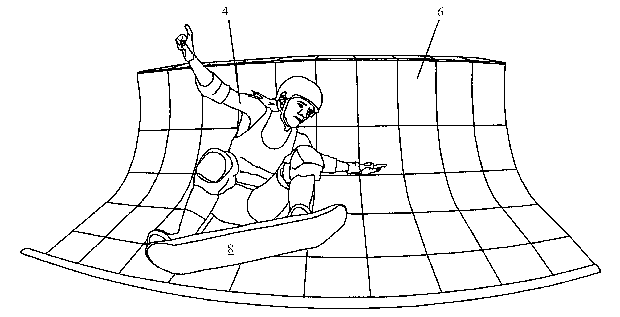
Auto site [Jalopnik] got some hands-on (or rather feet-on) time with the Lexus hoverboard that was built for an advert for the luxury car brand, and their video reveals a few secrets about how this interesting device works. It is definitely real: the Jalopnik writer got to ride it himself, and described it as “Unbelievably difficult yet at the same time unbelievably cool, both because you’re levitating and because the board is filled with magnets more than 300 degrees below zero“. But a look behind the scenes reveals that it is another tease.
The device looks like it is a real hoverboard, floating several inches above the surface and even traveling over water, a feat that Marty McFly couldn’t do. But, as usual, there is a little more going on than meets the eye. The device is built around superconducting magnets cooled by liquid nitrogen, so it only works for about 10 minutes. After that, you have to refill the device with liquid nitrogen. The surface that the board is floating over also has what the Jalopnik writer describes as having “several hundred thousand dollars worth of magnets built in“. Try this on a non-magnetic surface and you’ll come to a grinding halt. If you watch the video of the hoverboard serenely gliding over the water from another angle, you can see a magnetic track just under the surface. If you run off this track, you’ll end up with wet feet.
Is it a neat hack? Yes. Is it cool? Yes. Is it the future of transportation? No: it is a cool hack put together for a car advert with a big budget. Kudos to Lexus for spending the cash to do it properly, but once again, our dreams of hoverboards are dashed in the cold, hard light of reality. Darn.

 Three days ago on October 21, 2014 it was announced to the world the Back to the Future hoverboard was real. It’s a Kickstarter, of course, and it’s trending towards a $5 Million dollar payday for the creator. Surprisingly for a project with this much marketing genius, it’s a real, existing device
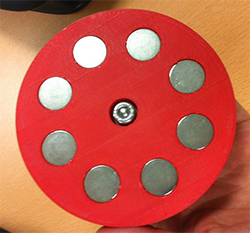
 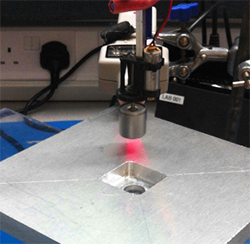 Like the Kickstarter hoverboard, [jelly] is using an array of magnets rotating in a frame above a non-ferrous metal. For the initial test, eight neodymium magnets were arranged in a frame, suspended over 3/4″ aluminum plate, and spun up with a drill. With just this simple test, [jelly] was able to achieve 2kg of lift at 1cm and 1kg of lift at 1 inch of separation. This test also provided some valuable insight on what the magnets do to the aluminum or copper; the 3kg aluminum plate was nearly spinning, meaning if this device were to be used on small plates, counter-rotating pairs of magnetic lifters would need to be used.