Performance Improvements For Open-Source 80386

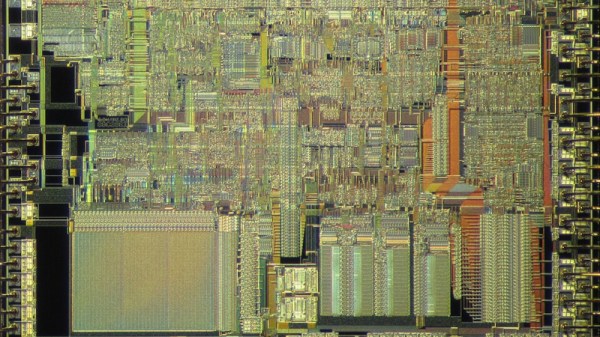
The Intel 80386 is a rather fascinating slice of computer history. It marked the first 32 bit X86 processor, and was a staple of early desktop computing. Like all chips, it has a number of quirks, one of which being the fact that all commands are executed in microcode. By this nature, it was a rather excellent prospect to be re-implemented in an FPGA core called the z386. However, it was lacking a feature native to the original 386, early start memory access. So to bring some performance to the z386 project, [nand2mario] went forth to fully implement this feature for FPGA 80386s.  

Instead of taking a cycle to find and allocate the memory required for executing the next instruction, the 386 would start this in the previous cycle. This is achieved in hardware by nature of having a separate memory management unit. In the FPGA, the key difficulty proved to be in getting the computation fast enough to execute within a single cycle. This change netted an approximate 9% performance benefit. However, for [nand2mario] this was too small a performance uplift. 

Some rewrites of the store cue allowed for cutting a cycle out of the process further improving the performance. However, more performance required slight deviations from the design of the original 386. Because code-branches are performance critical, the z386 project now computes the branch memory jump several cycles earlier than the 386, reducing the cycle time for the jumps from 9.25 to a mere 6. Some final changes to the microcode decode frontend rounded out the optimizations covered in this latest blog post.

The net result is an approximate 39% increase in performance in the all important DOOM benchmark. The z386 still not a complete project, the performance is still lacking compared to the 386, and it remains unable to boot Windows. X86 is complicated, which will take time, so make sure to stay tuned for more coverage! While you wait, make sure to check out our original writeup of the z386 project. 

Pauli Rautakorpi, CC BY 3.0.


Z386: An Open-Source 80386 Built Around Original Microcode

There are many ways you can implement an Intel i386 CPU on an FPGA, with the use of original microcode probably being one of the most interesting approaches. This is what [nand2mario]’s z386 project does, with a recent blog post summarizing the development so far.

This effort is similar to the previously developed z8086 project, which as one may guess does something similar, except for the Intel 8086 CPU. By executing the original microcode you’re basically guaranteeing close compatibility with the original hardware, though of course the sheer scale of this microcode between an 8086 and 80386 is quite different.

There’s a much larger instruction set with a correspondingly much more complicated internal state to keep track of, including all those newfangled features like memory management, paging and register debugging, as well extensions to protected mode that began with the i286.

Currently z386 runs on a number of FPGAs, including the Altera Cyclone V and Gowin GW5A, with performance equivalent to a ~70 MHz i386 albeit with slightly worse cycle efficiency, some of which could be due to the limited 16 kB cache compared to the 32+ kB cache in the fastest i386 CPUs. Either way, it’s more than enough to run all kinds of software, including games like DOOM.

Important to note is that the goal here isn’t to be more performant than cores such as for example ao486, but more as an archaeological reconstruction of the original hardware and its interaction with said microcode.


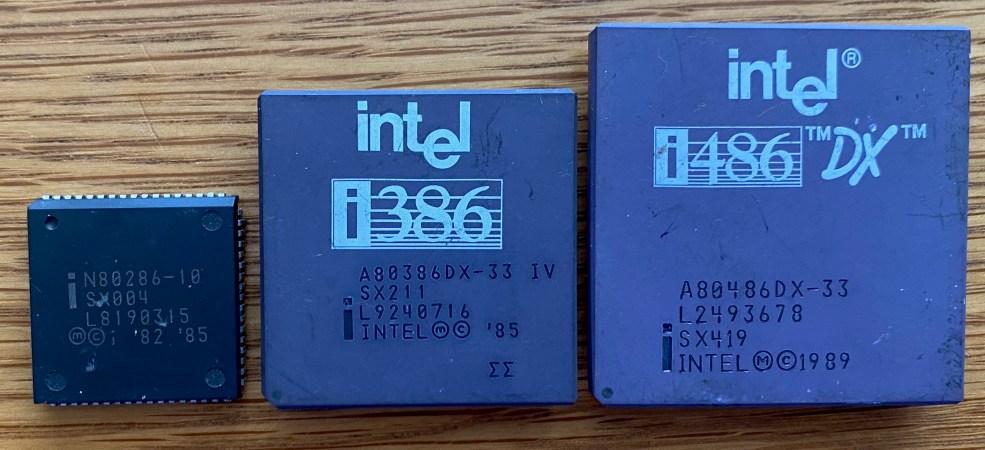
Top image: line-up of Intel 286, 386 and 486 CPUs. (Credit: Sgroey, Wikimedia)

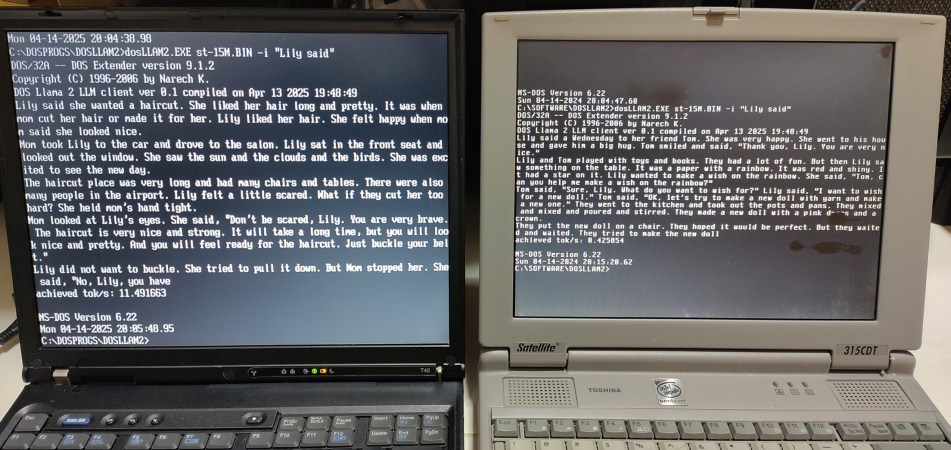
Two laptops, side by side, running Llama2 in DOS.

Will It Run Llama 2? Now DOS Can

Will a 486 run Crysis? No, of course not. Will it run a large language model (LLM)? Given the huge buildout of compute power to do just that, many people would scoff at the very notion. But [Yeo Kheng Meng] is not many people.

He has set up various DOS computers to run a stripped down version of the Llama 2 LLM, originally from Meta. More specifically, [Yeo Kheng Meng] is implementing [Andreq Karpathy]’s Llama2.c library, which we have seen here before, running on Windows 98.

Llama2.c is a wonderful bit of programming that lets one inference a trained Llama2 model in only seven hundred lines of C. It it is seven hundred lines of modern C, however, so porting to DOS 6.22 and the outdated i386 architecture took some doing. [Yeo Kheng Meng] documents that work, and benchmarks a few retrocomputers. As painful as it may be to say — yes, a 486 or a Pentium 1 can now be counted as “retro”.

The models are not large, of course, with TinyStories-trained  260 kB model churning out a blistering 2.08 tokens per second on a generic 486 box. Newer machines can run larger models faster, of course. Ironically a Pentium M Thinkpad T24 (was that really 21 years ago?) is able to run a larger 110 Mb model faster than [Yeo Kheng Meng]’s modern Ryzen 5 desktop. Not because the Pentium M is going blazing fast, mind you, but because a memory allocation error prevented that model from running on the modern CPU. Slow and steady finishes the race, it seems.

This port will run on any 32-bit i386 hardware, which leaves the 16-bit regime as the next challenge. If one of you can get an Llama 2 hosted locally on an 286 or a 68000-based machine, then we may have to stop asking “Does it run DOOM?” and start asking “Will it run an LLM?”

Continue reading “Will It Run Llama 2? Now DOS Can”

The Latest Linux – On A Floppy In A 486!

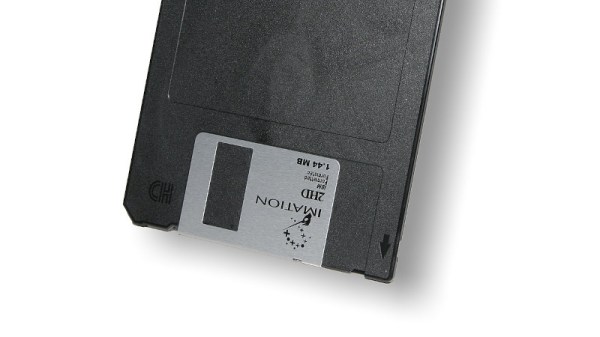
If you have ever studied the early history  of the GNU/Linux operating system in its many forms, you’ll have read that [Linus Torvalds] developed his first kernel for his Intel 386-based computer. Though the 386 architecture is now ancient, the current Linux kernel can still be compiled for it and many distributions still maintain an i386 branch to provide broad compatibility for later machines able to run i386 code. But what if you were to take a current Linux kernel and stick it on a floppy in a machine from the early 1990s, with meagre RAM? [Fozztex] did just that, with not a 386 but a 486, sporting what would have been an impressive for the time 36MB of RAM. You can watch it in action in the video below the break.

A recent Linux kernel is rarely if ever compiled for something as small as a floppy disk, so getting one to boot from such ancient media appeared to be a challenge. It was possible though with the tinyconfig make option, and after finding a small enough root filesystem courtesy of Aboriginal Linux, a bootable floppy was created. It’s not entirely useful and its sole purpose was to see whether Linux could see a large hard drive on the 486, but it’s still a version 5.6 Linux kernel booting from floppy on an ancient computer. Never complain that your Raspberry Pi Zero is slow again, we’ve come a long way!

Continue reading “The Latest Linux – On A Floppy In A 486!”