Hackaday Links: May 18, 2014

hackaday-links-chain

Think the original Pong is cool? How about point to point Pong? [v8ltd] did it in three months, soldering all the leads directly to the chip pins. No sockets required. It’s insane, awesome, a masterpiece of craftsmanship, and surprising it works.

[Jeremy Cook] is building a servo-powered light graffiti thing and needed a laser diode. How do you control a laser pointer with a microcontroller? Here’s how. They’re finicky little buggers, but if you get the three-pack from Amazon like [Jeremy] did, you get three chances to get it right.

NFC tags in everything! [Becky] at Adafruit is putting them in everything. Inside 3D printed rings, glued onto rings, and something really clever: glued to your thumbnail with nail polish. Now you can unlock your phone with your thumb instead of your index finger.

Photographs capture still frames, but wouldn’t it be great if a camera could capture moving images? No, we’re not talking about video because this is the Internet where every possible emotion, reaction, and situation can be expressed with an animated GIF. Meet OTTO, the camera that captures animated GIFs! It’s powered by the Raspberry Pi compute module, so that’s interesting.

[Nate] was getting tired of end mills rolling around his bench. That’s a bad thing. He came up with a solution, though: Mill a piece of plywood into a tray to hold end mills.

The Da Vinci printer, a printer that only costs $500 because they’re banking on the Gillette model, has been cracked wide open by resetting the DRM, getting rid of the proprietary host software, and unbricking the device. Now there’s a concerted effort to develop custom firmware for the Da Vinci printer. It’s extraordinarily bare bones right now, but the pins on the microcontroller are mapped, and RepRap firmwares are extremely modular.

Building A CO2 Laser In A Hardware Store

Over on the Projects site, [ThunderSqueak] is pushing the bounds of what anyone would call reasonable and is building a CO2 laser from parts that can be found in any home improvement store.

Despite being able to cut wood, paper, and a bunch of other everyday materials, a carbon dioxide laser is actually surprisingly simple. All you need to do is fill a tube with CO2, put some mirrors and lenses on each end, and run an electric current through the gas. In practice, though, there’s a lot of extra bits and bobs required for a working laser.

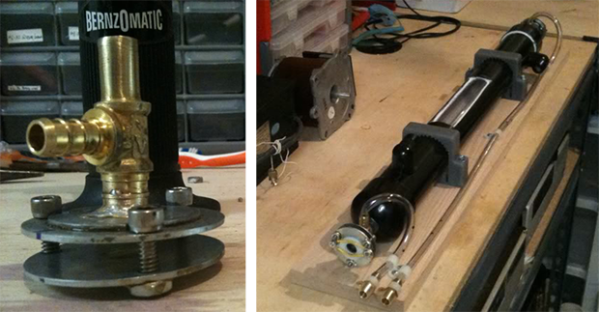
[ThunderSqueak] will need some sort of cooling for his laser, and for that he’s constructed a watercooling jacket out of 2″ PVC. In the end caps, a pair of brass pipe fittings are JB Welded in place, allowing a place for the mirror assembly and lenses.

The mirror mounts are the key component of this build, but the construction method is surprisingly simple. [ThunderSqueak] is using a few brass barbed hose fittings, with washers stuck on one end. The washers are drilled to accept a trio of bolts that will allow the mirrors to be perfectly parallel; anything less and the CO2 won’t lase.

The build isn’t complete yet, but having already built a few lasers, there’s little doubt [ThunderSqueak] will be able to pull this one off as well.


Hackaday Links: April 27, 2014

hackaday-links-chain


The HackFFM hackerspace in Frankfurt finally got their CO2 laser up and running, and the folks there were looking for something to engrave. They realized the labels on IC packages are commonly laser engraved, so they made a DIP-sized Arduino. The pins are labelled just as they would be on an Arduino, and a few SMD components dead bugged onto the pins provide all the required circuitry. Video here.

A few years ago, we heard [David Mellis] built a DIY cell phone for an MIT Media Lab thingy. Apparently it’s making the blog rounds again thanks to the Raspi cell phone we featured yesterday. Here’s the Arduino cell phone again. Honestly we’d prefer the minimalist DIY Nokia inspired version.

The Raspberry Pi is now a form factor, with the HummingBoard, a Freescale i.MX6-powered clone, being released soon. There’s another form factor compatible platform out there, the Banana Pi, and you can actually buy it now. It’s an ARM A20 dual core running at 1GHz, Gig of RAM, and Gigabit Ethernet for about $60. That SATA port is really, really cool, too.

[Richard] has been working on a solar-powered sun jar this winter and now he’s done. The design uses two small solar panels to charge up two 500F (!) supercapacitors. There’s a very cool and very small supercap charging circuit in there, and unless this thing is placed in a very dark closet, it’ll probably keep running forever. Or until something breaks.

Here’s something awesome for the synth heads out there: it’s an analog modeling synthesizer currently on Indiegogo. Three DCOs, 18dB lowpass filter, 2 envelopes and an LFO, for all that classic Moog, Oberheim, and Roland goodness. It’s also pretty cheap at $120 USD. We really don’t get enough synth and musical builds here at Hackaday, so if you’re working on something, send it in.

A glass-based PCB? Sure. Here’s [Masataka Joei] put gold and silver on a piece of glass, masked off a few decorative shapes, and sandblasted the excess electrum away. [Masataka] is using it for jewelery, but the mind races once you realize you could solder stuff to it.

Hackaday Links: April 20, 2014

hackaday-links-chain

[Josh] hit the same issue we’ve faced before: cable modems don’t match a form factor and usually don’t make themselves easy to mount on something. We could complain about routers as well, but at least most of those have keyhole slots so you can hang them on some screws. Inspiration struck and he fabricated his own rack-mount adapter for it. Velcro holds it in place, with a cutout bezel to see the status lights and an added fan to keep things cool.

Here’s a pair of strange but possibly interesting ones that were sent in separately. The first is an analysis of how much energy short-run CNC prototyping consumes versus traditional manufacturing. The other is an article that [Liz] wrote about getting started with CNC mill bits. She says she compiled all that she learned as she was getting started in the field and wants to save others the effort.

This one goes back several years, but who doesn’t love to hear about a voice-controlled wheelchair?

So you can solder QFN parts but you can’t hammer a nail straight into a piece of wood? The answer, friend, is a laser guided hammer. Someone hire this [Andybot] person, because the solution to the problem shows the ability to out-think an interesting dilemma: how do you put a laser in a hammer head and still use it to hit things?

We’ve seen a lot of these long-range WiFi hacks over the years. This one is worth looking at because of the work done to create an outdoor mount that will stand the test of time.

And finally, we’re still really fond of this 2-bit paper processor that helps you wrap your brain around what’s going on with those silicon wafers that rule our everyday lives. [glomCo] liked it as well, and actually coded an emulator so that you can play with it without printing anything out on paper. We think it takes away some of the fun, but what an excellent programming exercise!

Laser Cutter Becomes An Etch A Sketch

etch

The mirror in a laser cutter moves along an X Y axis. An Etch A Sketch moves its stylus along an X Y axis. Honestly, this laser cutter with Etch A Sketch controls is so obvious, we’re shocked we haven’t seen it before.

The Etch A Sketch interface is extremely simple – just two rotary encoders attached to laser cut knobs set inside a small, laser cut frame. The lines from the encoders are connected to an Arduino Pro Mini that interfaces with the controller unit on the laser cutter, moving the steppers and turning on the laser only when the head is moving. There’s an additional safety that only turns on the laser when the lid is closed and the water pump is running.

The circuit is extremely simple, and with just a few connections, it’s possible to retrofit the Etch A Sketch controller to the laser cutter in just a few minutes.  Just the thing for a weekend hackerspace project.


Continue reading “Laser Cutter Becomes An Etch A Sketch”

Etching Designs Into Denim With A Laser Cutter

JeansEtchLaser

Finding new uses for your tools and equipment can be very exciting. [Foamy] wrote in to tell us about a blog post by [qbotics] that demonstrates etching designs into denim with a laser cutter. What a cool unexpected use for a laser cutter!

According to the Epilog laser cutter’s website, “we have engraved everything from denim to acrylic with fantastic results”. This inspired the author of “Science with denim” to try engraving jeans. After some experimentation,  [qbotics] found that setting the 75W laser cutter to 15% power at 100% speed worked best. The results are quite impressive; the engraved pattern looks like naturally faded jeans. Amazing.

In the past, we have seen lasers engrave everything from calculators to wood. We would be curious to see if some of the DIY laser cutters could engrave denim as well. Give it a try and tell us about it!

A 3-Axis Paper Cutting Mini Laser

LaserCutter

Laser are awesome, and so are projects that use lasers. A recent Instructable by [kokpat] gives an overview of how to create a fully functional laser paper cutter using CDROM stepper motors and an Arduino.

What is special about this build, is that it showcases how easy it can be to build a 3-axis mechanical system used for laser cutters, CNC machines, and 3D printers. Using a stepper stage that consist of a motor screw with a nut slider based carriage, the mechanical system can be put together quite easily and cost effectively. Luckily, from an electronics and software perspective, everything is quite standardized with the proliferation of the RepRap and similar machines. Simply pick any three stepper drivers, find the most pertinent firmware, and voilà! You’re done! Well, almost. Don’t forget a 100mW violet laser!

We have seen a ton of really cool laser cutters before, but this has to be one of the cheapest. See the laser cutter in action after the break.

Continue reading “A 3-Axis Paper Cutting Mini Laser”