Communicating With A Beam Of Light

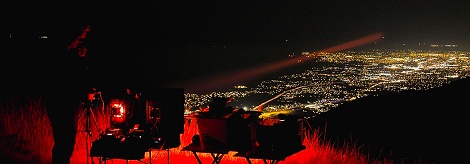
Last weekend, ARRL, the national association of amateur radio, held a contest called, “10 GHz and up” with the goal of communicating via radio or microwaves over long distances. [KA7OEI] and a few friends decided to capitalize on the “and up” portion of the ’10 GHz and up” contest by setting up a full-duplex voice link over a distance of 95 miles. They used the 478 THz band, also known as red LEDs and laser pointers.

With [Ka7OEI]’s friends [Ron] and [Elaine] perched atop a 5700 foot-high mountain near Park City, Utah, [Gordon], [Gary] and [KA7OEI] trudged up a hill about 10 miles north of Salt Lake City. With the help of a pair of 500,000 candlepower spotlights, the two teams found each other and began pointing increasingly higher power LEDs at each other.

The teams started off with 3 Watt red LEDs before moving up to 30 Watt LEDs and a photodetector at each end. Even though the teams weren’t working with a true line-of-sight – refraction of the atmosphere allowed them to transmit this far – they were able to transmit tone-modulated Morse and even full-duplex voice.

Not bad for a transmission that bends the FCC’s “275 GHz and up” amateur band to its breaking point.
Retroball Or Super Pong Table Grows Up

pong-table

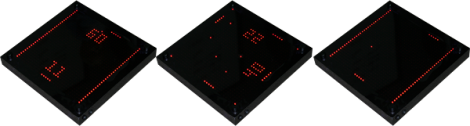
Retroball is, as its Kickstarter campaign says, “Retro Fun for up to Four Players.” What you might not know, is that it’s ancestor was featured here earlier last year. With a year and a half of development underway, the build looks spectacular, and the people in their promo video look like they’re having lots of fun (obviously).

The whole concept of the game is that it has up to four players that each manipulate a paddle as in the classic Pong game. The obvious difference is that there are four players, and everything is played on a 32 x 32 LED array.

Although it looks like fun in it’s stock form, readers of Hack a Day will most likely start thinking about how they could modify it for their own uses. Everything is open source, and they promise to release the documentation for this project. On the other hand, if you can’t wait, or would rather build something very similar, check out [Brad]’s original Instructable article!

Using An Undocumented Display With An FPGA

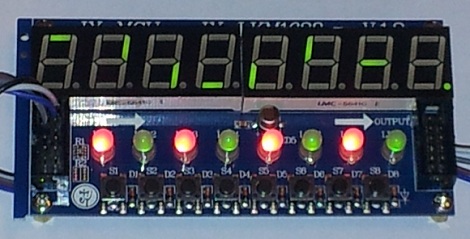
When [Mike] ran across a display on Deal Extreme with 8 seven-segment displays, 8 red/green LEDs, and 8 buttons, he knew it would find a good home in a future project. There was only one problem, though: except for an Arduino library, there was absolutely no documentation available for this display. Wanting to use this display with an FPGA board, [Mike] decided against bit-banging a protocol and ported the C++ code into a hardware implementation.

This Deal Extreme display, the TM1638, features enough seven-segment displays, LEDs and buttons to build something really cool, and surprisingly isn’t terribly hard to interface with a microcontroller. The TM1638 library communicates with the outside world via only three pins and a simple serial connection.

After figuring out what commands are sent to make the display turn LEDs on or off, [Mike] wrote a hardware implementation for his Digilent Nexys2 and Digilent Basys2. Now the display operates on an FPGA just like it does with an Arduino, and is a great tool for debugging HDL code for [Mike]’s FPGA.

Helmet Of Many LEDs Built For Burning Man

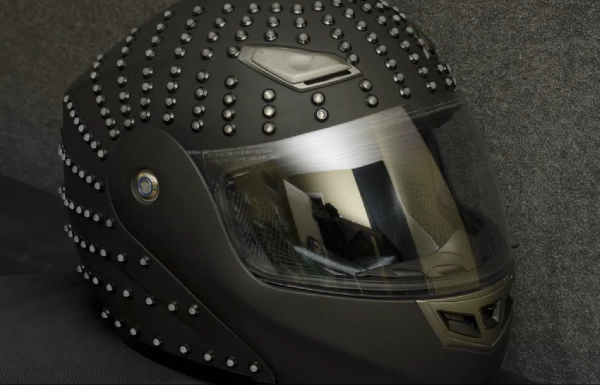
This motorcycle helmet was heavily altered to accept all of the hardware that goes into driving that huge array of LEDs. [Brian Cardellini] built it to wear at burning man. He claims to have been in over his head with the project, but we certainly don’t get that feeling when we see the thing in action. It’s light on build details, but there are plenty of demo shots in the video after the break. The animation and fading action really gets started about a minute and a half into it.

One of the early frames of the video is a shot of the parts order webpage. Since it’s an HD clip we were able to glean a few bits and pieces from that. It includes a MAX7219 LED Display Driver and fifteen 25-packs of Blue LEDs. Now that chip is a great choice, and one of the later shots shows two of them on breakout board driven by an Arduino. The look is very clean since he carved out most of the helmet’s padding to make room for the electronics.

Continue reading “Helmet Of Many LEDs Built For Burning Man”

Dinosaur Hoodie To Remind You Halloween Approaches!!

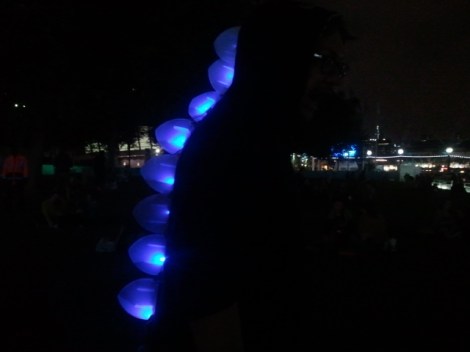
[Tom’s] dinosaur hoodie would make a bang up Halloween costume. It’s a glowing version of the bony plates you’d find on a Stegosaurus. Not only does it look great at night, you should be able to put one together or yourself in an afternoon.

He used a laser cutter to make the translucent fins, but it would not be hard to cut them all out by hand. Each piece is two sides of the plate connected by a narrow rectangle which leaves room inside for an RGB module. These are chained together and controlled by an Arduino (most likely using SPI or I2C, we’re not sure which), then sewn on the back of a hoodie.

Update: [Matt] made a derivative of this design. The plates are pointy like a stegosaurus.

Send in those Halloween projects

Which reminds us… Halloween quickly approaches and we haven’t seen the usual onslaught of awesome. We love this time of year because of the ingenuity that comes out to play in the costumes, yard decor, and scare tactics being prepared for the big night. Please send a link to your project and we’ll start pumping out the holiday features.

To get you thinking, here’s a set of folding wings used in a costume, and a possessed powerwheels to chase down the little ones. Don’t sit on your hands, we want to hear about every project!

More LED Madness!

So last week [Caleb] posted an article about hacking a floating LED ball.  In response, here’s a couple simple LED hacks or repurposings that I’ve come up with recently.

glow-cube-LED

LED Solar Glow Cube: If you’ve ever seen path lights lighting up people’s gardens or walkways you may have wondered what components they had in them and how they could be repurposed.  As shown in this article, there’s not much too them other than a circuit board, rechargeable battery, and, of course, a solar panel. Combine this with some leftover foam with a hole in it, and you have the device pictured above.  Really simple, but the results are pretty cool as seen in the video after the break.

LED light-nunchucks

LED Nunchucks: If you thought that wheel lights were only for actual wheels, than you haven’t seen these nunchucks built with some PVC pipe and acceleration-sensitive wheel lights. This may not be much of a “hack” in that they are quite easy to build, but the results are pretty neat, being fun to sling around or even for use in long-exposure photography.  Check out the videos after the break of these nunchucks in action and of some LED light paintings that can be made with them. Continue reading “More LED Madness!”

Hacking A Floating RGB LED Decorative Ball

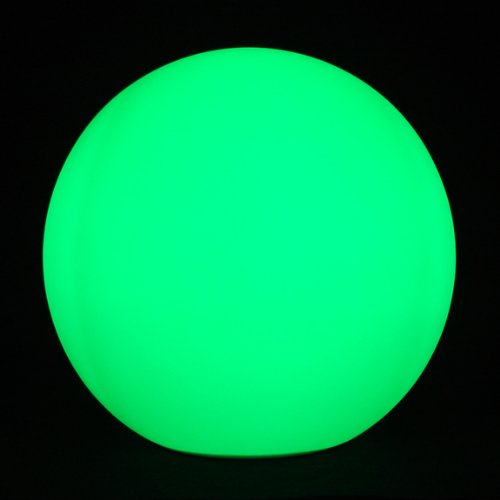
Knowing that I’m always happy to get something new and glowy, my wife brought home a cheap “floating pool light” that she found on sale for roughly $10. This is a large white floating ball that has LEDs inside and cycles through different colors. Meant to be put into a pool for neat effects, we found it to be much more interesting just used around the house.

However, it was a bit too bright and cycled colors too quickly for our taste. It was actually somewhat distracting when we were just trying to sit and have a few beers late at night on our patio. This gave me a perfect excuse to tear it apart and start hacking… like I wasn’t going to do that anyway.

What I found inside was extremely simple. There’s a single un-marked chip that holds the different display modes (there were 3 display modes: warm, cool, and white). The LEDs were arranged in an array of Reds, Blues, Greens, and Whites (half marked yellow).

Continue reading “Hacking A Floating RGB LED Decorative Ball”