

Linux Kernel Drops AI Tag Requirement, Uses Meta AI For Code Reviews

Since we last covered the way that the Linux Kernel project has been dealing with the influx of code created using LLM-based coding assistants, all the way back in April, things have changed a lot, with most recently the Linux maintainers deciding to fully drop the requirement to mark LLM-assisted commits with the Assisted-by tag.

While not a fully uncontroversial decision – as also reported by Phoronix – with key maintainers already having made this decision it seems certain to proceed. This is not the only change made fairly recently, with a ‘Sashiko’ bot introduced that is supposed to handle code reviews.

In a July LKML post [Linus Torvalds] defends this decision, with a follow-up post in August by [Jakub Kicinski] it being stated that budget has been secured for using Meta’s LLMs, using said LLM-based resources for reviewing patches, as well as creating and editing commit messages. As noted by [Jakub] they’re running multiple frontier models on each patch to try and weed out confabulations.

Whether this will prove to be the right decision remains to be seen. Whereas most open source projects have firmly banished or heavily curtailed LLM-based contributions on slop, copyright as well as licensing grounds, the Linux Kernel project may be an interesting experiment in what the outcome of the exact opposite approach will be.
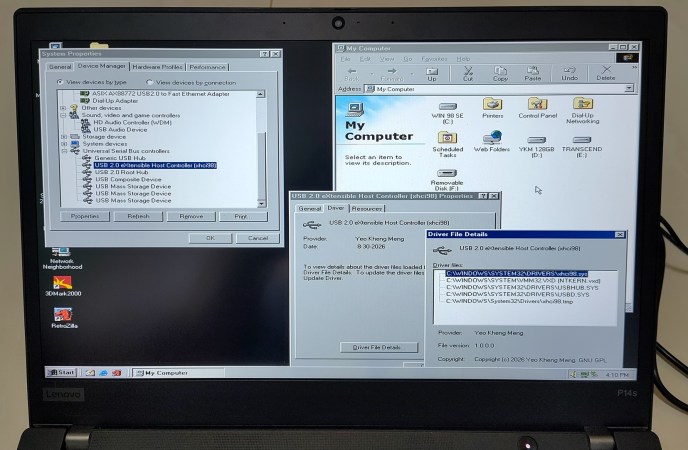

Modern USB Controllers On Win98 (and Up)

[Yeo Kheng Meng] has a problem: he likes Windows 98, but he also likes his 2020 ThinkPad, which only has an xHCI USB controller– you know, the kind needed for USB 3.0, something that post-dates Windows 98 by a full decade. Drivers? Finding none existed, he decided to do it himself, or at least guide the process of using  LLMs to produce drivers for Windows 98 and up.

Some of you just stopped reading, but can you blame him for making a demonic pact for this project? Driver development isn’t really a one-man show, especially as a part-time hobby project you’re not sure anyone else will ever use. If you do want to use it, you can find the code on GitHub.

It does work, though, he admits it might be buggy. Unlike purely vibe-coded projects, [Meng] intends to address bugs put forth in the repo, at least. If you want to know how he did it, check out the link to [Meng]’s blog– which is human-authored, we can tell– and the videos embedded therein. He demonstrates it working on a 2020 ThinkPad, which should be usable even with Windows 11, and another model from 2016– neither of which have any old-style USB ports. Older laptops might, while any desktop can just use a PCI card with a USB2.0 controller– or you can do like [Meng] did prior to this project, and use the PCI card via adapters. 

[Yeo Kheng Meng] evidently gets as much of a kick out of joining old and new as we do, like running DOS a modern ThinkPad X13, and running Slack on Windows 3.11 For Workgroups on a slightly-less-modern but still 21st Century Thinkpad T400.








