Tech In Plain Sight: Meet The Robot That Does CPR

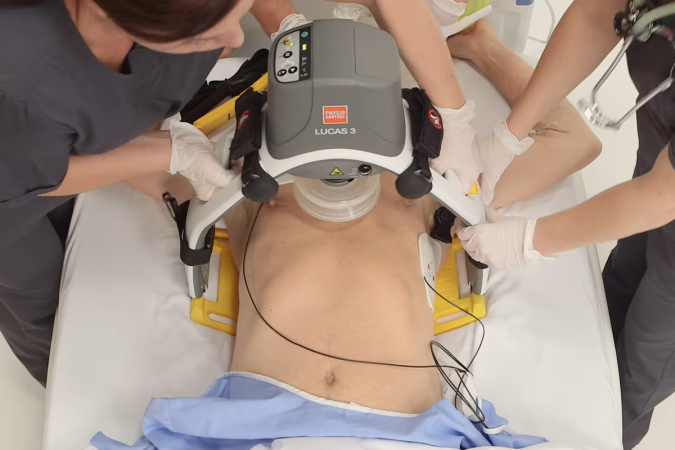
Usually in Tech In Plain Sight, we talk about technology you probably see every day, even if you don’t notice it. But we hope you don’t get to see one of the latest crop of medical robots, such as the LUCAS chest compression system. If you watch the popular TV series “The Pitt”, though, you may have caught a glimpse of one of these medical marvels. They aren’t fiction. They are very real devices.

Calling them robots might be stretching the definition a little. They don’t roam the halls looking for patients. But once attached to someone in cardiac arrest, they can take over one of the most important — and physically demanding — parts of CPR: chest compressions.

Keep The Blood Moving

When someone’s heart stops pumping blood, time is critical. CPR doesn’t normally restart the heart on its own. Instead, chest compressions produce enough blood flow to keep oxygen reaching the brain and heart while rescuers work on the underlying problem and, when appropriate, use a defibrillator.

Doing that well is harder than it looks on television. Current American Heart Association guidelines call for adult chest compressions 100 to 120 times per minute, at least 5 cm deep but generally no deeper than 6 cm, while allowing the chest to recoil fully between compressions. Interruptions should be kept to a minimum.

That’s hard physical work. In fact, studies show compression depth begins to fall after only about 90 to 120 seconds, which is one reason CPR teams normally swap compressors every two minutes. But a robot doesn’t get tired.

Continue reading “Tech In Plain Sight: Meet The Robot That Does CPR”
Hyundai Mini 45 EV Is A Small Car With Grand Ambitions

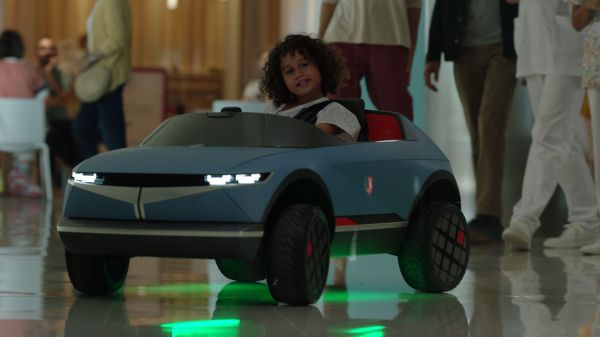
One of Hyundai’s recent concept cars was an electric vehicle named “45” in honor of its inspiration, another concept car from 45 years ago. When footage of a child-sized “Mini 45” surfaced, it was easy to conclude the car was a motorized toy for children. But Jalopnik got more information from Hyundai about this project, where we learned that was not nearly the whole picture.

The video (embedded below) explained this little vehicle is a concept car in its own right, and most of the video is a scripted performance illustrating their concept: using technology to help calm young patients in a hospital, reducing their anxiety as they faced treatment procedures. Mini 45 packs a lot more equipment than the toy cars available at our local store. The little driver’s heartbeat and breathing rate are monitored, and a camera analyzes facial expressions to gauge emotional stress. The onboard computer has an animated avatar who will try to connect with the patient, armed with tools like colorful animations, happy music, candy scent dispenser, and a bubble-blowing machine.

Continue reading “Hyundai Mini 45 EV Is A Small Car With Grand Ambitions”

Swallow The Doctor — The Present And Future Of Robots Inside Us

I recently finished the Silo series by Hugh Howey, a self-published collection of novellas that details life in a near-future, post-apocalyptic world where all that remains of humanity has been stuffed into subterranean silos. It has a great plot with some fun twists and plenty of details to keep the hacker and sci-fi fan entertained.

One such detail is nanorobots, used in later volumes of the series as both life-extending tools and viciously specific bio-weapons. Like all good reads, Silo is mainly character driven, so Howey doesn’t spend a lot of eInk on describing these microscopic machines – just enough detail to move the plot along. But it left me wondering about the potential for nanorobotics, and where we are today with the field that dates back to Richard Feynman’s suggestion that humans would some day “swallow the doctor” in a 1959 lecture and essay called There’s Plenty of Room at the Bottom.”

Continue reading “Swallow The Doctor — The Present And Future Of Robots Inside Us”