Singing House Lights Up Halloween Again This Year

[KJ92508] is flooding the neighborhood with light again this year. Everyone knows of that one house in town that really goes all out, but few put on a show anything like this one. The four Jack-o’-lantern faces lead the way with the opening sequence from A Nightmare Before Christmas. Each has at least four different mouth poses, and two eye orientations which are surprisingly well synchronized with the audio. The image above shows mostly orange lighting, but the home is outfitted with addressable RGB LEDs for a full color performance. In fact, it has seen an upgrade this year, increasing the channels by eight-fold to 1144! Don’t miss the performance which we’ve embedded after the break.

We had considered not featuring this, since we looked in on the same home last year. But the number of tips that rolled in made us think that a lot of you missed it, or are just delighted by the multitude of blinky lights. Either way, it’s worth the four minutes out of your day– it will either put a smile on your face, or make you glad not to live across the street from this guy.

Continue reading “Singing House Lights Up Halloween Again This Year”

Wireless Hackerspace Music Control

skipbutton_bitlair.nl

The crew at the Netherlands-based Bitlair hackerspace love their music, and have set up a digital jukebox for their workshop using mpd and fookebox. One problem that you run into with a bunch of different people working in one place is that everyone has their own distinct taste in music. The rhythmic “wub wub wub” of Dubstep might be great for some while leaving others trying to solder while simultaneously covering their ears. To ensure that everyone can exercise a musical veto (a la Empire Records) now and again, they built a Skipbutton which allows members to change what’s playing.

The button allows users to skip to the next song in the queue. as well as to control the volume of the space’s sound system. It uses an Arduino pro mini to run the show, sending signals to the mpd daemon using a 433 MHz transmitter. Bitlair is pretty large and they often spend time outdoors, so they had to ensure that the Skipbutton worked wherever they did. To do this, they built a Yagi-Uda antenna at the receiving end to ensure that the button functions no matter where it’s being triggered from.

Check out their wiki if you’re interested in making a similar system for your home or hackerspace – all of the code and schematics are available for the taking.

Analog IPhone Amplifier Made From Recycled Trumpets

analog_telephonographer

It’s no secret that the audio quality of the iPhone’s built-in speakers isn’t exactly what you would consider to be hi-fi. Sound quality aside, there are plenty of times where even the volume doesn’t do the music justice. While you can always go out and buy a fancy dock to amplify your iGadget’s sound, artist [Christopher Locke] has a different take on the subject.

For a while now, he has been constructing what he calls “Analog Tele-Phonographers”, metal sculptures that can be used to amplify a mobile phone’s audio. Built out of steel and old trumpets, his audio sculptures require no electricity, instead utilizing the same amplification technology as the original phonographs.

While the Tele-Phonographers won’t make your iPhone sound like a high quality tube amp, they do undoubtedly increase the phone’s volume and they are nice to look at. We can certainly get behind this sort of recycling/reuse of old items.

Continue reading to see a quick video of his Analog Tele-Phonographer in action.

[Thanks, Chris]

Continue reading “Analog IPhone Amplifier Made From Recycled Trumpets”

magic_music_table_accessible_jukebox

Magic Table Gives Disabled Child Control Over Her Music

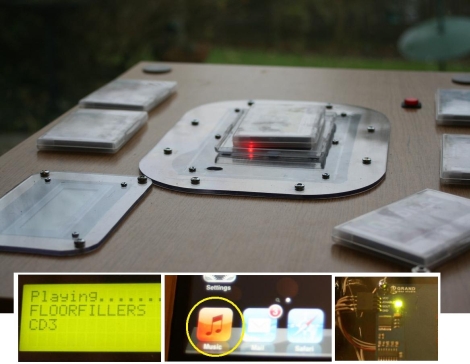
Instructables user [XenonJohn] recently put together a fantastic tutorial detailing how he made an RFID-controlled jukebox. The Magic Music Table was created for a disabled child, who is unable to use a CD payer, nor navigate small buttons and menus on MP3 players. He originally though about making the buttons more accessible a la the Frankenkindle, but ultimately settled on making the table instead.

Embedded in the center of the Music Table under a piece of plexiglass is a small project box containing an iPod, Arduino Mega, and a Parallax RFID reader. He crafted small RFID “bricks” that can be waved over the RFID reader, triggering the iPod to play a specific album from a large playlist. The Arduino acts as the middleman, controlling the RFID reader and relaying the appropriate information to the iPod when required.

The system looks pretty sturdy, and [XenonJohn] says that it works great. We think it’s a wonderful use of technology – you certainly can’t argue with brightening up a child’s day.

Continue reading to see a video of the Magic Music Table in action.

Continue reading “Magic Table Gives Disabled Child Control Over Her Music”

Star Wars Imperial March Played By Dual Floppy Drives

Although many have made some sort of music with improvised electronics, few sound as cool as this Imperial March from Star Wars played by two floppy drives. According to [Pawel], “It’s nothing new” and quite simple. This may be true as we’ve featured an Imperial March-playing floppy drive here before, but it was only one drive. Although it may not be the London Symphony Orchestra, the two drives together sound quite good!

According to him, the FDD has a fairly simple interface. To move the head, one simply needs to pull the DRVSB pin low and then activate the STEP pin on a falling edge.  This will make the head move one direction dependent on the DIR pin state. In this case, an ATMega microcontroller is moving everything. An explanation of the pins used in this hack can be found here.

Although it may look like an intimidating hack on the surface, something like this might be a neat project to try with some old hardware and an Arduino or other controller! [Pawel] did have the idea to hook up a 5 1/4″ and 8″ drive to make a full FDD orchestra, so we can’t wait to see what he comes up with! Continue reading “Star Wars Imperial March Played By Dual Floppy Drives”

Broken Vintage Record Player Reborn As A Portable MP3 Cabinet

old_record_player_pc_jukebox

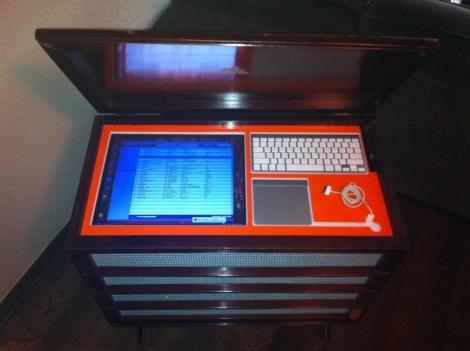
[Julian] picked up an old record player that was sitting in somebody’s trash pile, and brought it home to see if it could be restored to working order. When he got it home he discovered that it didn’t work at all, so he and his wife decided to modernize it a bit.

In an effort to simultaneously reunite himself with his music collection and piss off audiophiles/antique collectors in the process, he gutted the radio and began rebuilding it to serve as an MP3 jukebox. Once the innards were removed, his wife refinished the cabinet and gave the front grill a new cloth cover.

An old PC was installed inside the cabinet, along with a set of relatively cheap (but better than paper cone) speakers. A pair of custom cut plexi panels were used to cover the computer, while providing space for the monitor and Apple wireless keyboard + trackpad [Julian] uses to manage the jukebox.

The refurbed record player came out looking quite nice, and although it likely raises the ire of several different groups of purists, we think it’s pretty cool.

Improved FPGA Synth

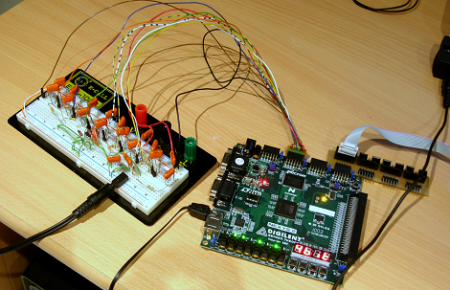
A week or so ago we featured an FPGA MIDI interface. Since then the builder has gone crazy with his FPGA and revised his code to include polyphony and PWM output, and posted a polyphony demo.

In our previous coverage of the build, the synth was monophonic, and the MIDI implementation was pretty shaky. After realizing the hard work was done, [Mich] re-wrote the MIDI interpretation module to keep 8 voices in memory. Now the synth can play 16th note arpeggios at 999bpm.

The original build used 8 pins to output the audio with an R/2R ladder for a digital to analog converter. This didn’t work well with a polyphonic synth (everything was clipped or noisy), so [Mich] moved to PWM output.

Continue reading “Improved FPGA Synth”