FPGA Plays Mario Like A Champ

fpga-controls-mario-bros

This isn’t an FPGA emulating Mario Bros., it’s an FPGA playing the game by analyzing the video and sending controller commands. It’s a final project for an engineering course. The ECE5760 Advanced FPGA course over at Cornell University that always provides entertainment for us every time the final projects are due.

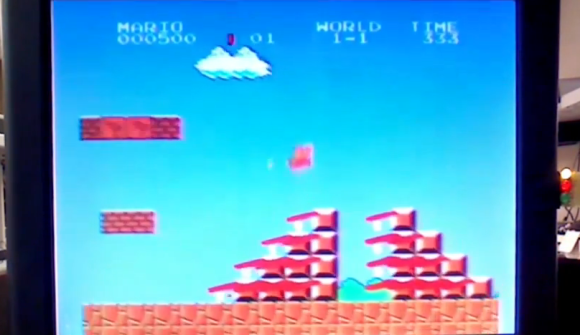
Developed by team members [Jeremy Blum], [Jason Wright], and [Sima Mitra], the video parsing is a hack. To get things working they converted the NES’s 240p video signal to VGA. This resulted in a rolling frame show in the demo video. It also messes with the aspect ratio and causes a few other headaches but the FPGA still manages to interpret the image correctly.

Look closely at the screen capture above and you’ll see some stuff that shouldn’t be there. The team developed a set of tests used to determine obstacles in Mario’s way. The red lines signify blocks he will have to jump over. This also works for pits that he needs to avoid, with a different set of tests to detect moving enemies. Once it knows what to do the FPGA emulates the controller signals necessary, pushing them to the vintage gaming console to see him safely to the end of the first level.

We think this is more hard-core than some other autonomous Mario playing hacks just because it patches into the original console hardware instead of using an emulator.

Continue reading “FPGA Plays Mario Like A Champ”

Reading Game Boy Carts With I2C

rasgame

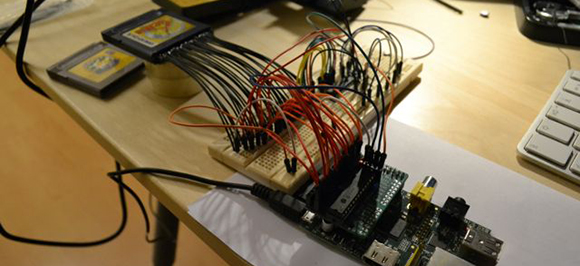
After seeing a Game Boy emulator for the first time, [Thijs] was amazed. A small box with just a handful of electronics that turns a Game Boy cartridge into a file able to be run on an emulator is simply magical. [Thijs] has learned a lot about GB and GBC cartridges in the mean time, but still thinks the only way to really learn something is to roll up your sleeves and get your hands dirty. Thus was born [Thijs]’ Game Boy cartridge dumper, powered by a pair of I2C port expanders and a Raspberry Pi.

Inspired by a build to dump ROMs off Super Nintendo games with the help of a Raspberry Pi, [Thijs] grabbed all the hardware necessary to create his own GB cart dumper. A DS Lite cartridge adapter provided the physical connection and a pair of MCP23017 I/O expanders – one soldered to a Slice of PI/O board – provided the electrical connections.

In the end, [Thijs] managed to dump the ROMs off the Japanese editions of Pokemon Yellow and Gold in about 13 minutes. This is a much slower transfer rate of 26 minutes per SNES cart in the post that gave [Thijs] the inspiration for this build. Still, [Thijs] will probably be the first to say he’s learned a lot from this build, especially after some problems with dumping the right banks from the cartridge.

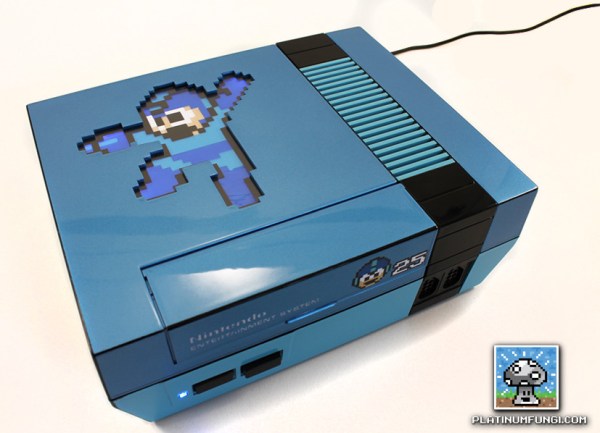
Beautiful Modded NES For The 25th Anniversary Of Mega Man, Plus Bonus Interview!


Today I had the pleasure of interviewing [PlatinumFungi] about this fantastic NES mod he did. This year is the 25th anniversary of the first Mega Man video game. Unhappy with the current celebratory actions of capcom, [PlatinumFungi] set out to create something he felt was worthy. He managed to pull that off pretty well.

The NES you can see in the video is fantastic looking. It has a beautiful shiny automotive finish, supplied by [Custom NES Guy] and a pixel perfect backlit Mega Man on top. Additional enhancements are stylized decals on the front of the game bay and matching labels on the sides and back. The cartridge is even illuminated while it is in place.

Check out some pictures after the break!

Continue reading “Beautiful Modded NES For The 25th Anniversary Of Mega Man, Plus Bonus Interview!”

Drop-in Pcb Makes Nintendo Four Score A USB Joystick

The Nintendo Four Score was a controller attachment for the original Nintendo Entertainment System which allowed you to use four controllers at one time. [Simon Inns] wanted to use some original NES controllers on his computer so he developed a drop-in replacement board that converts the device to USB.

As we’ve seen with other NES controller hacks, the hardware uses a simple parallel to serial shift register to deliver key-presses to the console. This means that reading four controllers at a time is no different than shifting in data to a microcontroller from the four different sources. The remaining portion of the problem is providing a USB connection that enumerates the device as a joystick. We’ve seen a bunch of USB projects from [Simon] so it’s no surprise that he was able to pull it off.

He went with the ATmega16U2 which has built-in support for USB. [Simon] wrote the code so that although there is only one USB cable, each of the four controller ports will appear as a separate USB joystick on the computer. To button up the project he carefully measured the original board and laid out his own version so that it fits the footprint of all the original components as well as the mounting brackets on the case. Top notch [Simon]!

Mining Bitcoins On A Nintendo

NES

His friends know [gbg] as an aficionado of just about anything with a 6502 processor in it. He’s also interested in bitcoins. A while back, a friend asked if it would be possible to mine bitcoins with an old Nintendo Entertainment System. While this suggestion was made in jest, it’s not one of those ideas anyone can let go of easily. Yes, it is possible to mine bitcoins with an NES, and [gbg] is here to show us how.

Mining bitcoins is simply just performing a SHA256 hash on a random value from the bitcoin network and relaying the result of that calculation back to the Internet. Of course this requires an Internet to NES bridge; [gbg] brought in a Raspberry Pi for this task. There’s the problem of actually getting data into an NES, though, and that’s something only a USB CopyNES can handle. After doing some 32-bit math, the NES sends this out to the Raspberry Pi and onto the bitcoin network.

When you consider that even a high-end gaming computer has little chance of mining a bitcoin in any reasonable amount of time, there’s little chance RetroMiner will ever be able to mine a bitcoin. It’s all random, though, so while it’s possible, we’ll just appreciate the awesome build for now.

A Brick-sized Game Boy Advance SP

gameboy

For a few years now, [Michael] has wanted to put the guts of a Game Boy Advance – the small clamshell version with a backlit LCD – into the classic and comfortable DMG-01 ‘brick’ Game Boy. He’s finally finished with his project, and we’ve got to say it’s looking pretty good.

The build began by excising the backlit LCD from an old clamshell Game Boy Advance and hot gluing it to the screen bezel of an old DMG-01. The cartridge slot from the original ‘brick’ Game Boy remained, but this design decision did require a fair bit of soldering and a length of ribbon cable.

Since [Michael] is using the original cartridge slot found in the original Game Boy, he can’t play any games in the smaller Game Boy Advance cartridge format. Still, it should be possible to build an adapter to fit those smaller cartridges inside the larger Game Boy, and he can always play Tetris and Little Sound DJ, so nothing of value is lost.

Building A Better NES

NES

The first model of the NES wasn’t all that great; just ask any one of the millions of six-year-olds who independently discovered blowing on a cartridge made it work. The second NES hardware revision, the top loader, was better but only had RF video output. These are the only two pieces of hardware that can play every single NES game, and even with years of hacking NES-on-a-chip devices, there’s still much to be desired.

[low_budget] over on the AtariAge forum decided he’d had enough of these hardware compromises and decided to build the first new NES hardware revision in 20 years. It’s got all the best features from both of its predecessors and a few new features not seen on any existing NES. There’s support for composite and RGB video generators, new and better amplifiers for the audio, no lockout chip, and a top loading cartridge slot to prevent bent pins on the 72 pin connector.

While [low_budget]’s prototype works, it only does so by salvaging the CPU and PPU from a working NES. There’s still much work to be done on the prototype, but even if we’ll have to destroy our beloved NES, we’d love to get our hands on one of these improved consoles.