nes_cart_building

Creating NES Cartridge Clones From ROM Dumps

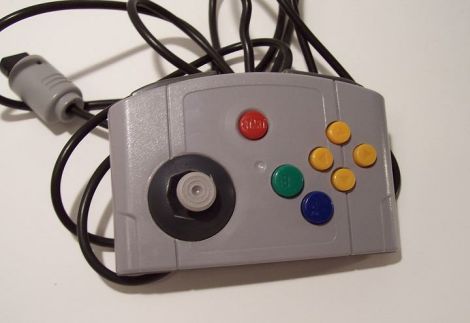
Sometimes emulators just don’t cut it when you want to play a vintage game. Like it or not, some people enjoy the nostalgia of playing old games on the actual hardware for which it was designed.

[Callan] wrote in to share a method he has been using to make some of his own NES game cartridges from ROM dumps in order to play them on an honest to goodness NES console.

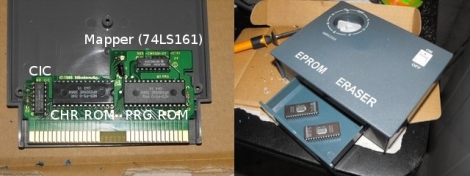
He starts out with a 190 in 1 game cartridge, where he found a neat Famicom game never released in the US. He decided he would patch the ROM he found on the multicart in order to have an English menu, and then create his very own cartridge from the image. He discusses how to identify which EPROM chips you will need in order to construct your cartridge, as well as some helpful ways of finding a donor cart that has a similar enough board to house your components.

[Callan] also provides a quick walkthrough of erasing and burning your new EPROM chips, before discussing some post-soldering troubleshooting steps you might need to take before your game will work properly.

While we can’t comment on the legality of these game clones, we still think it’s pretty awesome.

Be sure to check out his site for a far more in-depth discussion of the process if this is something that interests you.

Awesome Portable N64 Keeps Your Games In Hand, Out Of Sight

n64_portable

[David] recently wrote us to share the portable Nintendo 64 he constructed with the help of the friendly people over at the ModdedbyBacteria forums. We are no strangers to N64 portables, as you may have noticed, but this one was just too good to pass up.

Sheathed in a metallic blue case, this console is an instant standout among the other portable N64 mods we have seen. As you would expect, he trimmed down an N64 console board and some various controller bits in order to fit them into the case, finishing it off with a 5″ PSOne display panel. A small fan protrudes out of the back side of the device, which seemed out of place at first. However, it not only keeps the console cool, but it can serve as a bit of a “kickstand” as well, if the console is placed on a flat surface. [David] also added a dongle for the bottom of the console, which allows him to use an external N64 controller if he so desires.

To be honest, one of our favorite features is that the game cartridges do not stick up from the back of the case when inserted. He included just enough room to allow the game to be completely hidden while playing.  Nice job!

Continue reading to see a video build log and demonstration of his portable N64.

Continue reading “Awesome Portable N64 Keeps Your Games In Hand, Out Of Sight”

Nintendo Hacked To Fit Inside An NES Cartridge

nintendo_meta_console

Instructables user [dany32412] recently built what is arguably one of the smallest NES consoles we have seen to date. Using a Nintendo on a Chip (NOAC) board, he has fabricated an NES system that fits inside a hollowed out NES cartridge.

He purchased a NOAC system at a local resale shop and got to work disassembling it. As most of these devices typically consist of a game system built into the controller with a Famicom game slot added for good measure, he knew he had a lot of work ahead of him if he was going to convert it to work properly with actual NES games and controllers.

He hacked apart most of the NOAC’s board, leaving just the CPU and the controller interface chip. He then built a custom controller interface board in order to properly map his NES controller’s buttons to the pads on the NOAC. He wired in a 72-pin NES cartridge slot, then added a pair of controller ports and a power switch. Once he had everything connected and tested, it was all secured in a Super Mario Brothers NES cartridge.

Check out the video below of his mini NES in action.

If you can’t get enough Nintendo hacks, be sure to take a look at this portable NES as well as this emulator-based NES in a cartridge.

Continue reading “Nintendo Hacked To Fit Inside An NES Cartridge”

Portable NES Console Gets It Oh So Right

nes_portable

[Doug] over at the moddedbybacteria forums has been working hard on a fantastic looking portable NES console and wrote in to let us know it was complete.

The console started as a simple idea to use a Nintendo on a chip (NOAC) board in order to create a portable console that played original NES cartridges. Once a plastic case and some batteries were sourced, along with the NOAC board, the project was well on its way.

[Doug] eventually decided that he would rather use a real Nintendo motherboard in the project, so the NOAC was scrapped…temporarily. He accidentally fried the Nintendo board, so it was back to the NOAC, but with upgraded wiring to take care of some interference problems he was having earlier in the build. An original NES controller was disassembled for use in the console, which gives the portable an authentic feel. Getting the case to look just right was a long process, but we think he did a great job with it.

If you want to take a look at his entire build log, be aware that it is 23 pages long. If you’re impatient and want to jump straight to the unveiling, that happens on page 22.

Keep reading to see a pair of videos [Doug] put together both during the production and after his build was completed.

If you are interested in seeing some other portable NES consoles we have featured in the past, look no further than here, here, and here.

Continue reading “Portable NES Console Gets It Oh So Right”

Real Life Super Mario Coin Block

mario_coin_block

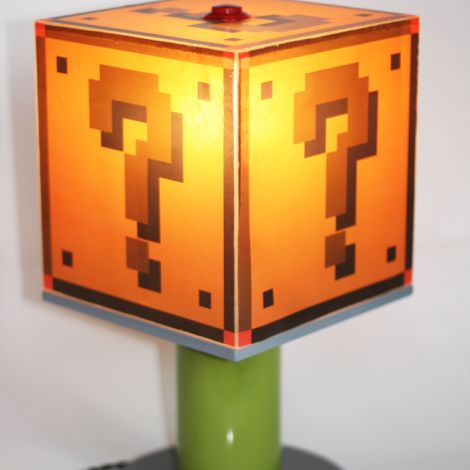
Instructables user [Bruno] recently constructed a fun little toy that brings a bit of the Mario nostalgia out of the video game universe and into ours. His Super Mario coin block is instantly recognizable from the first Mario game and performs just as you would expect it to. Punching or tapping the bottom of the block releases coins one at a time, complete with sounds straight from the game.

The coin block is constructed from thick cardboard and wrapped in color mock ups of the in-game block. Inside, a spring-loaded tube of coins is placed above a launch arm which is also connected to a spring. A servo actuated arm pulls the launch arm down, dropping a coin from its tube on to the launch arm which is then flung from the top of the box once the servo arm rotates far enough. When this occurs, the built-in MP3 player is triggered to play the “coin sound” from the game. A 555 timer is used to ensure the servo actuated arm rotates once per activation, and a LM386-based amplifier is used to increase the output volume of the MP3 player, both of which operate using rechargeable batteries.

Be sure to check out some of the inner workings as well as the final product in the videos embedded below.

[Thanks, Samjc3]

Continue reading “Real Life Super Mario Coin Block”

N64Boy Advance

[Hailrazer] found a Game Boy Advance carrying case in his closet and thought he could pull off an N64Boy Advance in a few weekends. Despite the fast build time, [Hailrazer] built something that wouldn’t look out of place sitting on a shelf at a toy store.

This isn’t the first time we have covered an N64 Advance portable gaming system that uses a GBA carrying case, but this hack keeps the original styling of the Game Boy Advance without all the epoxy, bondo and sanding. Inside is a 4.3″ screen, GameCube joystick, N64 expansion pack, and enough Li-ion to get 5-6 hours of play time. The build doesn’t include a D-pad because [Hailrazer] doesn’t use that while playing. It also doesn’t have controller or A/V ports, because he doesn’t, “want to sit around with friends playing N64 on a 4.3″ screen.” A very pragmatic build, indeed.

We love seeing people re-purpose odd bits of plastic they have lying around, so we’re wondering when someone with an Original Game Boy Carrying Case will build an NESBoy. Video after the jump.

Continue reading “N64Boy Advance”

Nintendo 3DS Teardown

The Nintendo 3DS has been out for a couple days now (in japan) and the folks over at [tech on] were nice enough to do a teardown. Besides all the regular teardown goodies you can also get a good look at the 3DS’ 3D screen with a microscope. Turns out its a parallax barrier display which means that there are slits on top of the LED array to create a 3D effect without the use of special glasses. The rest of the hardware seems pretty standard, running an ARM based processor with some DRAM and NAND flash. Apparently the 3DS didn’t get much of an upgrade (downgrade?) as far as DRM is concerned because there are already examples of the 3DS running pirated games using a R4 card on youtube.

[via engaget]

Continue reading “Nintendo 3DS Teardown”