SNES-001 Advance Puts Displays In The Controllers

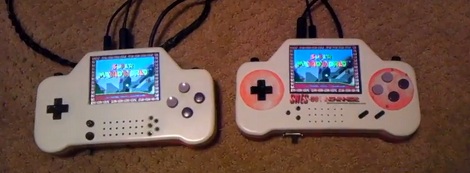
Twenty years ago, [Downing] would fight with his siblings over who got to watch TV. Obviously, this gave him the idea of putting a television inside his Super Nintendo controller, but at he tender age of 12, [Downing] had neither the experience nor skills to make that happen. Now that he’s older, and much less impressed by the Sega Nomad, [Downing] made his dream a reality.

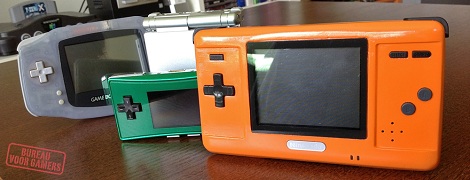
Reading over [Downing]’s madebybacteria forum thread, he began the build by adding two controller ports and painting the system a classic Famicom red and white. The prominent feature of [Downing]’s design – a display in each controller – are connected to the console through a second pair of SNES controller ports. Internally, the video signal generated by the SNES is broken out to each controller; the controller displays are just a small mirrored version of whats sent to the TV.

Like [Downing]’s previous Genesis portable, the SNES-001 is a master work of Bondo and vacuum forming. After the break you can see a few demos of what this console mod can do.

Continue reading “SNES-001 Advance Puts Displays In The Controllers”

The WiiKart, A Wireless Go Kart

Whoops… Looks like we covered this already. My mistake.

In case the name didn’t tip you off, this fun little kart was inspired by MarioKart. The goal was to build a functional go kart that could be controlled via the Nintendo Wiimote. They did a pretty good job and kept it fairly simple too. They designed a frame that vaguely mimics the shape of the carts in the game. The steering is handled by a 4″ stroke linear actuator. This was initially hooked directly to the tie-rod, but they found it to be too slow. Their solution was to put a lever in between the two with a 1to 3 ratio. This made everything much snappier.

Though they were capable of implementing PWM on the motors in their hardware, they opted to stick with full on, full off because of the push-button nature of the controller. The connection and communication are handled with an Arduino and they don’t mention what bluetooth module they use.

You can see in the video below it is fairly responsive and has more than enough power to lug a passenger over some varied terrain.

Continue reading “The WiiKart, A Wireless Go Kart”

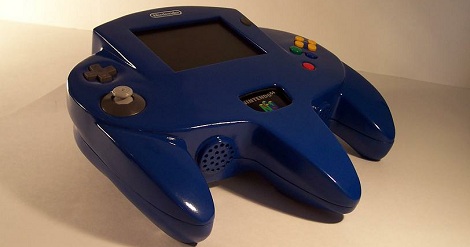
Miniaturized N64 Controller Fits The Tiniest Of Hands

n64-controller-mod

The controllers that came with the Nintendo 64 don’t exactly measure up to the “Duke” of Xbox fame, but they’re not the smallest in the world either. Made by Bacteria forum member [Bungle] says that his girlfriend has incredibly tiny hands, so he thought he might try trimming some of the fat from an N64 controller by cramming its components into an N64 cartridge.

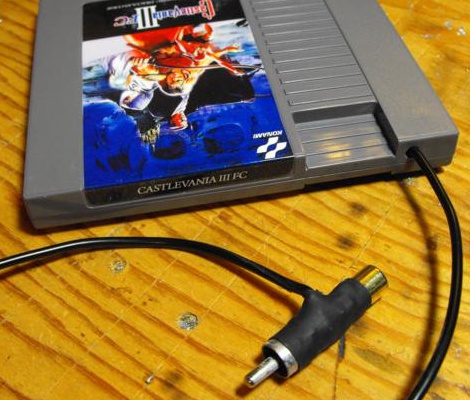
He tore down a 3rd-party N64 controller, tossing out the D-Pad, plug, and rumble motor, retaining all of the other buttons. After gutting the game cartridge, he heated the back side under a lamp and stretched the plastic over a roll of electrical tape to make room for the N64’s trademark “Z” button. Having only removed the rumble motor due to size constraints, he found a suitable replacement at Radio Shack, which fills in for the original nicely.

After a good amount of careful trimming, wiring, and mounting, he came up with the little gem you see above. We’re sure [Bungle’s] girlfriend is pleased with his work, and he seems happy with how it came out as well.

Continue reading to see a short video showing off [Bungle’s] latest creation.

[Thanks, Chris Downing]

Continue reading “Miniaturized N64 Controller Fits The Tiniest Of Hands”

Funtendo Connects All Your Nintendo Controllers To A PC

For those of us who can’t be bothered to dig out or N64 whenever we want to play Ocarina of Time or our NES whenever we get the urge to play Battletoads, emulators are a godsend. There is a problem, though. A keyboard doesn’t provide the right experience as a the classic NES ‘brick’ or the N64 tritopus controllers. Enter the Funtendo, a breakout box that converts all your well-loved controllers to USB.

The Funtendo uses the Gadget Gangster Propeller Platform with a terminal block module. Putting together the electronics is fairly easy; just strip the ends of the controllers and screw them down to the terminal blocks. N64, NES and Wii Classic Controllers are supported by the Funtendo. Going for the Classic Controller over a Super Nintendo controller reduces the complexity of the build. The Classic Controller can play SNES games and uses an I2C bus, making it easier to wire.

For interfacing the controllers to the computer, the Parallax Propeller Tool, Parallax serial terminal, and PPJoy convert button mashing into readable buttons for the emulator. The build may take more time than pulling an NES out of the attic, but even with a large project box it takes up much less space.

Check out the demo of the Funtendo after the break.

Continue reading “Funtendo Connects All Your Nintendo Controllers To A PC”

Playing SNES With An R/C Controller

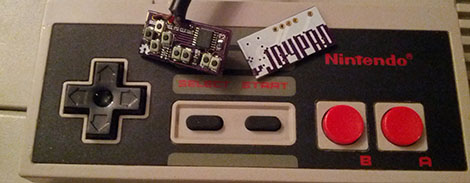
Normally when we see an R/C transmitter used in a build we’re prepared for robots, quadcopters, or UAVs. [Alex] found a new use for his Futaba radio – hooking it up to his Super Nintendo.

We’ve seen a lot of builds using game controllers as interfaces to other hardware. The N64 media remote comes to mind, as does the NES iPod dock. Outside of a few builds to automatically win in-game currency for you, we haven’t seen much of anything to control a video game with additional electronics. [Alex]’s build happily bucks that trend, and technically gives the SNES an analog controller.

The build uses an mBed microcontroller to capture the radio’s button and stick positions. This is sent through a two shift registers to produce the 16-bit packet required of the SNES controller protocol. [Alex] posted all the software for his build, and from the looks of it the code seems pretty portable. [Alex] says he’s working on getting his Sega Saturn running with his Futaba, so we can’t wait to see some Panzer Dragoon action. Check out [Alex] demoing his controller with Gradius III after the break.

Continue reading “Playing SNES With An R/C Controller”

Super Mario Coin Block Lamp Is A Nintendo Fanboy’s Dream Come True

super_mario_coin_block_lamp

[Laurence] was racking his brain coming up with potential birthday gifts for his friend when the idea of a Super Mario Bros. coin block lamp popped into his head. The block is constructed from drain pipe, a few pieces of plywood, some perspex, and a whole lot of awesome.

He wanted the lamp to make sounds when it was turned on and off, so he put together an audio circuit based on [LadyAda’s] WaveShield. His design is similar, though he swapped out the DIP packages for SOIC versions, adding a DAC, Op amp, and an audio buffer to fit his needs.

Once he had his electronics in order, he started construction of the lamp, painting the drain pipe green and mounting it under his light’s base. He built a large perspex box to serve as the coin block itself, printing the familiar graphics on tracing paper which he then glued into place. An arcade button adorns the top of the box, making for a very appropriate and fun light switch.

Be sure to check out the video below to see the lamp in action. We’re just a bit jealous of [Laurence’s] friend, and we sure wouldn’t mind having one of these in our office to sit alongside this mechanical coin block we featured a while back.

Continue reading “Super Mario Coin Block Lamp Is A Nintendo Fanboy’s Dream Come True”

Retro Video Games Sounds…for Your Toilet

super_mario_toilet

After reading about a Super Mario Brothers themed bathroom, [Jonathan] decided that it would be pretty cool to have his toilet play the “warp pipe” sound whenever anyone flushed.

He grabbed a small sound drop key chain on eBay and disassembled it to see how things worked. Once he figured out which solder pads corresponded to the warp pipe sound he added a few wires that, when shorted, trigger the sound effect.

He debated as to how the sound generator should be wired to the toilet, and was pretty reluctant to place the key chain inside the tank due to concerns about sound volume and water damage. He ultimately decided to trigger the sound effects using triboelectric charge, much like those touch lamps from the ’80s. He rigged up a simple circuit that is connected to both the toilet handle as well as the water intake valve on the wall. When someone touches the handle, the small charge that is present in their hand triggers the sound effect as you can see in the video below.

Instead of using a standard project box, he opted to build a small warp tube replica from cardboard and paper, which really brings everything together nicely.

While he says that the circuit is pretty sensitive, triggering at odd times or not at all, we still think it’s awesome.

Continue reading “Retro Video Games Sounds…for Your Toilet”