Xprotolab: Oscilloscope And Xmega Development Board

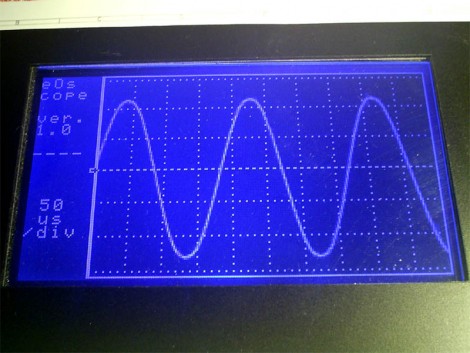
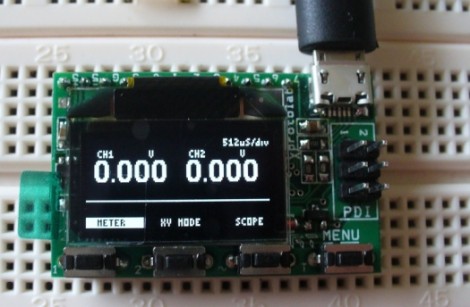
Here’s a nice hands-on overview of the Xprotolab, a development board based around the AVR ATxmega32A4 microcontroller. The tiny DIP package includes an OLED display, four tactile switches, and it can be powered via a micro USB connector. The device ships ready to use as a two-channel Oscilloscope, but check out how small it is in the video after the break to decide if this will actually be useful for you. It’s not that it doesn’t have a lot of features, in fact it’s packed with them, but that screen is quite small for meaningful work. Still, at $35 it’s an inexpensive way to get your hands on the hardware and acquaint yourself with this line of microprocessors. Not that in order to flash new firmware you will need a PDI capable programmer. Continue reading “Xprotolab: Oscilloscope And Xmega Development Board”
Double The Hertz, Double The Pleasure

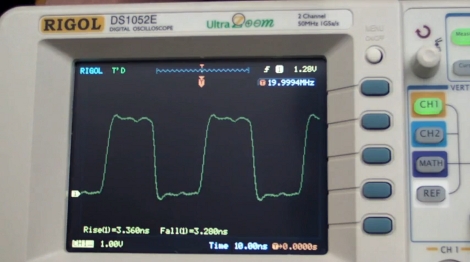
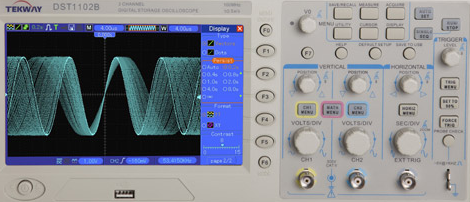
[tinhead] has opened up a Tekway DST1102B oscilloscope and doubled its bandwidth to 200MHz, sharing his work in the eevblog forum. This is great news to anyone who is looking for a faster sampling rate but can’t afford the high-end models. Mind you, for a lot of us even these Hanteks and Tekways are hard to afford but there are more appropriate options for the ramen-dependent hacker.

In the hacking guide [tinhead] includes comprehensive information on the different scopes he originally considered (a Rigol, Atten and UniTrend) before settling on the Tekway, as well as links to regional distributors for the hackable scope. Good quality benchtop units are invaluable for development and troubleshooting, and it pays off to understand their inner workings. It’s heartwarming to know that even the tools of hacking can be hacked.

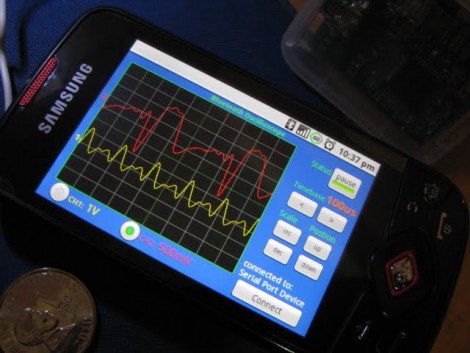
Android Oscilloscope

Here’s a 2-channel Oscilloscope for your Android phone. It uses a base module driven by a dsPIC for signal processing. From there, an LMX9838 Bluetooth module broadcasts the data to the phone so that the waveform can be displayed. [Yus] ported some Python code he had been using over to a set of Java and XML files in order to get it working on Android. This was actually the first time he worked with the SDK… we’d say he’s a quick learner. See it in action after the break.

Continue reading “Android Oscilloscope”

40 MSPS Digital Oscilloscope

If you can fabricate single-sided circuit boards at home you can build this digital oscilloscope. It uses mostly through-hole components with just a couple of surface mount chips to contend with. An ATmega162 handles the hardware end of things with a CPLD used to manage the sampling rate. Data is displayed on a 240×128 LCD display which will be the most expensive component to acquire. It’s still a lot cheaper than buying a commercially available oscilloscope, even if you get a base model and hack it to unlock all the features.

[Thanks Juan]

Update: 50MHz To 100Mhz Scope Conversion

Changing this 50MHz Rigol oscilloscope into its larger, more expensive brother just became quite a bit easier. When we originally looked at this hack it required pulling some capacitors off of the board. Now all it takes is three commands over a serial terminal connection.

Take a look at the walk through video after the break. You’ll see that there’s one chip that needs to be setup differently to change the functionality. Removing capacitors was actually changing the commands sent to initialize that chip at power-up. Now you can just change the model number and one letter of the serial number via a terminal and the firmware will recognize this as the more expensive DS1102E.

Continue reading “Update: 50MHz To 100Mhz Scope Conversion”

50MHz To 100Mhz Scope Conversion

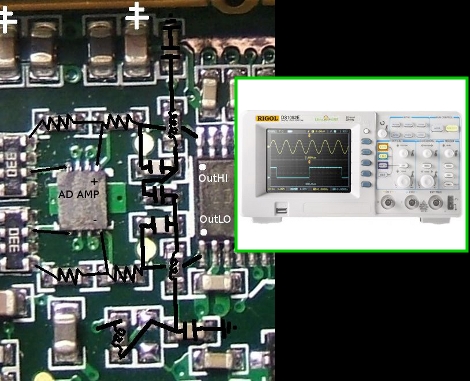
[Ross] is the proud owner of a 50 MHz Rigol DS1052E oscilloscope. He’d like to have the 100 MHz version but the $400 difference in price puts it out of his reach. After some extensive poking around on the PCB and pouring over datasheets, he managed to reverse engineer the design and upgrade to a 100 MHz version. This is as easy as desoldering one capacitor to deactivate a high-pass filter present in the lesser model of scope, unlocking the faster potential of its bigger brother.

USB Oscilloscope

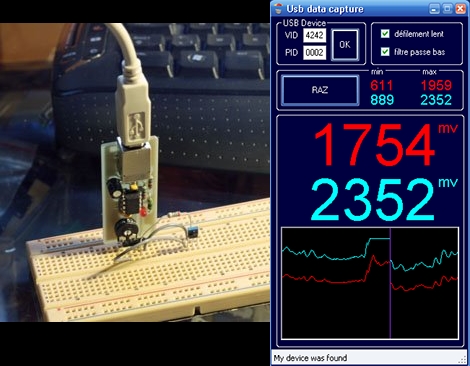
Here’s a USB oscilloscope project from a few years back. It’s easy to build on a single-sided PCB and very cheap because it uses just a handful of parts. At the center, an ATtiny45 microcontroller uses its ADC capabilities for the two traces and also handles the USB connectivity. The internal oscillator is used and trimmed up for accuracy by referencing the USB clock. On the PC side of things, a program written in C# displays the data coming over the serial bus. Quick, small, and useful; a schematic, board layout, firmware, and PC software sources are all available for download.

[Thanks Shri]