Oscilloscope Doubles As A Serial Terminal

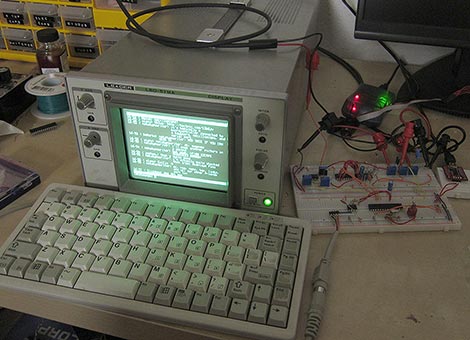
PC-based USB oscilloscopes are fast becoming all the rage. [Matt Sarnoff’s] Terminalscope takes the reverse approach, adapting an oscilloscope into a full serial terminal. You may have seen something similar before in the Dutchtronix/SparkFun O-Clock, but [Matt’s] project goes one further by adding a PS/2 keyboard port for full bidirectional serial communication, and with much sharper display resolution to boot.

The mostly VT-100 compatible Terminalscope is built around two AVR microcontrollers: an ATmega328P runs full-tilt to generate the video signal and handle serial I/O, while an ATtiny45 handles keyboard input to avoid interrupting the ’328’s duties. Rather than vector trace each character, a raster-scanning approach is used: the beam follows a fixed X/Y path (like a television), while modulating the Z input (beam intensity) to form an image. The device can be connected to a PC via serial port or USB-to-TTY adapter, or directly to another microcontroller to debug serial output.

We recently showed an oscilloscope being used as a multichannel digital logic display. The Terminalscope provides yet another use for this essential bench tool and could nicely round out a “poor man’s” testing setup. The schematic and full source code are available for download.
Use An Analog Oscilloscope To Display Digital Logic

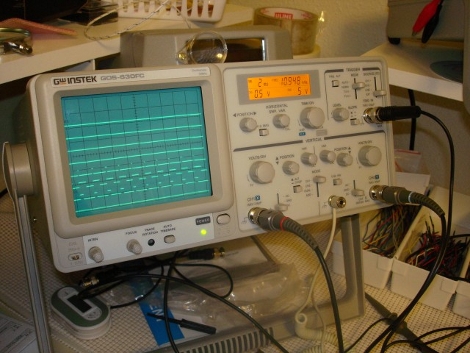
[Mike Bradley] wanted to use his oscilloscope to display 8 channels of digital signals. Alas, the analog unit didn’t have this capability. Not to worry, he threw together an adapter module that does the trick. Using a PIC 18F26K20 microcontroller he inputs four or eight channel digital logic (at 5V) and filters the output to an analog signal that the oscilloscope can interpret. What you see in the photo above is the result.

DSO Nano Oscilloscope Reviewed

dsonano

We’ve been eyeing Seeed Studio’s DSO nano digital storage oscilloscope with a mix of intrigue and skepticism. A pocket-sized $89 storage ’scope? This is a joke, right? Hack a Day reader [Blair Thomson] has written a thorough review based on his experience with one of the beta test units, and it might be a winner after all.

[Blair] feels the unit compares favorably to buying a similarly-priced secondhand analog oscilloscope. The DSO nano wins major points for ease of use, a good range of functionality, and of course the whole portability thing (the enclosure is a repurposed portable media player). Can’t say we’re entirely convinced though. As a single-trace ’scope with 1 MHz bandwidth, the DSO nano may be extremely limiting for anything but basic hobbyist use…which, to be fair, is exactly how they’re marketing it. We can see a place for this the same way there’s a place for $10 multimeters — an inexpensive, toss-in-the-toolbag second ’scope to quickly test for vital signs, something that might complement but not replace a good bench unit.

Text On An Oscilloscope

[youtube=http://www.youtube.com/watch?v=zLpfq4tHZxE]

This is an interesting little toy. A tiny board that can display text on an oscilloscope. The components, or rather just component, is a PIC16F628A. Aside from a power supply, that’s it. It can display 10 characters at a time and, as you can see above, scroll them as well. We don’t really know of a practical use for this, but it would make a nice practical joke tool. If you want some more complicated oscilloscope effects, check out Tennis for Two.

[via HackedGadgets]

Music Visualizer (oscilloscope)

musicscopetv

The Music visualizer is actually a second build based on an earlier design[Thanks Roger]. The build was influenced by Zyra’s How to make an oscilloscope out of a television. The hack is quite simple, patch the output of an amplifier into the vertical deflection coils of the CRT. This is a good use for that old TV you may have laying around  but don’t want to recycle it just yet. While on the subject we had covered the Mac SE/30 audio visualizer in 2006. For those looking for something a little more hard core, here is a bit about Homemade cathode ray tubes.

Bohemian Rhapsody On Old Hardware

[youtube=http://www.youtube.com/watch?v=Ht96HJ01SE4]

Here’s another junk music performance to add to the list. [bd594] put together this rendition of Queen’s Bohemian Rhapsody on assorted computing equipment. The lead piano sound is from an Atari 800XL. Lead guitar is a Texas Instruments TI-99/4a. An 8inch floppy plays bass while a HP ScanJet 3C covers the vocals. He had to dub the scanner four times to get all of the vocal parts. He wanted to use four independent scanners but the prices on eBay were forbidding. The use of oscilloscopes to show the wave forms in the video is a nice touch. Check out our post about Radiohead’s Nude for more examples of this.

[via adafruit]

Bouncing Ball Analog Computer

bounce

[Eric Archer] constructed an analog computer to model the physics of a bouncing ball. The core is a TL074 opamp that does all the integral math. He had no trouble finding descriptions of analog computers, but how to set the initial conditions was rarely covered. The controls include potentiometers to set the initial velocity, force of gravity, and coefficient of restitution (how much energy is lost in the bounce). The output is displayed on an oscilloscope. He mentions that this output could be used in electronic music, citing Aphex Twin’s Bucephalus Bouncing Ball. Watch the video below for a demo of all the features.

Continue reading “Bouncing Ball Analog Computer”