A Candle-Powered Game Boy For Post-Apocalyptic Tetris

We’re not exactly worried about Armageddon here at Hackaday, but should we end up facing the end of the world as we know it, having something to pass the time would be nice. That’s why we were intrigued by [Janus Cycle]’s latest video where he both plays and powers a Game Boy by candlelight.

You’ve probably figured out the trick already: he’s using a Peltier module as a thermoelectric generator. Candles, after all, release a lot more energy as heat than light, and all that high-quality heat is just begging to be put to use somehow. It’s hardly a new idea; [Janus] references space-age radioisotope thermoelectric generators (RTGs) in the video, but back in the day the Soviets had a thermoelectric collar that fit around a kerosene lantern to power their tube radios.
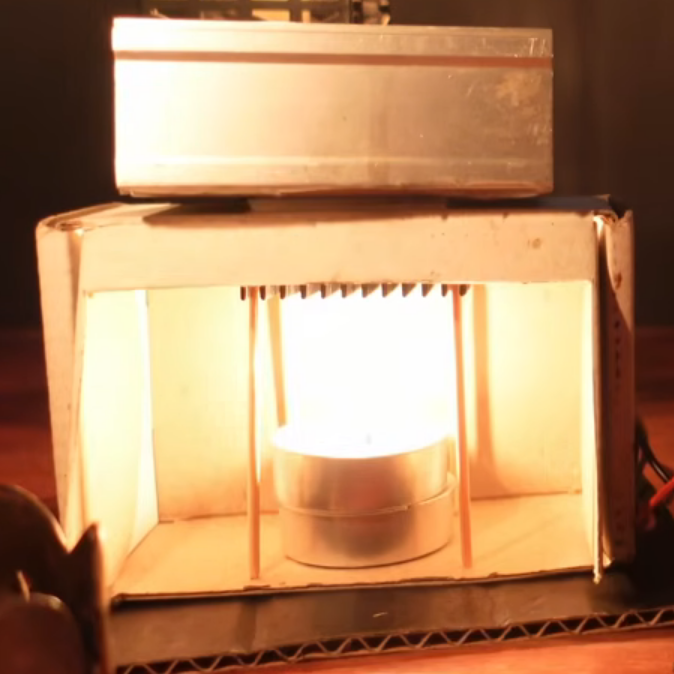
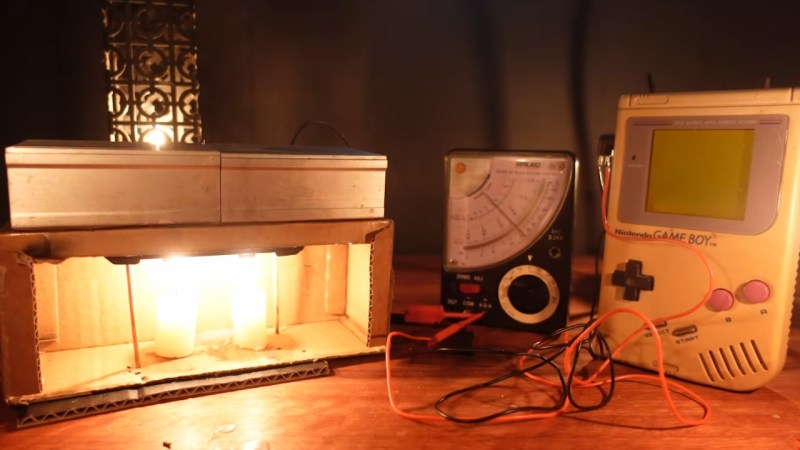
In [Janus]’s case, he’s using a commercial module sandwiched between two heatsinks with the rather-questionable choice of a cardboard box reinforced with wooden skewers to hold it over the candle. Sure, as long as the flame doesn’t touch the cardboard, it should be fine, but you will not be at all surprised to see the contraption catch fire in the video’s intro. For all that, he doesn’t get enough power for the Game Boy — one module gets him only 2 V with tea light, but he has a second module and a second candle.

Doubling the energy more than doubles the fun, since a working Game Boy is way more than twice as fun as an un-powered one. But one candle should be more than enough power, so [Janus] goes back and optimizes his single-Peltier setup with a tall candle and actual thermal grease, and gets the Game Boy going again. Any fire marshals in the audience should look away, though, as he never gives up on keeping a candle in a cardboard box.

The “power something with a Peltier module” project is probably a right of passage for electronics enthusiasts, but most are more likely to play with the irony of candle-powered LEDs, or fans to cool the cold-side heatsink. We did see a phone charger one time, and that didn’t even involve open flames, which seems much safer than this. Remember — no matter how much you want to game after the end of the world, it’s not worth burning down your fallout shelter.

Continue reading “A Candle-Powered Game Boy For Post-Apocalyptic Tetris

Better Solid State Heat Pumps Through Science

If you need to cool something, the gold standard is using a gas compressor arrangement. Of course, there are definite downsides to that, like weight, power consumption, and vibrations. There are solid-state heat pumps — the kind you see in portable coolers, for example. But, they are not terribly efficient and have limited performance.

However, researchers at Johns Hopkins, working with Samsung, have developed a new thin-film thermoelectric heat pump, which they claim is easy to fabricate, scalable, and significantly more efficient. You can see a video about the new research below.

Manufacturing requires similar processes to solar cells, and the technology can make tiny heat pumps or — in theory — coolers that could provide air conditioning for large buildings. You can read the full paper in Nature.

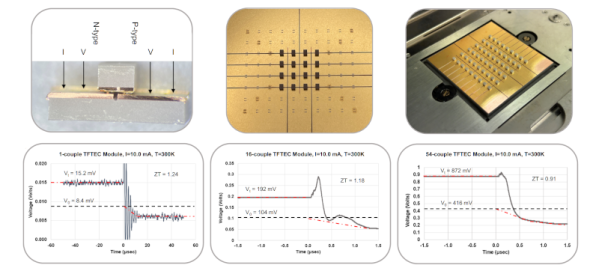
CHESS stands for Controlled Hierarchically Engineered Superlattice Structures. These are nano-engineered thin-film superlattices (around 25 μm thick). The design optimizes their performance in this application.

The new devices claim to be 100% more efficient at room temperature than traditional devices. In practical devices, thermoelectric devices and the systems using them have improved by around 70% to 75%. The material can also harvest power from heat differences, such as body heat. The potential small size of devices made with this technology would make them practical for wearables.

We’ve looked at the traditional modules many times. They sometimes show up in cloud chambers.

Continue reading “Better Solid State Heat Pumps Through Science”

A Flashlight Of Fire And Ice

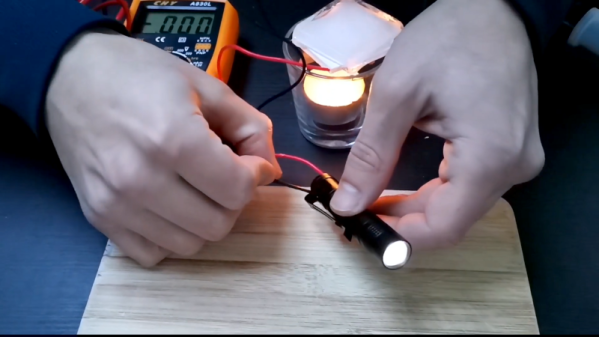
[Daniel Salião Ferreira] may or may not be a Game of Thrones fan, but he does have a fun demo of the Seebeck effect in the form of a flashlight powered by fire and ice. The basic idea is to use a thermocouple, but — in this case — he uses a Peltier effect cooler.

The Peltier and Seebeck effects are two sides of the same coin: the Peltier effect creates heating and cooling when current flows through a thermoelectric material. In contrast, the Seebeck effect generates a voltage when there is a temperature gradient. While thermocouples do produce voltage this way, they usually have much lower power output and are useless as heat pumps.

Continue reading “A Flashlight Of Fire And Ice”

DIY Mini Fridge Is Pure Brilliance In Foam

There’s nothing more pleasing on a hot day than an ice-cold beverage. While the vast majority of us have a fridge in the kitchen, sometimes it’s desirable to have a further fridge in the lab, games room, or workshop. To that end, you may find value in this ultra-cheap, low-cost DIY fridge build from [Handy_Bear].

Like many tiny fridge builds, this design eschews complex gas-cycle refrigeration techniques for simple Peltier modules. These are devices that have one cold side and one hot side, because they move heat when electricity is applied. This build uses a Peltier module fitted with a fan to better shift away heat from the hot side, improving the module’s cooling ability.

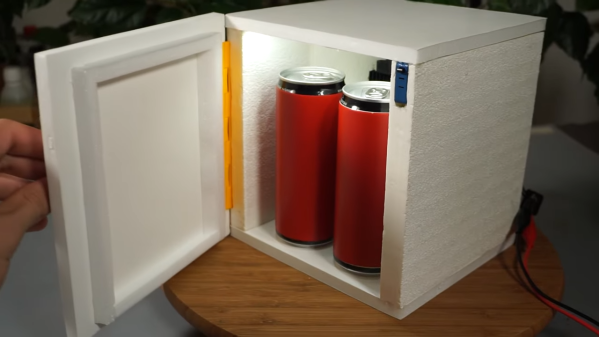
The “fridge” itself is assembled out of thick XPS insulation foam. A hot wire cutter was used to cut several slabs which were then assembled using hot glue. The Peltier module is installed on the back, at the top of the fridge. Thus, air which is cooled in this area will then travel down through the rest of the fridge’s cavity. [Handy_Bear] also goes over how to produce a working hinge and a gasket for the door, which helps with ease-of-use and efficiency. As a nice touch, a set of 12V LED lights are also installed inside, which light when the door is open. Just like the real thing!

The final build is noisy, slow to cool down, and it uses 60 watts of power to cool down just two regulation-sized sodas. Notably, you could fit two standard NATO smoke grenades in the same space, as they’re almost-identically sized (ask us how we know). However, smoke grenades don’t usually need to be refrigerated.

None of that means it isn’t fun though! Plus, [Handy_Bear] notes that adding a second Peltier would greatly aid the fridge’s ability to quickly chill your grenades sodas. You might even like to explore the use of special fan designs to make the fridge even quieter! Video after the break.

Continue reading “DIY Mini Fridge Is Pure Brilliance In Foam”