Intro To DC Motor Control Using The SN754410

So your electronic hobby skills are coming along quite nicely but you’re not very comfortable doing more than blinking a few LEDs. Now’s a good time to try something new by driving a couple of DC motors.

You probably know that you can’t just hook these up to the pins of your favorite uC and call it good. The motors draw a lot of current (especially if they’re strained in lifting a heavy load) which would burn out your logic circuitry. Add to this the excess induced current that is generated when a spinning motor is shut off and you’re going to need a control system that can handle these dangers.

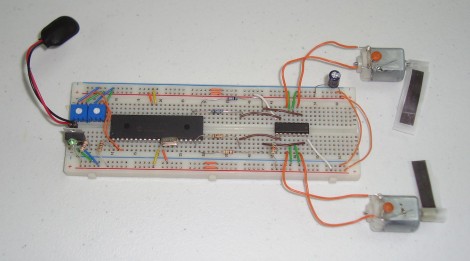
Enter the h-bridge motor driver. [Chris] has guided us through the process of building and using a H-bridge in the past. This time he’s using a motor controller that has four half H-bridges built into it. He hooks up the SN754410 to two motors, giving him speed and direction control for both based on the duty cycle of a PWM signal entering the chip for less than $2.50. Check out the video after the break for an overview of his methodology, then work your way through the multi-page post that he recently published.

Continue reading “Intro To DC Motor Control Using The SN754410”

IOIO Upgrades Get A Bit Easier

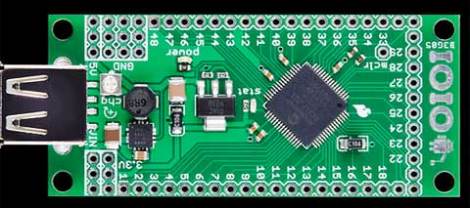
The IOIO, a breakout board for Android phones that predates the Android Developer Kit hardware, is a now a little bit easier to upgrade. That’s because [Ytai’s] IOIO manager app just his the Android market. The PIC24F that sits proudly on top of the board has always been running a bootloader, but for security reasons it is programmed to only talk to apps that have been officially signed. Now that there’s an app that meets this qualification, you can upgrade the firmware from your phone without the need for an external programmer.

What about the bootloader itself? Surely that will need upgrades over time, right? Well, yes. [Ytai’s] announcement today also came with an option for upgrading the bootloader but with one caveat. You’ll need two IOIO boards to complete the upgrade. One connects to the phone and becomes a programmer, while the other lays back and waits for a refreshing code flash.

Automotive Battery Voltage Monitor

car_battery_voltage_monitor

[Rajendra’s] car had just about all the bells, whistles, and gauges he could dream of, but he thought it was missing one important item. In an age where cars are heavily reliant on intricate electrical systems, he felt that he should have some way of monitoring the car’s battery and charging system.

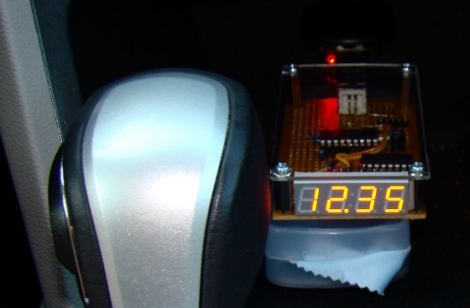
To keep tabs on his car’s electrical system, he built a simple device that allows him to monitor the battery’s instantaneous voltage when the car is powered off, as well as the charging voltage across the battery when the car is running. A PIC16F1827 runs the show, using a simple voltage divider network to step the input voltage down to an acceptable level for use with the PIC’s A/D conversion channel. The resultant measurements are output to a four digit 7 segment display, mounted on the front of the device.

He says that the voltage monitor works quite well, and we’re sure he feels a lot better about the health of his car’s charging system. For anyone interested in keeping closer tabs on their car, he has a circuit diagram as well as code available on his site.

Faux LED Scroller Using Phosphorescence

poor_mans_phosphorescent_led_scroller

Hackaday reader [BGR] wrote in to share a video he put together showing off a cool “poor man’s LED scroller” that he built. Rather than build a huge array of LEDs, spending tons of time time wiring and programming, he decided to use only a handful of LEDs on a moving display instead.

The scroller is built upon a PIC16F887 microcontroller which resides on an EasyPIC6 dev board he borrowed for the project. The PIC controls a strip of eight bright white LEDs, which are used to write text on a long strip of phosphorescent paper that can be found at many printing supply outfits. The paper’s dispensing mechanism was cobbled together with parts from several sources, including  a laser printer and VCR.

When he wants to display a message, he inputs text into a flash application he wrote. The app sends the LED byte values to his scroller via a separate serial proxy that talks to the pic over his computer’s COM port.

The effect is pretty slick, looking similar to a slow-moving diffused LED scroller. The messages disappear after about 5 minutes in a pitch black room, which is perfect, since he originally intended to use the device for displaying Twitter updates. He is already considering a second revision of the project, which he wants to mount on the wall – sounds great to us!

Be sure to swing by YouTube to see the video, or continue reading to watch it here.

Continue reading “Faux LED Scroller Using Phosphorescence”

Playing Chess On A Microcontroller

[Arthur Benemann] started a little project for his electrical engineering program, and suffered the worst case of feature creep we’ve ever seen. He just posted an instructable of his picChess project that is able to play chess on a VGA monitor with a keyboard, with sound, a clock, temperature sensor. Apparently, [Arthur] was bored one evening and threw in an implementation of Conway’s game of life.

[Arthur] chose a DSPIC33F μC for his project with everything laid out on a bread board. He’s quite proud of his VGA routine, the first time he’s ever used DMA. We’re really impressed by [Arthur]’s chess engine – his is the first homebrew chess engine we’ve seen on Hack A Day. Although the engine is a brute-force search with Alpha-beta pruning, the engine itself seems fairly advanced that will even supports castling.

Although a few rules aren’t supported and the ELO rating of the engine isn’t known, [Arthur]’s engine should still be able to beat an amateur player. A fairly impressive feat indeed.

Check out [Arthur]’s video after the break.

Continue reading “Playing Chess On A Microcontroller”

Magic Locket

[Andrey] from RTFM has built himself a glowing LED pendant using only three parts and some simple code. The hack is not particularly complicated but [Andrey] provides some decent instructions on Pickaxe programming via an RS232 serial port and RGB LED control to produce the nice glowing effects. The pendant contains an RGB LED, a Pickaxe-08 microcontroller and a couple of button cell batteries. To cram everything inside the locket, [Andrey] had to grind down the LED and Pickaxe-08 to their minimum dimensions using a file.

All of the Basic code for the pendant is supplied on the project page and [Andrey] describes how he manages to PWM all three LED pins for the colour effects. The video after the break may be of interest to anyone who has not had a go at Picaxe programming before or for a beginner who wants to try out some new embedded devices without a big hit to the wallet.

Continue reading “Magic Locket”

DIY Servo Activated Door Lock With Capacitive Touch Keypad

diy_servo_activated_door_lock_capacitive_touch

Since he was a kid [Giorgos Lazaridis] has always loved the idea of having an electronic door locking mechanism, and now that he has the means, he’s decided to construct one for securing the door to his apartment. He calls the project “simple and cheap”, though we’re not sure about the first part. Taking a look at his very detailed build log, you can see that he has invested quite a bit of time and effort into this impressive project.

Buying an off the shelf product was expensive and not a whole lot of fun, so [Giorgos] disassembled his door’s locking mechanism to see how he might be able to actuate the lock electronically himself. With minimal modifications to the lock, he was able to add a servo which reliably opens the it when triggered.

With the mechanical portion of the project out of the way, he spent a great deal of time working on the door’s electronic components, including the PIC-based controller and capacitive keypad. The keypad proved to be a bit of a problem, but after a few revisions he found a design that was both reliable and pleasing to the eye.

The locking mechanism works pretty well, as you can see in the video below, and [Giorgos] is quite pleased with the results.

Continue reading “DIY Servo Activated Door Lock With Capacitive Touch Keypad”