DIY PIC Development Board And Web Server

websd

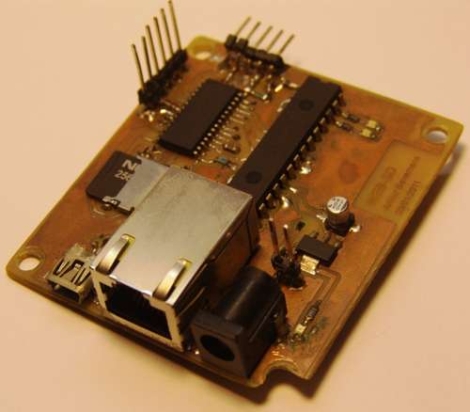
Inspired by a project featured here on Hack-a-Day, [arthurb] bought himself a PIC 24F and started experimenting once he learned the ins and outs of programming the chip. Using a breadboard and a nest of wires was fine for his first few projects, but as he advanced, he began to feel the need for a full-fledged development board. With a list of required features in mind he got to work, constructing a well thought out board as well as a handful of expansion boards that can be used for various other projects. His main development board includes Ethernet connectivity for use with his web server software, the ability to utilize an SD card for storage, and a USB port for programming. His expansion boards include a temperature sensor, a numeric touchpad, as well as a video output module. Overall it is a pretty impressive build, considering he had never programmed a PIC before starting this project. All of his boards are thoroughly documented, and he has included plenty of source code in hopes of helping other individuals just starting out in PIC programming.

You can see his web server in action here, but keep in mind that it is running off a PIC, so please be courteous in your usage.
bradley_smoker_clone

PID Controlled Bradley Smoker Clone

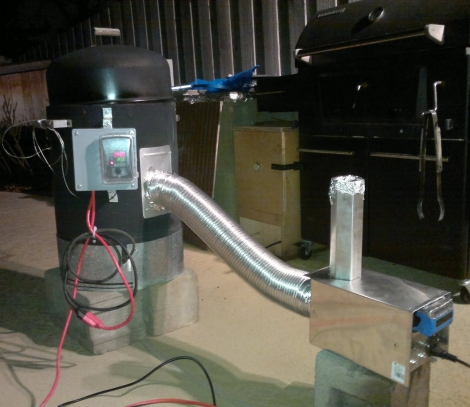
Bradley smokers are coveted for their ease of use, as they require very little interaction from the user once the hopper is loaded with wood pucks and the machine is powered on. The more robust models are quite pricey, so [Maukka] decided to build his own version of a Bradley smoker as an add on to his existing unit. He fabricated a smoke generator out of aluminum, including all of the components you would normally find in an automated smoker. Once the hopper is loaded with wood pucks, the smoker runs autonomously, shuffling new pucks onto the heating element, presumably at timed intervals. The main barrel of the smoker has a separate PIC-controlled heating element installed, and is connected to the smoke generator by an aluminum duct. This configuration allows [Maukka] to cold smoke items such as fish, nuts, and cheeses using the smoke generator by itself, while also permitting the smoking of meats at far higher temperatures when the main heating element is used. This is truly a fantastic build, and the cold smoker component is something I would love to have as an addition to my Weber bullet.

Be sure to explore his blog a bit to catch all of the build details, as they are separated into various posts.

[Thanks Hali Batsuiba]

RGB “Tilty Cube”

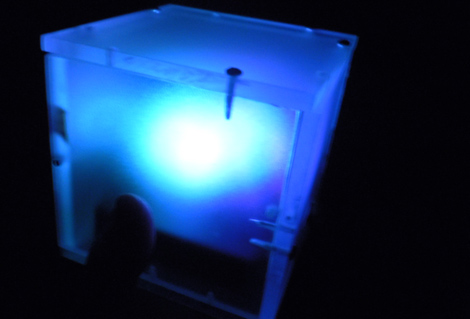
[Ben’s] introduction to microcontrollers was this fun little gift he calls the “tilty cube”. It is an acrylic box with 3 LEDs mounted inside that changes color based off of how you tilt it. Sounds like a fun toy, and a good project to learn with. [Ben] chose the PIC12F615 as the brains and laid it all out on a perfboard.  Since this was his first microcontroller experience he had to learn how to blink the LEDs, then figure out PWM etc. Though there is no video of the project in its finished state, since it was given away as a gift, we assume he figured it out pretty well.  He does state that the LEDs are dimmer than he had hoped and offers some thoughts on how he would do the entire project better next time.

Multitool Alarm System

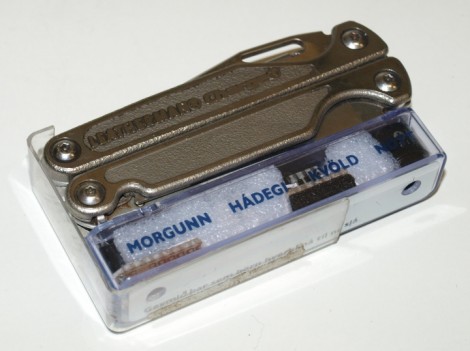
Here’s a way to make sure you don’t leave your Leatherman multitool somewhere. It’s an alarm system that will start a timer when the tool is removed from the holster. After five minutes the module beeps to remind you to put the tool back where it belongs. Annoying? Possibly, but if you’re not done with your work just press the reed leaf switch on the module to reset the timer. A PIC 12F683 handles the timing and generates the waveform for the piezo buzzer. Perhaps this could have been accomplished with a dual 555 chip like the LM556 (one timer for the countdown and another for the piezo waveform) but the PIC has power-down modes available that should make the button batteries last a long time.

Replace An N64’s Worn Out Joystick

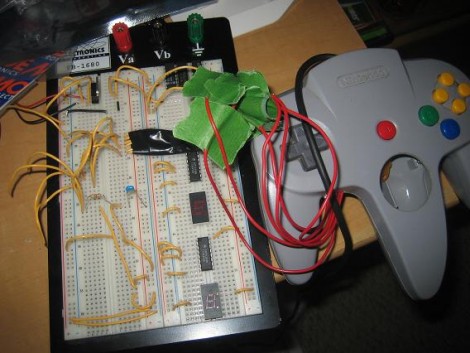
As gaming consoles age the controllers will inevitably show some wear, and sadly may give out all together. [Kyle] couldn’t bear to watch his Nintendo 64 controller bite the dust so he replaced the thumb stick with one from a PlayStation. This is a bigger job than you might imagine because the two parts are fundamentally different. The original N64 stick uses a rotary encoder to output data to the control chip, while the PlayStation stick is an analog device. [Kyle’s] solution was to read the analog values using a PIC, but lower in the thread you can read about another user who pulled off a similar hack using an AVR. Both convert the signals into the rotary encoder format that the N64 chip is listening for. From the looks of the clip embedded after the break, this couldn’t work any better!

Continue reading “Replace An N64’s Worn Out Joystick”

Microsimon

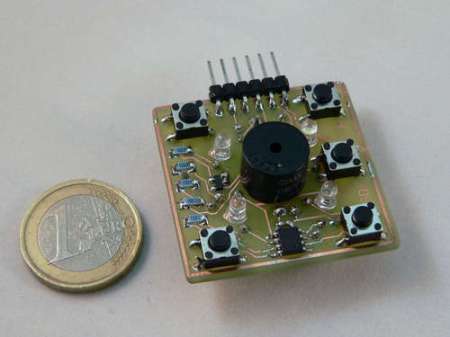
[Simoninns] is hoping to compete in the Sparkfun Microcontroller Contest with this cool little Microsimon instructible. The parts list is pretty small, at around 20 components. At the heart is a PIC 12F683 microcontroller. The whole project is very well documented with schematics, PCB layouts, code, and great pictures. This is a great project that you could put together really quickly and is a perfect introduction to charlieplexing. We find that, especially when teaching a new person, games are often a good project to learn from. The interactive and competitive nature of the finished product usually keeps people interested a little longer. You can catch a video of it after the break.

Continue reading “Microsimon”

Homebrew Mp3 Player With Some Bonus Features

When [falldeaf] set about making his own homebrew Mp3 player, he ended up at the same place we most do while looking into the subject, the wonderful Minty Mp3. Basing the design on [Adafruit Industries] popular board, we are presented The Mp3 Garbler.

First change of the project was to replace the sometimes difficult to find ST013, or the more expensive ST015T Mp3 decoder chip, and the CS4340 digital to analog cconverter with a single vs1001k, which we have checked out before. And while yes VLSI says that the 1001 series is a discontinued product, and it may be a bit hard to find now days, they also offer an updated model on their website, which should suit the application fine.

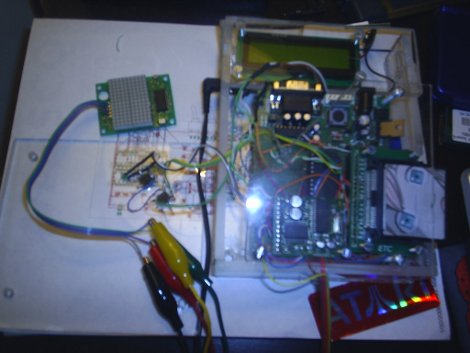
Next up is a useful LCD display sporting a Sparkfun lcd backpack, that shows us all the important to know music info. And finally there is a 10×14 led matrix display, that can be used to display all sort of user feedback icons, and is driven by a MAX6953, which we think is a pretty spiffy chip.

While there is no schematic, there are brd files, and source code available for your PIC18F452 or similar micro controller to complete your own