Brushless Gimbal 3D Printed And Bolted To Quadcopter

IMG_20130602_004802

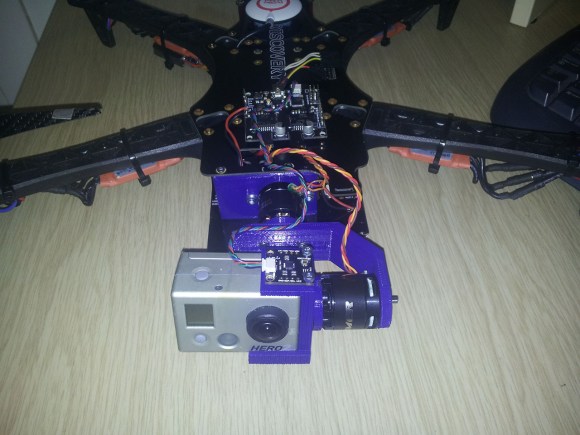
A handful of 3D printed parts, some brushless motors, and a bit of control hardware add a flair of cinematography to this quadcopter.

[Sean] sent in a tip about his work after seeing yesterday’s feature of a brushless gimbal being used to improve image stability with a shoulder mounted camera. That rig was designed to be used with a quadcopter, and this hacks shows why. It’s obvious from the demo footage that the gimbal — which is mounted directly to the frame of the TBS Discovery quadcopter — does a great job of keeping the image steady. The panning and tilting in directions contrary to the physics of flight make for a much more interesting video experience. Watch the inset video which is a live feed from the aircraft to the pilot. As the quadcopter makes very sharp banking turns you wouldn’t even be able to tell the pitch or roll have changed in the HQ version.

You can see a pair of images detailing the 3D printed parts and the assembled gimbal below.

Continue reading “Brushless Gimbal 3D Printed And Bolted To Quadcopter”

Best Robot Demos From ICRA 2013

best-robots-from-2013-ICRA

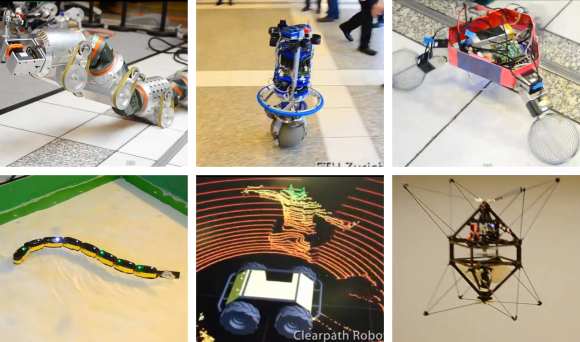
The 2013 IEEE International Conference of Robotics and Automation was held early in May. Here’s a video montage of several robots shown off at the event. Looks like it would have been a blast to attend, but at least you can draw some inspiration from such a wide range of examples.

We grabbed a half-dozen screenshots that caught our eye. Moving from the top left in clockwise fashion we have a segmented worm bot that uses rollers for locomotion. There’s an interesting game of catch going on in the lobby with this sphere-footed self balancer. Who would have thought about using wire beaters as wheels? Probably the team that developed the tripod in the upper right. Just below there’s one of the many flying entries, a robot with what looks like a pair of propellers at its center. The rover in the middle is showing off the 3D topography map it creates to find its way. And finally, someone set up a pool of water for this snake to swim around in.

Continue reading “Best Robot Demos From ICRA 2013”

GoPro Hack Delivers Live Video Feed For Piloting Your Quadcopter

The GoPro line of HD cameras seem like they were specifically designed for use with quadcopters. We say that because the small, light-weight video devices present a payload which can be lifted without too much strain, but still have enough horse power to capture video of superb quality. Here’s a hack that uses the camera to provide a remote First Person View so that you may pilot the aircraft when it is out of your line of sight.

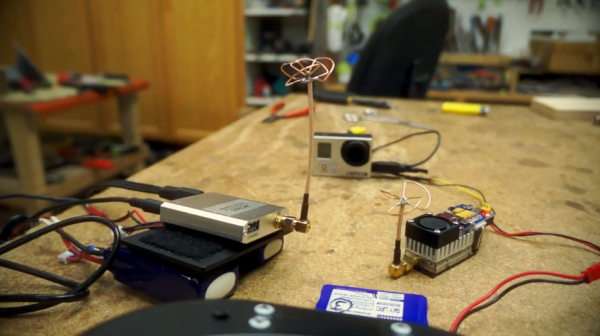
The camera in question is a GoPro Hero 3. It differs from its predecessors in that the composite video out port has been moved to a mini USB connector. But it’s still there and just a bit of cable splicing will yield a very clear signal. The image above shows the camera in the middle, connecting via the spliced cable to an FPV transmitter on the right. This will all be strapped to the quadcopter, with the signal picked up by the receiver on the left and piped to a goggle display worn by the pilot. You can see the cable being construction process in the clip after the break.

If you’re looking for other cool stuff to do with your GoPro camera check out the bullet-time work [Caleb] did with ours.

Continue reading “GoPro Hack Delivers Live Video Feed For Piloting Your Quadcopter”

Hackaday Links: Sunday, May 12th, 2013

hackaday-links-chain

[Johnathan Crawford] isn’t bashful about tearing the insides of his truck apart. He’s built his own remote starter using a Raspberry Pi.

We vaguely remember hearing about a startup that planned to deliver tacos using quadcopters instead of people. We assume that company was a bust but here’s the concept in action at the 2013 RoboGames [thanks Don].

On the topic of food: pizza and joysticks… do they go together? Perhaps. Here’s a joystick made out of an empty pizza box (note the remains of grease stains inside).

[Jonathan] brings to our attention the problem of running out of fingers to press all the buttons on your Monome at just the right moment. No worries, just add some solenoids to act as extra fingers.

Apparently some Samsung cameras (NX20, NX210 and NX1000) can use their USB port as a shutter release. The trick is finding the right resistor values for the ID pin [thanks Janne].

Plagued with a tablet dock that wasn’t weighty enough to prevent the device from tipping over [John] filled base with lead to keep the thing upright.

[Helmut’s] bathroom had no windows. He faked one using an Arduino and an RGB led.

And finally, as a reward for all the readers that made it to the bottom of the article, here’s a gem of a project. [Charlie] was inspired by the recent logic combo lock post to send in his own plans for a lock he made years ago. Unfortunately he can’t find the pictures from the build but the theory behind it is quite engaging.

[FlorianH] Shows Off MinimaBL, The Next Generation Of His Quadcopter Project

minimabl

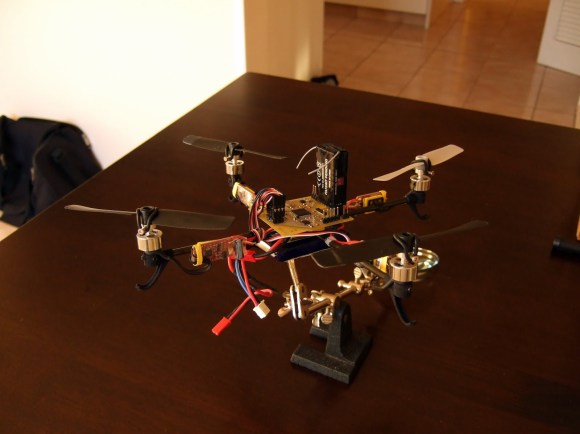
[FlorianH] has all kinds of new features to show off with this generation of his quadcopter project. Just about everything has seen an upgrade or some other kind of tweak since we looked in on the last version of the aircraft.

You’ll find some outdoor flight demo clips after the break. Right off the bat we’re impressed at the rock solid stability of the quadrotor while in flight. Even indoors the last version had a hint of a wobble as the control loop calculated stabilization. Here he borrowed some code from the open source Aeroquad project which helps account for this improvement. But the hardware choices lend a hand too. He moved from an ATmega32 up to an STM32F405RG processor. That’s an ARM chip which he programs using one of STM’s Discovery boards. The motors have all been upgraded as well (if you listen in the demo videos for both models you can hear a difference) and he redesigned the frame, which combines carbon tube with 3D printed parts to keep it light yet strong. The upgrade is every bit as impressive as the original build!

Continue reading “[FlorianH] Shows Off MinimaBL, The Next Generation Of His Quadcopter Project”

DIY Arduino Pro Mini Quadcopter

[execUc] took a stock V929 quadcopter and started making some crafty customizations. The main change – the control electronics were replaced by an Arduino Pro Mini (16Mhz model). He soldered all the modules on a prototyping board and, although admittedly a bit heavy, the little guy takes flight with no problem.

Among other details, an HMC5883L (magnetometer) and MPU6050 (accelerometer / gyroscope) are used as sensors. A LiPo 7.4V battery pack supplies the power. The brushed motors are controlled by pulse-width modulation from SI2302 MOSFET with added diodes. He plans to swap out the micro-controller for an ARM7 stm32F103 for extra computing power, and needs to play with the PID values to correct a slight problem he seems to be having when rotating.

Check out a test flight video after the break. [execUc] has a thorough list of all the alterations he made in the video description, so be sure to read it.

[via Hacked Gadgets]

Continue reading “DIY Arduino Pro Mini Quadcopter”

Quadcopter Brain

quadcopter-brain

This project is the warm center of [Alan Kharsansky’s] thesis in Electronic Engineering. It’s an all-in-one control board for a quadcopter. This is the second iteration of the board, the first version he actually etched himself. As you can see after the break the firmware is not quite ready for prime-time. But that doesn’t stop us from appreciating the design choices he’s made.

You can see the effort he made to keep the board symmetrical which will help when it comes time to balance the aircraft. At the center of the PCB is the jewel of the sensor array, a combination accelerometer and gyroscope. This location will help easy the trouble of designing PID algorithms to drive the four propellers. Also included in the sensor array is a magnetometer for navigation, and a barometric pressure sensor which can be used as an altimeter. There are four multipurpose connectors used to drive the motors and provide feedback to the boards. He also included two more sets of pads on the board (without their own connectors) in case he wants to add more motors in the future. The quadcopter can be controlled from a base station via the XBee module.

Continue reading “Quadcopter Brain”