Hackaday Links: Sunday, May 12th, 2013

hackaday-links-chain

[Johnathan Crawford] isn’t bashful about tearing the insides of his truck apart. He’s built his own remote starter using a Raspberry Pi.

We vaguely remember hearing about a startup that planned to deliver tacos using quadcopters instead of people. We assume that company was a bust but here’s the concept in action at the 2013 RoboGames [thanks Don].

On the topic of food: pizza and joysticks… do they go together? Perhaps. Here’s a joystick made out of an empty pizza box (note the remains of grease stains inside).

[Jonathan] brings to our attention the problem of running out of fingers to press all the buttons on your Monome at just the right moment. No worries, just add some solenoids to act as extra fingers.

Apparently some Samsung cameras (NX20, NX210 and NX1000) can use their USB port as a shutter release. The trick is finding the right resistor values for the ID pin [thanks Janne].

Plagued with a tablet dock that wasn’t weighty enough to prevent the device from tipping over [John] filled base with lead to keep the thing upright.

[Helmut’s] bathroom had no windows. He faked one using an Arduino and an RGB led.

And finally, as a reward for all the readers that made it to the bottom of the article, here’s a gem of a project. [Charlie] was inspired by the recent logic combo lock post to send in his own plans for a lock he made years ago. Unfortunately he can’t find the pictures from the build but the theory behind it is quite engaging.

[FlorianH] Shows Off MinimaBL, The Next Generation Of His Quadcopter Project

minimabl

[FlorianH] has all kinds of new features to show off with this generation of his quadcopter project. Just about everything has seen an upgrade or some other kind of tweak since we looked in on the last version of the aircraft.

You’ll find some outdoor flight demo clips after the break. Right off the bat we’re impressed at the rock solid stability of the quadrotor while in flight. Even indoors the last version had a hint of a wobble as the control loop calculated stabilization. Here he borrowed some code from the open source Aeroquad project which helps account for this improvement. But the hardware choices lend a hand too. He moved from an ATmega32 up to an STM32F405RG processor. That’s an ARM chip which he programs using one of STM’s Discovery boards. The motors have all been upgraded as well (if you listen in the demo videos for both models you can hear a difference) and he redesigned the frame, which combines carbon tube with 3D printed parts to keep it light yet strong. The upgrade is every bit as impressive as the original build!

Continue reading “[FlorianH] Shows Off MinimaBL, The Next Generation Of His Quadcopter Project”

DIY Arduino Pro Mini Quadcopter

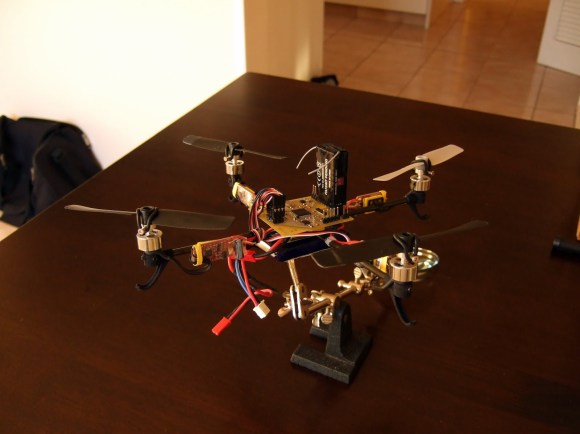
[execUc] took a stock V929 quadcopter and started making some crafty customizations. The main change – the control electronics were replaced by an Arduino Pro Mini (16Mhz model). He soldered all the modules on a prototyping board and, although admittedly a bit heavy, the little guy takes flight with no problem.

Among other details, an HMC5883L (magnetometer) and MPU6050 (accelerometer / gyroscope) are used as sensors. A LiPo 7.4V battery pack supplies the power. The brushed motors are controlled by pulse-width modulation from SI2302 MOSFET with added diodes. He plans to swap out the micro-controller for an ARM7 stm32F103 for extra computing power, and needs to play with the PID values to correct a slight problem he seems to be having when rotating.

Check out a test flight video after the break. [execUc] has a thorough list of all the alterations he made in the video description, so be sure to read it.

[via Hacked Gadgets]

Continue reading “DIY Arduino Pro Mini Quadcopter”

Quadcopter Brain

quadcopter-brain

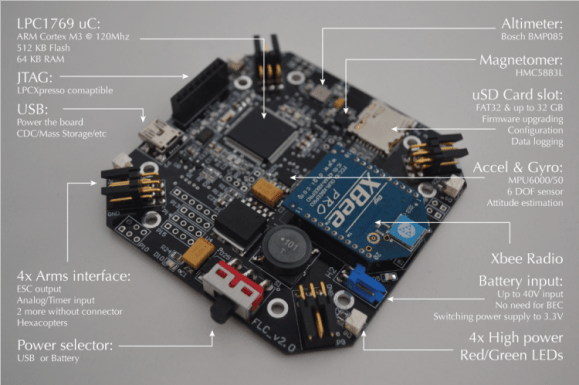
This project is the warm center of [Alan Kharsansky’s] thesis in Electronic Engineering. It’s an all-in-one control board for a quadcopter. This is the second iteration of the board, the first version he actually etched himself. As you can see after the break the firmware is not quite ready for prime-time. But that doesn’t stop us from appreciating the design choices he’s made.

You can see the effort he made to keep the board symmetrical which will help when it comes time to balance the aircraft. At the center of the PCB is the jewel of the sensor array, a combination accelerometer and gyroscope. This location will help easy the trouble of designing PID algorithms to drive the four propellers. Also included in the sensor array is a magnetometer for navigation, and a barometric pressure sensor which can be used as an altimeter. There are four multipurpose connectors used to drive the motors and provide feedback to the boards. He also included two more sets of pads on the board (without their own connectors) in case he wants to add more motors in the future. The quadcopter can be controlled from a base station via the XBee module.

Continue reading “Quadcopter Brain”

The Hexapod Hexacopter

Hexapod Hexacopter

Over at Mad Lab Industries, they had the idea of building a quadcopter that could walk and fly. By combining a hexapod with a hexacopter, they ended up with this creation.

The hexapod part started off with PhantomX Hexapod Kit, but it was far too heavy to fly. To reduce weight, they manufactured carbon fibre parts for the frame and legs. Even with the weight reductions, they still needed to six rotors to keep it stable.

The hexacopter part of the build uses more custom carbon fibre parts to mount the motors. The booms and mounts are also custom built out of aluminium. They used six E-Flite motors, propellers, and ESCs to provide lift.

A variety of controllers are used to run the robot. Two Arbotix devices handle the hexapod control, and a Hoverfly flight controller keeps it in the air. It’s controlled remotely using a Spektrum controller.

They have some ambitious next steps, including a mechanism that disconnects and reconnects the hexacopter and the base. After the break, check out a video of this impressive build in action.

Continue reading “The Hexapod Hexacopter”

Turning Four Smaller Helicopters Into One Larger Quadcopter

copter

There’s a reason we’ve seen a menagerie of quadcopters over the past few years – the key piece of any quadcopter build is an inertial measurement unit. Historically a very complicated and expensive piece of kit, these IMUs came down in price a few years back, allowing anyone with a few dollars in their pocket and a handful of brushless motors to build a four-bladed drone in their workshop.

[Starlino] built a few quadcopters, but he wanted to shy away from IMUs and get most of the mass of his new ‘copter over the center of the chassis. He came up with a design he calls the quadhybrid that can be built out of a quartet of those cheap 3-channel helicopter toys.

Most of the lift for [Starlino]’s quadhybrid comes from a pair of coaxial rotors from a Syma 001 3-channel helicopter toy. Anyone who has played with one of these toy helicopters knows how stable they are; if the tail rotor breaks, you’re left with a helicopter that can only go up and down.

To give his quadhybrid a few degrees of freedom, he attached four tail rotors from 3-channel helis to a few booms laid out in a cross pattern. By taking the receiver out of a 4-channel helicopter and adding his own controller board, [Starlino] made each of the tail rotors control the pitch and roll of the craft.

In the video after the break, you can see the quadhybrid is amazingly stable even without an IMU and surprisingly agile. As [Starlino]’s ‘copter can be made out of replacement parts for cheap 3-channel helis, we’ll expect a rush on these tail motors at your favorite online RC retailer very shortly.

Continue reading “Turning Four Smaller Helicopters Into One Larger Quadcopter”

Man Tracks Children Using A Quadcopter

child-tracking-quadcopter

Instead of walking his kid to the bus stop like he used to, [Paul Wallich] lets this quadcopter watch his son so he doesn’t have to. It is quite literally an automated system for tracking children — how wild is that?

The idea came to him when wishing there was a way to stay inside the house during the winter months while still making sure his kid got to the bus stop okay. [Paul] picked up a quadcopter kit and started looking at ways to add monitoring. He found the easiest technique was to include a cellphone and watch via a video chat app. But that is only part of the build as he would still have to fly the thing. After searching around he found a beacon that can be placed in the backpack. It has a GPS module, an RF modem, and runs a stripped down Python scripting shell. Whenever the GPS data changes (signaling his son is on the move) it uplinks with the quadcopter and gives it the new coordinates.

This goes a long way to making your family a police state. May we also recommend forcing the children to punch a time clock?

[via: theGrue]