A Robot… That Can See Through Walls!

Robots on four wheels are fun on their own merits, but one thing that most lack is the ability to see through walls.  With it’s onboard radar system, this bot is equipped to see objects that a person couldn’t normally detect on the other side of the wall.

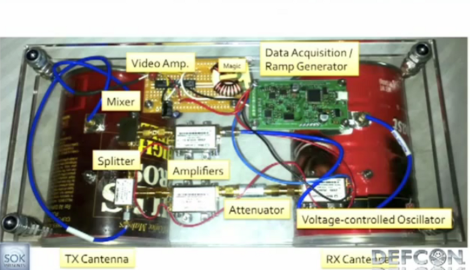
Although some of the more “nuts and bolts” details of this build are missing, the robot uses an Ultra-Wideband Radar system called the [D1] Radar System. This system can, according to their documentation, “Avoid false positives caused by vapor, dust, smoke, rain or other small particles.” Apparently this means drywall as well if programmed correctly.

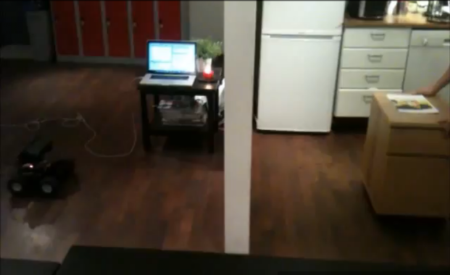
In the video after the break, the robot’s sensor package is programmed to ignore anything within 1.5 meters. This allows the robot to mirror the movement of the apparent shelving unit on the other side. This sensor could certainly have some interesting robotics applications besides imitating a rolling shelf, so we’re excited to see what it will be used for!

Continue reading “A Robot… That Can See Through Walls!”

Ultrasonic Rangefinder As Scanning Radar

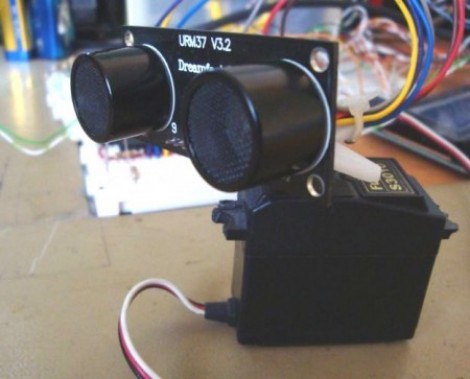
Ultrasonic rangfinders are a cheap and easy way to gather obstacle avoidance data. When added to a servo motor they form something of a scanning radar for near-proximity objects.

In this implementation, [Rui Cabral] is driving the servo, and collecting data from the sensor using a PIC 18F4520. The servo rotates 180 degreees, taking sensor measurements in increments of nine degrees. If it discovers obstacles, the distance and orientation are recorded. Feedback is displayed on a 20-LED bar graph display which shows a moving LED to track the sensor orientation, with LEDs remaining lit whenever an object is found. Right now the obstacle data is pushed over a serial connection with a PC, but could easily be injected into navigation logic for a robot in order to triangulate a path around the obstruction. You can see [Rui’s] project in action after the break.

We looked in on the same concept with a different display technique a couple of years back. That hack used an Arduino and Processing to map sensor data with a traditional green sweep display.

Continue reading “Ultrasonic Rangefinder As Scanning Radar”

Autonomous Cars Already Drive The Roads Among Us

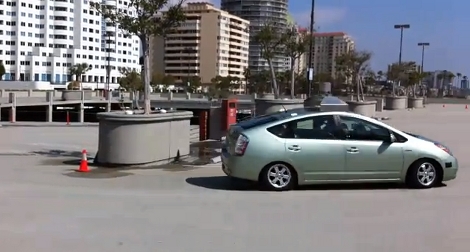
Google’s showing off this autonomous car at the TED convention right now, but the hardware has already made automated trips from San Fransisco to Los Angeles. According to the commentary in the video after the break, the scene above shows the car “hauling Prius ass” on a closed course. The car learned this route while being driven by a person and now the vehicle is set to take riders through an aggressively driven loop in the cone-adorned parking ramp. But on the open road you do not need to teach it anything. It has no problem taking a GPS route and following the rules of the road while traveling from one waypoint to another.

The link above doesn’t include hardware information but they did point to a Times article which includes an infographic. The spinning box on the top of the car is 3D-mapping LIDAR with a 200 foot radius. There’s a rotary encoder on one of the wheels for precise movement data, radar sensors on the front and back bumpers, and a rear-view-mirror-mounted camera for image processing. It makes us wonder how the system performs when the car is coated in road-muck? Maybe you just add a dedicated wiper for each sensor.

Continue reading “Autonomous Cars Already Drive The Roads Among Us”

Radar Gun Teardown

[Jeri Ellsworth] is at it again, this time she takes apart a hot wheels speed gun and in the process she does a good job of  explaining how radar can be used to measure speed.  She also demonstrates a way to determine if an object is approaching or receding from the radar gun.

The Doppler shift is one way to remotely measure the speed of an object. It works by measuring the change in frequency of a wave after it strikes an object. Rather than measuring the Doppler shift of the returning wave most radar guns use the phase shift. The reason is that the frequency shift of a relativly slow object (60mph), to a relitivly high frequency signal(10GHz) is small (about 0.893Hz), where the phase shift varies based on the distance of the object.  This is all just a stepping stone in her quest to build a crude TSA body scanner.

X-Band Linear Rail SAR Imaging

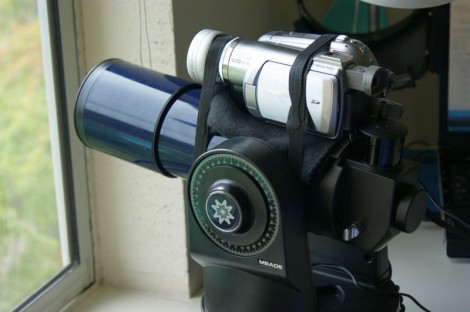
[Greg Charvat] really wanted high resolution X-Band linear rail SAR imaging system. He wanted it bad enough to scrounge through parts at HAM radio swap meets until he had the bits to build one himself. The unit is used to take high resolution radar imaging. For example, the image above is constructed of push pins behind a foam wall. The synthetic aperture radar system came in at roughly  $250. Not bad at all. You may have to dig through the links a bit to find the build information. Be sure to check out the hardware gallery and the schematics(pdf).

[via Makezine]

HUD For Real Life Capture-the-flag

If you’ve played any of the Splinter Cell games you’ll remember the PDA that [Sam Fisher] carried around with him.  What if you could have one of your own when playing capture-the-flag? [Brad] has created the ZephyrEye as an electronic command and communications device for real-life games.

Each player carries around their own unit. The ZephyrEye has a GPS module, Xbee module, LCD screen, and control buttons. This allows a player to setup one of several different games, map out the game field including base locations and flag locations, and monitor a time limit and scoring. Other players can join the game in progress. The best part? The GPS modules report tracking to each handheld and act as radar for your team and the enemy team. We’ve got a couple of demo videos after the break.

Words can’t describe how delighted this would have made us back in the day. We don’t play outside with the other neighborhood kids anymore (insert dirty-old-man joke here) but that might change just because of this device. We may end up joining [Barney Stinson] for some amazingly awesome laser-tag games after all.

[Brad’s] posted hardware information and source code so that you can use to throw together a dozen or so units. We think the next version should incorporate a wearable display.

Continue reading “HUD For Real Life Capture-the-flag”

Hackaday Links: December 7 2009

[youtube=http://www.youtube.com/watch?v=_5lksMvmqQc]

Ah the beauty of watching molten solder pull SMD components into place. Yeah, we’ve seen it before, but for some reason it never gets old.

The glory days of wardriving are certainly behind us but if you’re still hunting in certain areas for access points you can leave the laptop at home. A homebrew program called Road Dog can turn your PSP into a WiFi search device. You must be able to run custom code to use this app.

[youtube=http://www.youtube.com/watch?v=OE2pB1pyZN0]

Ferrofluid is our friend. But having grown up watching the Terminator and Hellraiser movies we can’t help being a little creeped out by the effects seen in this movie.

[youtube=http://www.youtube.com/watch?v=-1OTSbIzcwI]

Follow along with the NASA astronauts in this 20 minute HD tour of the international space station. It’s a cramped place to live but we can’t help thinking that it looks incredibly clean. After all, where would the dirt come from?

How are your woodworking skills?  Can you take a wooden block and turn it on a lathe until you have a lampshade 1/32″ thick? We’d love to see how these are made, but imagine the artist’s reaction when hours of labor are ruined by a minuscule amount of misplaced pressure on a carving tool. Patience, we’ll learn it some day!

[youtube=http://www.youtube.com/watch?v=F6pUMlPBMQA]

This video from the past that is about the future of  travel does leave us wondering why our cars don’t have built-in radar for poor visibility? We’ve already realized the rear-view-mirror-tv-picture, but we’re going to need your help before the flying police/fire/ambulance-mobile is a common sight. Oh, the fun of seeing a high-tech push-button selector 3:30 into the video. Perhaps the touch-screen was a bit beyond the vision of the time.

[youtube=http://www.youtube.com/watch?v=VW5PByaR2EQ]

Sometimes you have so many servants you need to find creative things for them to do. Only the most discriminating of the super-rich employ a person whose sole responsibility is to erase and redraw the hands of a clock each minute. This video is obviously a result of the global recession as the live time-keeper has been let go; a looping recording took his job!

[youtube=http://www.youtube.com/watch?v=i7woG0pqFjs]

Last time we checked in with [Marco Tempest] he was syncing video over multiple iPhones. Now he’s at it again with an augmented reality setup. A camera picks up some IR LEDs in a canvas and translates that into information for a video projector. We’d call this a trick, but it’s certainly not magic.