Submarine To Plane: Can You Hear Me Now? The Hydrophone Radar Connection

How does a submarine talk to an airplane? It sounds like a bad joke but it’s actually a difficult engineering challenge.

Traditionally the submarine must surface or get shallow enough to deploy a communication buoy. That communication buoy uses the same type of radio technology as planes. But submarines often rely on acoustic transmissions via hydrophones which is fancy-talk for putting speakers and microphones in the water as transmitters and receivers. This is because water is no friend to radio signals, especially high frequencies. MIT is developing a system which bridges this watery gap and it relies on acoustic transmissions pointed at the water’s surface (PDF warning) and an airplane with high-precision radar which detects the oscillations of the water.

The complexity of the described setup is mind-boggling. Right now the proof of concept is over short distances and was tested in a water tank and a swimming pool but not in open water. The first thing that comes to mind is the interference caused by waves and by aerosols from wind/wave interactions. Those challenges are already in the minds of the research team. The system has been tested to work with waves of 8 cm (16 cm measured peak to trough) caused by swimmers in the pool. That may not sound like much, but it’s about 100,000 times the surface variations being measured by the millimeter wave radar in order to detect the hydrophone transmissions. Add to that the effects of Doppler shift from the movement of the plane and the sub and you have a signal processing challenge just waiting to be solved.

This setup is very interesting when pitched as a tool for researching aquatic life. The video below envisions that transmitters on the backs of sea turtles could send communications to aircraft overhead. We love seeing these kinds of forward-thinking ocean research projects, like our 2017 Hackaday prize winner which is an open source underwater glider. Oceanic studies over long distances have been very difficult but we’re beginning to see a lot of projects chipping away at that inaccessibility.

Continue reading “Submarine To Plane: Can You Hear Me Now? The Hydrophone Radar Connection”

Touch Anything And Everything

Powering IoT devices is often a question of batteries or mains power, but in rare exceptions to this rule there is no power supply (PDF Warning). At the University of Wisconsin-Madison and the University of California, San Diego, researchers have gone the extra mile to make advanced backscatter devices, and these new tags don’t need the discrete components we have seen in previous versions. They are calling it LiveTag, and it doesn’t need anything aside from a layer of foil printed or etched on a flexible ceramic-PTFE laminate. PTFE is mostly seen in the RF sector as a substrate for circuit boards.

We have seen some of the wild creations with wifi backscatter that range from dials to pushbuttons. RF backscatter works by modulating the RF signals in which we are continuously swimming. Those radio waves power the device and disrupt the ambient signals, which disruption can be detected by a receiver. With a BOM that looks like a statement more than a list, integration with many devices becomes a cost-effective reality. Do not however broadcast important data because you cannot expect great security from backscatter.

[Via IEEE Spectrum]

Researcher uses antenna to clone Tesla key fob

Tesla Opens With Precomputed Key Fob Attack

This clever precomputation attack was developed by a group of researchers at KU Leuven in Belgium. Unlike previous key fob attacks that we’ve covered in the past which have been essentially relay attacks, this hack precomputes a ton of data, looks for a collision in the dataset, and opens the door. Here’s how it works.

Continue reading “Tesla Opens With Precomputed Key Fob Attack”

No Signal For Your Radio-Controlled Watch? Just Make Your Own Transmitter

You can win any argument about the time when you have a radio controlled watch. Or, at least, you can if there’s any signal. [Henner Zeller] lives in a place where there is no reception of the DCF77 signal that his European wristwatch expects to receive. Consequently, he decided to make his own tiny transmitter, which emulates the DCF77 signal and allows the watch to synchronise.

A Raspberry Pi Zero W is the heart of the transmitter, and [Henner] manages to coax it into generating 77500.003Hz on a GPIO pin – close enough to the 77.5kHz carrier that DCF77 uses. The signal is AM, and transmits one bit/s, repeating every minute. A second GPIO performs the required attenuation, and a few loops of wire are sufficient for an antenna which only needs to work over a few inches. The Raspberry Pi syncs with NTP Stratum 1 servers, which gives the system time an accuracy of about ±50ms. The whole thing sits in a slick 3D printed case, which provides a stand for the watch to rest on at night; this means that every morning it’s synchronised and ready to go.

[Henner] also kindly took the time to implement the protocols for WWVB (US), MSF (UK) and JJY (Japan). This might be just as well, given that we recently wrote about the possibility of WWVB being switched off. Be sure to check the rules in your area before giving this a try.

We’ve seen WWVB emulators before, like this ATtiny45 build, but we love that this solution is an easy command line tool which supports many geographical locations.

A No-Fuss Rack Of Ham

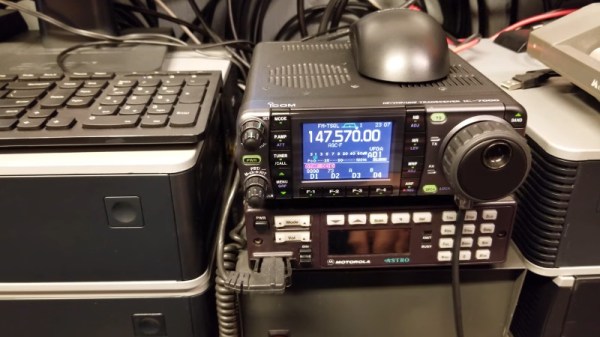
With any hobby, it’s easy for things to get out of hand. Equipment can get scattered around the house, chargers lost in the car while cables languish in the shed… but it doesn’t have to be this way. With a go-bag or go-box, everything required is kept together in a ready-to-go condition. Heading out for a day of filming? Grab the go-bag and you’re all set. [oliverkrystal] wanted to apply this to a ham radio setup, and built this ham shack-in-a-box.

Wanting to use proven components and keep things rugged and usable, the build starts with a 6U-sized plastic rack mount case. This saves weight over plywood versions and is nice and tough. A combination of off-the-shelf rack mount parts and 3D printed pieces are brought together to make it all happen. [oliverkrystal]’s printed cable organisers are a particular treat, and something we think could help a lot of builds out there.

It all comes together as an impressive self-contained unit with two radios, an antenna tuner, in-built illumination and other useful features. No longer does one have to scramble around preparing gear for the weekend’s hamventures – grab the box and you’re ready to go!

Perhaps you don’t have a lot of ham gear, though? Try this setup to get going for less than $100.

Friday Hack Chat: GNU Radio

Software defined radio picked up a lot of popularity when it was discovered that cheap USB TV tuners were functional bits of hardware that could become SDRs. It’s the software that makes this possible, and when it comes to SDR software, there’s no better tool than GNU Radio. For this week’s Hack Chat we’re going to sit down with some of the people behind this awesome software tool and pick their brains.

Our guests for this week’s Hack Chat will be Derek Kozel and Nate Temple, officers of the GNU Radio project. They’re also organizers of this year’s GNU Radio Conference. Also joining in on the Hack Chat will be Martin Braun, community manager, PyBOMBS maintainer, and GNU Radio Foundation officer.

GNU Radio is perhaps the most important bit of any software defined radio toolchain. This is the software that provides signal processing blocks to implement software defined radios. GNU radio is how you take a TV tuner USB dongle and pull images from satellites. You can use it for simulation, and GNU Radio is widely used by hobbyists, academics, and by people in industry.

For this week’s Hack Chat, we’re going to be talking all about GNU Radio. What can you do with it? Was the interface really inspired by MaxMSP? All that and more in this week’s Hack Chat.

  • Various bits of hardware that make GNU Radio work
  • The core process of writing modules
  • Upcoming features of GNU Radio

You are, of course, encouraged to add your own questions to the discussion. You can do that by leaving a comment on the GNU Radio Hack Chat Event Page and we’ll put that in the queue for the Hack Chat discussion.join-hack-chat

Our Hack Chats are live community events on the Hackaday.io Hack Chat group messaging. This week is just like any other, and we’ll be gathering ’round our video terminals at noon, Pacific, on Friday, August 31st. Need a countdown timer? We should look into hosting these countdown timers on hackaday.io, actually.

Click that speech bubble to the right, and you’ll be taken directly to the Hack Chat group on Hackaday.io.

You don’t have to wait until Friday; join whenever you want and you can see what the community is talking about.

Cross-Correlation Makes Quick Work Of Ads

Once relegated to the proverbial Linux loving Firefox user, ad blocking has moved into public view among increased awareness of privacy and the mechanisms of advertising on the internet. At the annual family gathering, when That Relative asks how to setup their new laptop, we struggle through a dissertation on the value of ad blockers and convince them to install one. But what about mediums besides the internet? Decades ago Tivo gave us one button to jump through recorded TV. How about the radio? If available, satellite radio may be free of The Hated Advertisement. But terrestrial radio and online streams? [tomek] wasn’t satisfied with an otherwise sublime experience listening streaming Polish Radio Three and decided to build a desktop tool to detect and elide ads from the live audio stream.

[tomek] was aware of this hip knowledge domain called Digital Signal Processing but hadn’t done any of it themselves. Like many algorithmic problems the first step was to figure out the fastest way to bolt together a prototype to prove a given technique worked. We were as surprised as [tomek] by how simple this turned out to be. Fundamentally it required a single function – cross-correlation – to measure the similarity of two data samples (audio files in this case). And it turns out that Octave provides it in the box. After snipping the start-of-ad jingle out of a sample file and comparing it to a radio program [tomek] got the graph at the left. The conspicuous spike is the location of the jingle in the audio file.

At this point all that was left was packaging it all into a one click tool to listen to the radio without loading an entire analysis package. Conveniently Octave is open source software, so [tomek] was able to dig through its sources until they found the bones of the critical xcorr() function. [tomek] adapted their code to pour the audio into a circular buffer in order to use an existing Java FFT library, and the magic was done. Piping the stream out of ffmpeg and into the ad detector yielded events when the given ad jingle samples were detected.

[tomek] packaged that tool into a standalone executable, but the gem here is the followup post. After removing ads in the online stream they adapted a RaspberryPi to listen to an FM receiver and remote control their Yamaha tuner over the network. So when the tuner is playing Radio Three the Pi notices and ducks the audio appropriately to avoid those pesky ads. Video of this after the break.

Continue reading “Cross-Correlation Makes Quick Work Of Ads”