[Robert Glaser] kept all his projects, all of them, from the 1960s to now. What results is a collection so pure we feel an historian should stop by his house, if anything, to investigate the long-term effects of the knack.
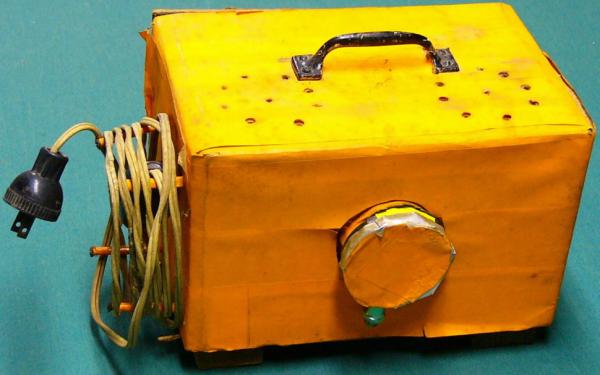
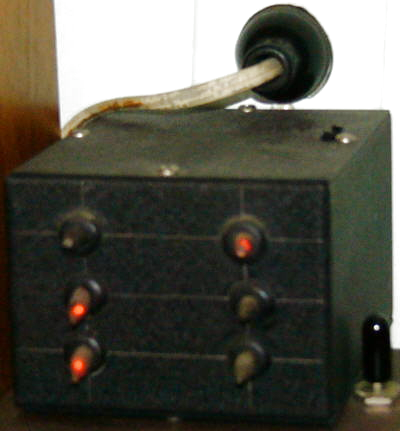
He starts with an opaque projector he built in the third grade, which puts it at 1963. Next is an, “idiot box,” which looks suspiciously like “the Internet”, but is actually a few relaxation oscillators lighting up neon bulbs. After that, the condition really sets in, but luckily he’s gone as far as to catalog them all chronologically.
We especially enjoyed the computer projects. It starts with his experiences with punch cards in high school. He would hand-write his code and then give it to the punch card ladies who would punch them out. Once a week, a school-bus would take the class to the county’s computer, and they’d get to run their code. In university he got to experience the onset of UNIX, C, and even used an analog computer for actual work.
There’s so much to read, and it’s all good. There’s a section on Ham radio, and a very interesting section on the start-up and eventual demise of a telecom business. Thanks to reader, [Itay Ramot], for the tip!
Here’s a question: when did you last listen to an AM radio station? If your answer is “recently”, chances are you are in the minority.
You might ask: why should you listen to AM? And you’d have a point, after all FM, digital, online, and satellite stations offer much higher quality audio, stereo, and meta information, and can now be received almost anywhere. Even digital receivers are pretty cheap now, and it’s by no means uncommon for them to not even feature the AM broadcast band at all. Certainly this has driven an exodus of listeners to the extent that AM radio has been in slow decline for decades, indeed it’s disappearing completely in some European countries.
We are entering a new era of radio technology. A new approach to building radios has made devices like multi-band cell phones and the ubiquitous USB TV receivers that seamlessly flit from frequency to frequency possible. That technology is Software Defined Radio, or SDR.
A idealized radio involves a series of stages. Firstly, an antenna receives the radio signal, converting it into an electrical signal. This signal is fed into a tuned resonator which is tuned to a particular frequency. This amplifies the desired signal, which is then sent to a demodulator, a device which extracts the required information from the carrier signal. In a simple radio, this would be the audio signal that was encoded by the transmitter. Finally, this signal is output, usually to a speaker or headphones.
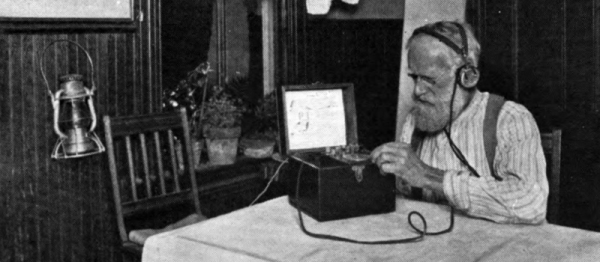
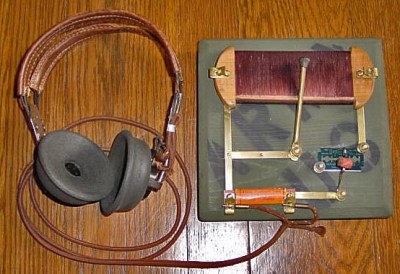
A replica foxhole crystal set. Photo: Bill Jackson
That’s how your basic crystal radio works: more sophisticated radios will add features like filters that remove unwanted frequencies or additional stages that will process the signal to create the output that you want. In an FM radio, for example, you would have a stage after the demodulator that detects if the signal is a stereo one, and separates the two stereo signals if so.
To change the frequency that this radio receives, you have to change the frequency that the resonator is tuned to. That could mean moving a wire on a crystal, or turning a knob that controls a variable capacitor, but there has to be a physical change in the circuit. The same is true of the additional mixing stages that refine the signal. These circuits may be embedded deeply in the guts of the radio, but they are still there. This is the limitation with normal receivers: the radio can’t receive a signal that is outside the range that the resonator circuit can tune to, or change the way it is demodulated and processed. If you want to receive multiple frequency bands or different types of signals, you need to have separate pathways for each band or type of signal, physically switching the signal between them. That’s why you have physical AM/FM switches on radios: they switch the signal from an AM radio processing path to an FM one.
Software Defined Radios remove that requirement. In these, the resonator and demodulator parts of the radio are replaced by computerized circuits, such as analog to digital converters (ADCs) and algorithms that extract the signal from the stream of data that the ADCs capture. They can change frequencies by simply changing the algorithm to look for another frequency: there is no need for a physical change in the circuit itself. So, an SDR radio can be tuned to any frequency that the ADC is capable of sampling: it is not restricted by the range that a resonator can tune to. Similarly, the demodulator that extracts the final signal you want can be updated by changing the algorithm, changing the way the signal is processed before it is output.
This idea was first developed in the 1970s, but it didn’t really become practical until the 1990s, when the development of flexible field-programmable gate array (FPGA) chips meant that there was enough processing power available to create single chip SDR devices. Once programmed, an FPGA has no problem handing the complex tasks of sampling, demodulating and processing in a single device.
Most modern SDRs don’t just use a single chip, though. Rather than directly converting the signal to digital, they use an analog front end that receives the raw signal, filters it and converts it down to a fixed frequency (called the intermediate frequency, or IF) that the ADCs in the FPGA can more easily digitize. This makes it cheaper to build: by converting the frequency of the signal to this intermediate frequency, you can use a simpler FPGA and a cheaper ADC, because they don’t have to directly convert the maximum frequency you want to receive, only the IF. As long as the front end can convert a band of signals down to an intermediate frequency that the FPGA can digitize, the SDR can work with it.
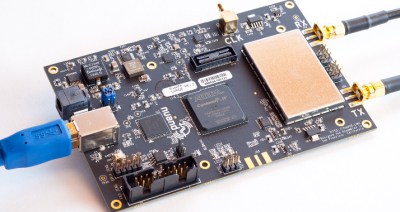
The BladeRF, a modern SDR device that can receive and transmit signals between 300 MHz and 3 GHz
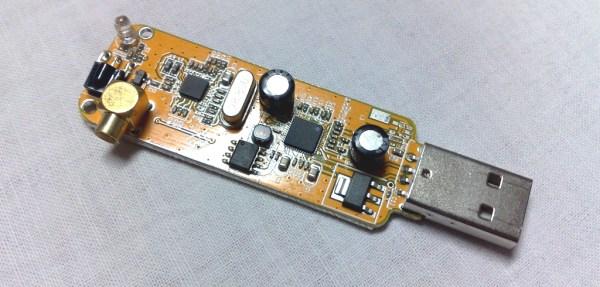
This flexibility means that SDR devices can handle a huge range of signals at relatively low cost. The $420 BladeRF, for instance, can receive and transmit signals from 300 MHz to 3.8 GHz at the same time, while the $300 HackRF One can work with signals from 1 MHz up to an incredible 6 GHz. The ability of the BladeRF to both receive and transmit means that you can use it to build your own GSM phone network, while the low cost of the HackRF One makes it a favorite of radio hackers who want to do things like make portable radio analyzers. Mass produced models are even cheaper: by hacking a $20 USB TV receiver that contains an SDR, you can get a radio that can, with a suitable antenna, do things like track airplanes or receive satellite weather images. And all of this is possible because of the idea of Software Defined Radio.
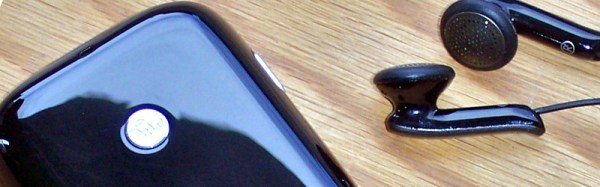
If you have owned Android phones, there’s a reasonable chance that as the kind of person who reads Hackaday you will at some time have rooted one of them, and even applied a new community ROM to it. When you booted the phone into its new environment it’s not impossible you would have been surprised to find your phone now sported an FM radio. How had the ROM seemingly delivered a hardware upgrade?
It’s something your cellphone carrier would probably prefer not to talk about, a significant number of phones have the required hardware to receive FM radio, but lack the software to enable it. The carriers would prefer you to pay for their data to stream your entertainment rather than listen to it for free through a broadcaster. If you are someone capable of upgrading a ROM you can fix that, but every other phone owner is left holding a device they own, but seemingly don’t own.
Across North America there is a group campaigning to do something about this situation. Free Radio On My Phone and their Canadian sister organization are lobbying the phone companies and manufacturers to make the FM radio available, and in the USA at least they have scored some successes.
We have covered numerous attempts to use the DMCA to restrict people’s access to the hardware they own, but this story is a little different. There is no question of intellectual property being involved here, it is simply that the carriers would rather their customers didn’t even know that they had bought an FM radio along with their phone. If this bothers you, thanks to Free Radio On My Phone you can now join with others and find a voice on the matter.
It’s interesting to note that many FM radio chips also support a wider bandwidth than the North American and European 88 to 108MHz or thereabouts. In parts of Asia the broadcast band extends significantly lower than this, and the chipset manufacturers make products to support these frequencies. This opens up the interesting possibility that given a suitable app a cellphone could be used to receive other services on these frequencies. Probably more of a bonus for European radio amateurs with their 70MHz allocation than for North American residents.
Via CBC News. Cellphone image: By Rob Brown [Public domain], via Wikimedia Commons.
Can you build a HF SSB radio transciever in one weekend, while on the road, at parts from a swap meet? I can, but apparently not without setting something on fire.
Of course the swap meet I’m referring to is Hamvention, and Hamvention 2016 is coming up fast. In a previous trip to Hamvention, Scott Pastor (KC8KBK) and I challenged ourselves to restore tube radio gear in a dodgy Dayton-area hotel room where we repaired a WW2 era BC-224 and a Halicrafters receiver, scrounging parts from the Hamfest.
Our 2014 adventures were so much fun that it drove us to create our own hacking challenge in 2015 to cobble together a <$100 HF SSB transceiver (made in the USA for extra budget pressure), an ad-hoc antenna system, put this on the air, and make an out-of-state contact before the end of Hamvention using only parts and gear found at Hamvention. There’s no time to study manuals, antennas, EM theory, or vacuum tube circuitry. All you have are your whits, some basic tools, and all the Waffle House you can eat. But you have one thing on your side, the world’s largest collection of surplus electronics and radio junk in one place at one time. Can it be done?
When the big annual meteor showers come around, you can often find us driving up to a mountaintop to escape light pollution and watching the skies for a while. But what to do when it’s cloudy? Or when you’re just too lazy to leave your computer monitor? One solution is to listen to meteors online! (Yeah, it’s not the same.)
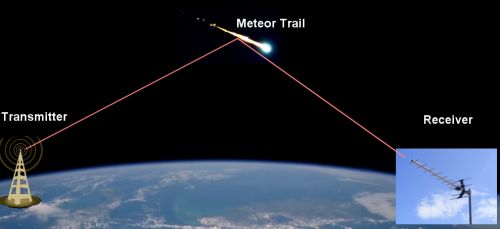
Meteors leave a trail of ionized gas in their wake. That’s what you see when you’re watching the “shooting stars”. Besides glowing, this gas also reflects radio waves, so you could in principle listen for reflections of terrestrial broadcasts that bounce off of the meteors’ tails. This is the basis of the meteor burst communication mode.
[Ciprian Sufitchi, N2YO] set up his system using nothing more than a cheap RTL-SDR dongle and a Yagi antenna, which he describes in his writeup (PDF) on meteor echoes. The trick is to find a strong signal broadcast from the earth that’s in the 40-70 MHz region where the atmosphere is most transparent so that you get a good signal.
This used to be easy, because analog TV stations would put out hundreds of kilowatts in these bands. Now, with the transition to digital TV, things are a lot quieter. But there are still a few hold-outs. If you’re in the eastern half of the USA, for instance, there’s a transmitter in Ontario, Canada that’s still broadcasting analog on channel 2. Simply point your antenna at Ontario, aim it up into the ionosphere, and you’re all set.
We’re interested in anyone in Europe knows of similar powerful emitters in these bands.
As you’d expect, we’ve covered meteor burst before, but the ease of installation provided by the SDR + Yagi solution is ridiculous. And speaking of ridiculous, how about communicating by bouncing signals off of passing airplanes? What will those ham radio folks think of next?
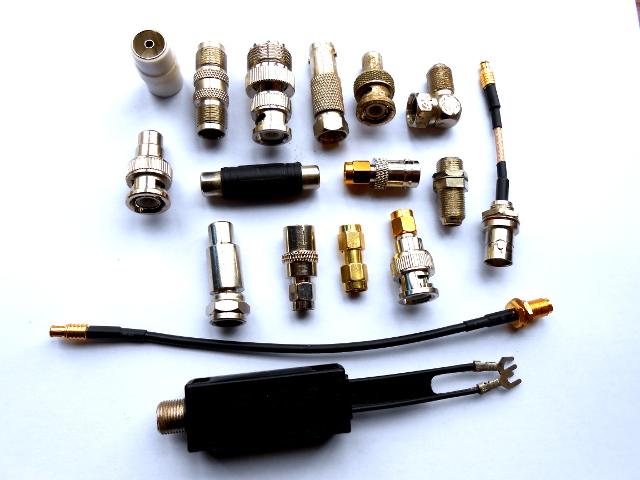
Just a selection from the author’s unholy assortment of adaptors.
If you do any work with analogue signals at frequencies above the most basic audio, it’s probable that somewhere you’ll have a box of coax adaptors. You’ll need them, because the chances are your bench will feature instruments, devices, and modules with a bewildering variety of connectors. In making all these disparate devices talk to each other you probably have a guilty past: at some time you will have created an unholy monster of a coax interface by tying several adaptors together to achieve your desired combination of input and output connector. Don’t worry, your secret is safe with me.