A DIY NFC Tag

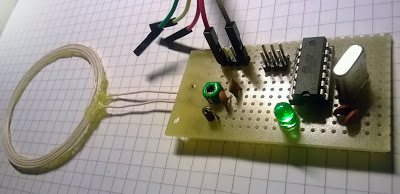
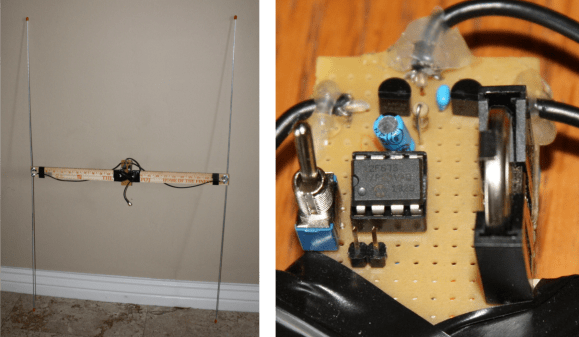
[Nicholas] built a simple NFC tag using an ATtiny84 microcontroller, four resistors, three capacitors, a diode, and an antenna. It implements ISO 14443-3, a standard for identification cards, and can communicate with the NFC chip sets found in most new smartphones.

This standard uses on-off keying for communication, which makes the hardware slightly more complex than the AVR RFID tag that we saw a few years back. The antenna and a variable capacitor form an LC circuit tuned at 13.56 MHz, which is the carrier frequency for the protocol. The diode acts as an envelope detector, letting the microcontroller recover the signal.

It may not be fully compliant with the standard, but [Nicolas] successfully tested out the device with his Lumia 620 phone. The firmware is available on Google Code so you can program your own tag data into main.c, build the firmware, and send some NFC packets. You can also check out a demo of the device after the break.

Continue reading “A DIY NFC Tag”

BITX, A Return To Hackers’ Paradise

bitx

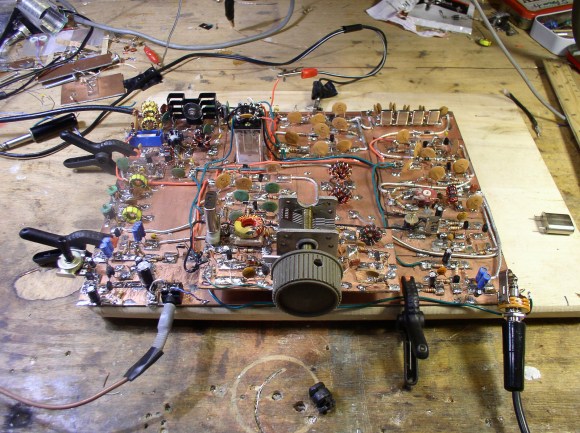
[Bill Meara] has finished up his radio. It both looks and sounds great. It was only a few weeks ago that [Bill] posted a guest rant here on Hackaday. The Radio he mentioned building in the rant is now complete. The transceiver itself is a BITX, a 14MHz Single Sideband (SSB) radio designed by Ashhar Farhan VU2ESE. Ashhar designed the BITX as a cheap to build, and easy to tune up transceiver for radio amateurs in India.

By utilizing parts easily sourced from scrapped TV sets, the BITX can be built for less than 300 Indian Rupee – or about $4.70 USD. In [Bill]’s own words, “Five bucks and some sweat equity gets you a device capable of worldwide communication.” He’s not kidding either. [Bill’s] first QSO was with a ham in the Azores Islands of Portugal.

[Bill] built his radio using the “Manhattan” building style, which we’ve seen before. Manhattan style uses rectangular pads glued down onto a copper ground plane. It makes for a more flexible design than regular old dead bug style building. Looking at all those components may be a bit daunting at first, but plenty of support is available. [Bill] has an 18 part build log on the soldersmoke website. There also is an active yahoo group dedicated to the BITX.

Diagnose And Repair A Yaesu FT-7800 Ham Radio

Yaesu FT-7800 Ham Radio

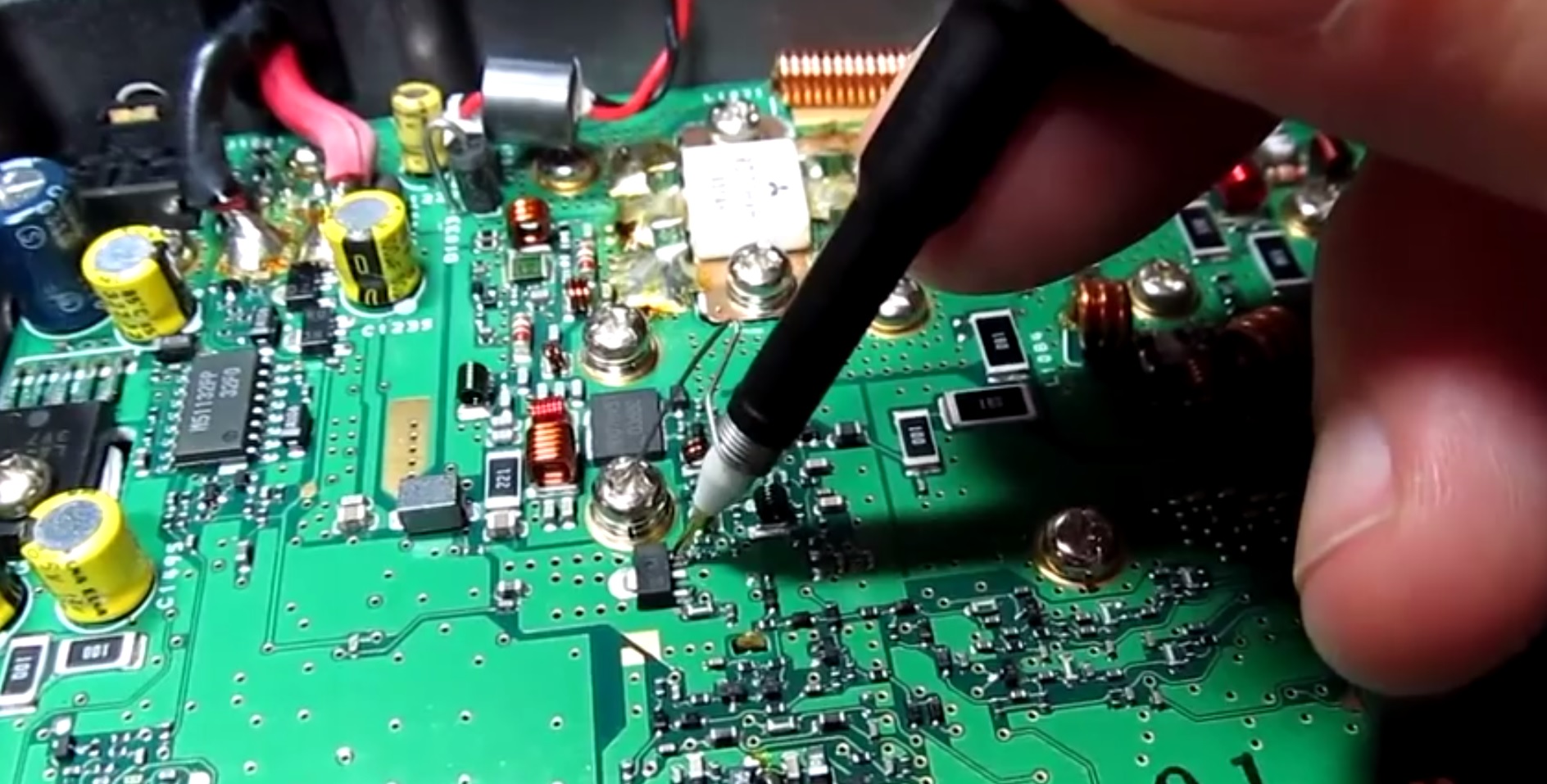
[Alan Wolke] aka [w2aew] was challenged to repair a friends Yaesu FT-7800 ham radio. This radio operates on two ham bands, 2 m VHF and 70 cm UHF. The complaint was that the 2 m side was not working but the 70 cm was transmitting fine. Alan started by verifying the complaint using a Bird watt meter with a 50 watt slug and terminating the signal into a 50 W dummy load. [Allen’s] bird meter is the type that has an RF sampler that can be connected to an oscilloscope for added signal viewing and validation.

After verifying that the radio was not working as described, Alan starts by glancing over the circuit board to look for any obvious damage. He then walks us through a block diagram as well as a circuit diagram of the FT-7800 radio before stepping us through the troubleshooting and diagnostics of radio repair. Even when he realizes he might have found the problem he still steps us through the remainder of his diagnostics. The skills and knowledge that Alan shares is extremely valuable to anybody looking to repair radios.

Spoiler alert. At the end of the first video he determines that the pin diodes near the final VHF output were bad. In the second video he reveals that he could no longer source these bad components. Through some clever evaluation of a more current Yaesu radio, [Allen] was able to find suitable replacement components. Lesson two ends with some surface mount solder rework tips as well as testing that the repair was successful.

And just in case you don’t know what a pin diode is, or is used for, Alan shares a third video covering just what this component is and does in a radio. You can follow the jump to watch all three videos.

Continue reading “Diagnose And Repair A Yaesu FT-7800 Ham Radio”

Transmitting Data With A Pi And RTL-SDR

Sometimes the best builds aren’t anything new, but rather combining two well-developed hacks. [Marc] was familiar with RTL-SDR, the $30 USB TV tuner come software defined radio, but was surprised no one had yet combined this cheap radio dongle with the ability to transmit radio from a Raspberry Pi. [Marc] combined these two builds and came up with the cheapest portable radio modem for the Raspberry Pi.

Turning the Raspi into a transmitter isn’t really that hard; it only requires a 20cm wire inserted into a GPIO pin, then toggling this pin at about 100 MHz. This resulting signal can be picked up fifty meters away, and through walls, even.

[Marc] combined this radio transmitter with minimodem, a program that generates audio modem tones at the required baud rate. Data is encoded in this audio stream, sent over the air, and decoded again with an RTL-SDR dongle.

It’s nothing new, per se, but if you’re looking for a short-range, low-bandwidth wireless connection between a computer and a Raspberry Pi, this is most certainly the easiest and cheapest method.

Weightless, The Internet Of Things Chip, Becomes Less Vaporware

weightless

Several months ago, we caught wind of Weightless, a $2 chip that will run for 10 years on a AA battery and communicate to a Weightless base station 10 Km away. Yes, this is the fabled Internet of Things chip that will allow sensors of every type to communicate with servers around the world. It looks like Weightless is becoming less and less vaporware, as evidenced by the Weightless SIG hardware roadmap; Weightless modules might be in the hands of makers and designers in just a few short months.

Weightless is an extremely low-cost wireless module that operates in the radio spectrum previously occupied by analog broadcast television. This is a great place for the Internet of Things, as signals in this spectrum have a lot of range and the ability to go through walls. These signals are sent to a Weightless base station where they are then sent over the Internet to servers around the world.

The Weightless SIG has been hard at work producing new silicon, with the third generation of chips heading for volume production next month. The only thing this chip requires is a battery and an antenna, making Weightless integration for new designs and projects a snap.

There’s one thing Weightless is not, and that’s a free, high-speed connection to the Internet with a $2 adapter. Weightless is designed for sensors that only transmit a kilobyte or so a day – medical sensors, irrigation control, and other relatively boring things. There’s a summary video from the recent 2013 Weightless SIG Summit going over all this information below.

Continue reading “Weightless, The Internet Of Things Chip, Becomes Less Vaporware”

Retrotechtacular: Fundamentals Of AM And FM Radio Communication

How radios send and receive information can seem magical to the uninformed. For some people, this week’s Retrotechtacular video, “Frequency Modulation – Part 1 Basic Principles”, from the US Army Department of Defense 1964 will be a great refresher, and for others it will be their first introduction into the wonderful world of radio communications.

The stated objective is to teach why FM radio communication reduces interference which normally afflicts AM radio communications. Fundamentals of AM and FM is a better description, however, because the first part of the video nicely teaches the principles of AM and FM radio communications. It isn’t until later in the clip that it delves into interference, advantages of FM modulation, and detailed functioning of FM radio. The delivery is slow at times and admittedly long, yet the pace is perfect for a young ham to follow along with plenty of time to soak in the knowledge. If you’re still on the fence about becoming a ham here’s some words or encouragement.

Though the video isn’t aimed at ham radio users it does address core knowledge needed by amateur radio hobbyists. Amateur radio is full of many exciting communication technologies and you should have a clear understanding of AM and FM communication methodologies before getting on Grandpa’s information super highway. Once you have your ham license (aka ticket) you have privileges to create and test amazing ham related hacks, like [Lior] implementing full programmable control of a Baofeng UV5R ham radio using an Arduino.

Join us after the break to watch the video.

Continue reading “Retrotechtacular: Fundamentals Of AM And FM Radio Communication”

Trash To Treasure Bluetooth Radio And Tube Amp Build

trash-to-treasure-internet-radio

The before image doesn’t look all that bad but we were still impressed with what went into the restoration of this radio. Perhaps restoration isn’t the right word since it didn’t manage to hold on to any of the original internals. This is more resurrection of a retro radio case for use as a Bluetooth radio.

At first look we didn’t notice that the original knobs were missing. The speaker fabric is ripped and the glass on the tuning dial is broken as well. [Yaaaam] happened to have another antique radio with interesting knobs — but he didn’t just transplant them. He made a mold of one knob and cast three replacements for the radio. After refinishing the wood he replaced the fabric and things were really starting to look up.

All of the electronic components were removed and a new tube amp was built on the original metal chassis. It uses a Bluetooth module for input which facilitates using your smart phone as the playback device without involving any wires or other nonsense. Two problems popped up after the project was completed. The first replacement power supply overheated. The second replacement had a different problem, needing some additional shielding to prevent noise from creating unwanted… noise.

This looks so much better than modern injection molded plastic shelf systems. But there are some fun wireless hacks out there for those too.