Simple MIDI Sample Player Runs On ESP32

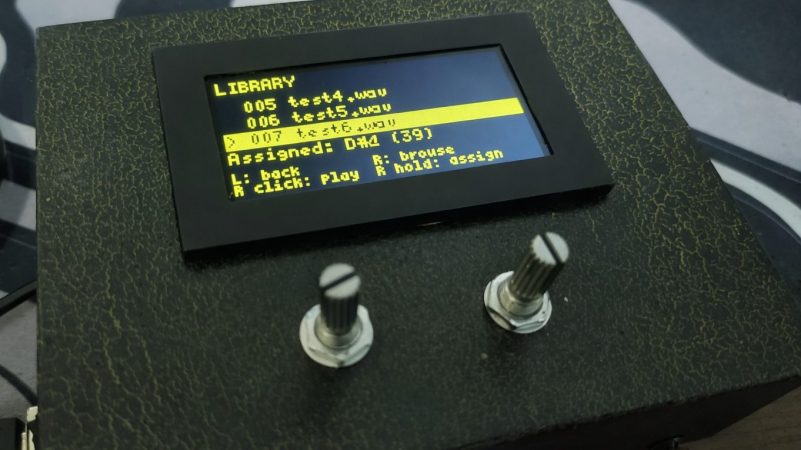
[Jakub] is a musician, and found himself in need of a simple way to trigger samples via MIDI when on stage. So many commercial solutions exist, but most were overkill for the job or too messy and complicated to justify their use in a live environment. Thus, [Jakub] worked up Samplotron to do exactly the job needed with a minimum of fuss.

The project is based around the ESP32. It’s effectively a lightweight hardware sampler that can trigger sounds on command via MIDI. Sample data is loaded from an SD card, which also stores the device configuration. The Samplotron plays back mono 16-bit WAV files at 44,100 Hz, delivering audio via an ES8388 audio codec module connected via I2S. Two encoders are used to control the device, with a menu system presented via an SSD1309 OLED screen. Samples can be loaded and managed via this interface, and it allows tweaks to be made to volume levels and one-shot/loop playback as needed. MIDI input to the device is simply handled via the onboard UART functionality of the ESP32 itself.

It’s a neat little bit of music hardware that does exactly what [Jakub] needs and nothing more. We’ve featured similar builds before, like this neat RP2040 soundboard. If you’re building rad custom hardware for your own musical adventures, we’d love to know all about it. 

Solving A Retrocomputing Mystery With An Album Cover: Greengate DS:3

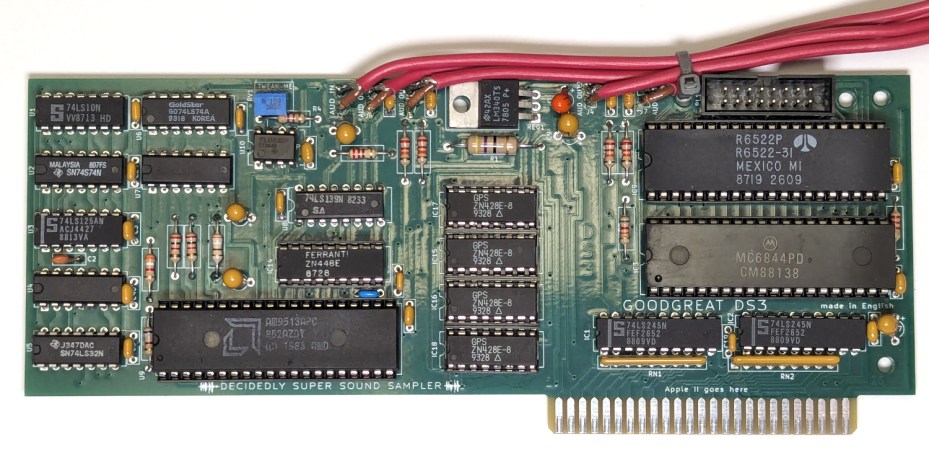
[Bea Thurman] had a retro music conundrum. She loved the classic Greengate DS:3 sampler, but couldn’t buy one, and couldn’t find enough information to build her own. [Bea’s] plea for help caught the attention of [Eric Schlaepfer], aka  [TubeTime]. The collaboration that followed ultimately solved a decades-old mystery. 

In the 1980s, there were two types of musicians: Those who could afford a Fairlight CMI and everyone else. If you were an Apple II owner, the solution was a Greengate DS:3. The DS:3 was a music keyboard and a sampler card for the Apple II+ (or better). The plug-in card was a bit mysterious, though. The cards were not very well documented, and only a few survive today. To make matters worse, some chips had part numbers sanded off. It was a bit of a mystery until [Bea and Tubetime] got involved. 

Continue reading “Solving A Retrocomputing Mystery With An Album Cover: Greengate DS:3”

A Brief Look Inside A Homebrew Digital Sampler From 1979

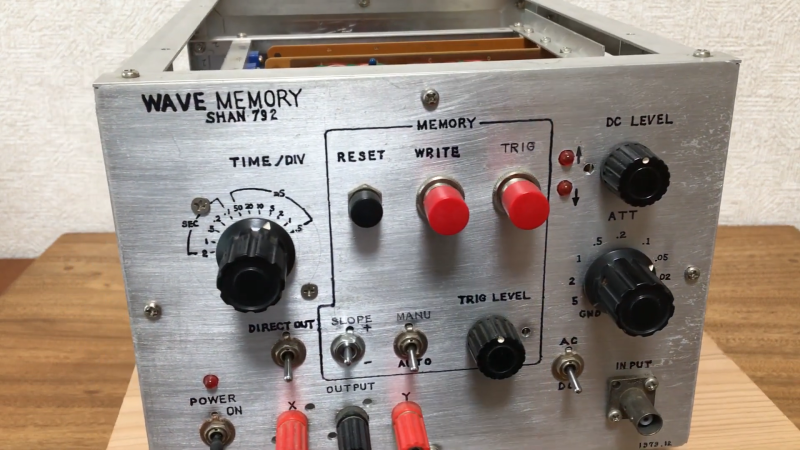
While we generally prefer to bring our readers as much information about a project as possible, sometimes we just have to go with what we see. That generally happens with new projects and work in progress, but it can also happen with old projects. Sometimes very old indeed, as is the case with this digital sampling unit for analog oscilloscopes, circa 1979.

We’ve got precious little to go on with this one other than the bit of eye candy in the video tour below and its description. Luckily, we’ve had a few private conversations with its maker, [Mitsuru Yamada], over the years, enough to piece together a little of the back story here — with apologies for any wrong assumptions, of course.

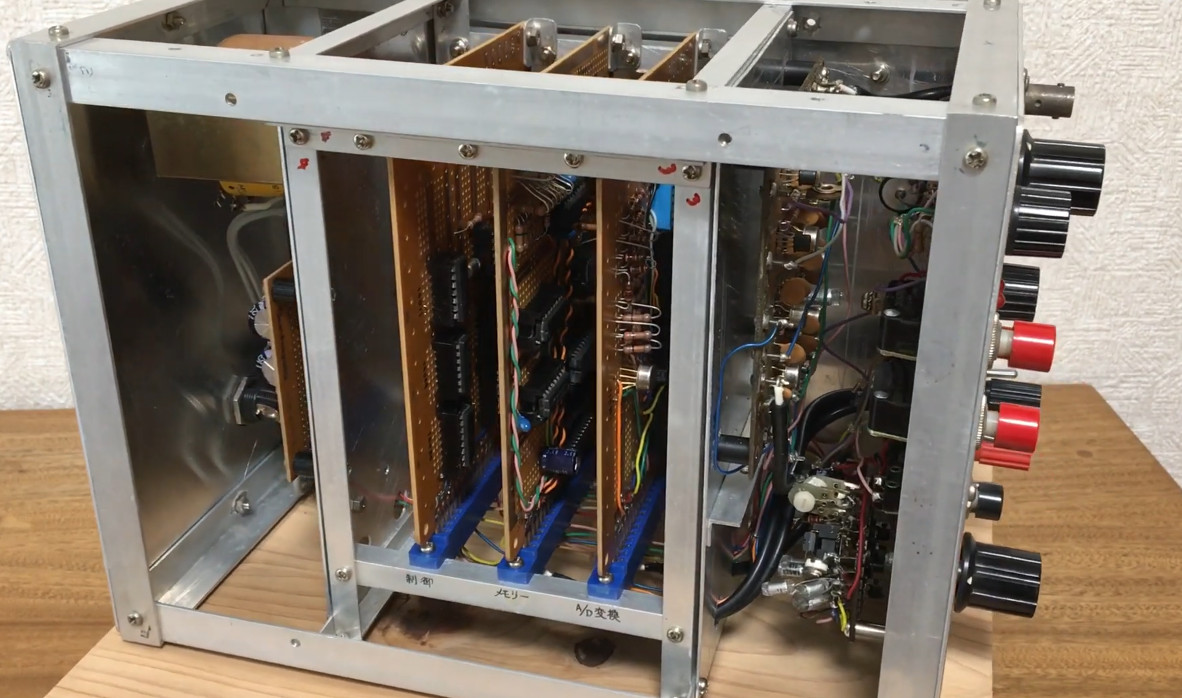
Built when he was only 19, this sampler was an attempt to build something that couldn’t be bought, at least not for a reasonable price. With no inexpensive monolithic analog-to-digital converters on the market, he decided to roll his own. A few years back he recreated the core of that with his all-discrete successive approximation ADC.

The sampler shown below has an 8-bit SAR ADC using discrete CMOS logic and enough NMOS memory to store 256 samples. You can see the ADC and memory cards in the homebrew card cage made from aluminum angle stock. The front panel has a ton of controls and sports a wide-range attenuator, DC offset, and trigger circuit with both manual and automatic settings.

It’s an impressive build, especially for a 19-year-old with presumably limited resources. We’ve reached out to [Yamada-san] in the hope that he’ll be able to provide more details on what’s under the hood and if this still works after all these years. We’ll pass along whatever we get, but in the meantime, enjoy.

Continue reading “A Brief Look Inside A Homebrew Digital Sampler From 1979”

ISD1700 Based Lo-Fi Sampler

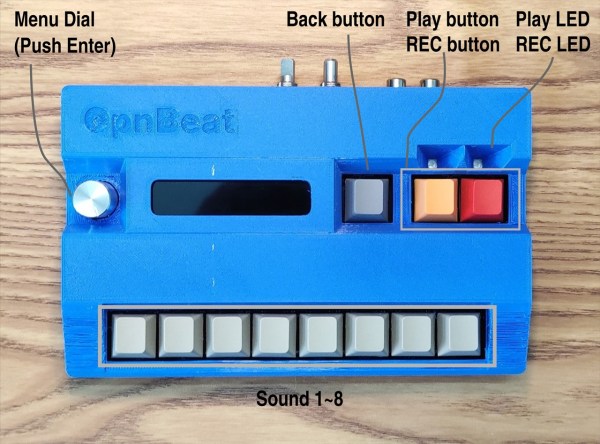
Custom music instruments here at Hackaday range from wacky to poignant. OpnBeat by [Hiro Akihabara] focuses on something different: simplicity.

There are few buttons, the design and code are optimized to be straightforward and easy to modify, and the interface is slick. Eight musical keys complement three interface keys and a knob. An Arduino Nano powers the main brains of the system but the music generation comes from eight Nuvoton ISD1700s controlled over SPI by the Nano. The beautifully laid-out PCB is 110mm by 180mm (4.33″ by 7″), so cases can easily be printed on smaller FDM printers. All the switches are Cherry MX switches for the beautiful tactile feedback.

The code, PCB, and 3D case files are all available on GitHub. We love the thought that went into the design and the focus on making it easy to recreate. It might be quite as cute and simplified as this twelve-button musical macro pad, but the two together could make quite the band.

Continue reading “ISD1700 Based Lo-Fi Sampler”

Microwave Sampler Is Like Time Domain Mixer

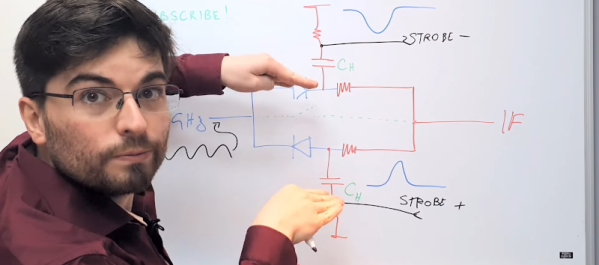
[Gregory] is building some microwave gear and wanted to convert a 3.3 GHz signal to a 12 MHz intermediate frequency. You might think of using a mixer, but you’d need a local oscillator of nearly 3.3 GHz which is not only hard to build, but also will be very close to the signal of interest which is not a great idea. Instead, [Gregory] opted for a sampler, which uses an effect you usually try to avoid — aliasing — to allow downconversion with a much smaller local oscillator. You can see the design in the video below.

In the case of converting 3.3 GHz to 12 MHz, the local oscillator is around 100 MHz. How does that work? Watch the video and find out. The final project will triple the 3.3 GHz signal and we presume the 12 MHz downconvert is to easily phase lock the frequency using a PLL (phase-locked loop).

Continue reading “Microwave Sampler Is Like Time Domain Mixer”

A Tidy Octave Mod For The Casio SK-1

1985 saw the release of the Casio SK-1, a compact sampling keyboard that brought the technology to a lower price point than ever before. However, one drawback of this was that it comes stock with only a 2.5 octave keyboard. [Jonas Karlsson] wanted a little more range out of the instrument, so set about hacking in his own octave mod.

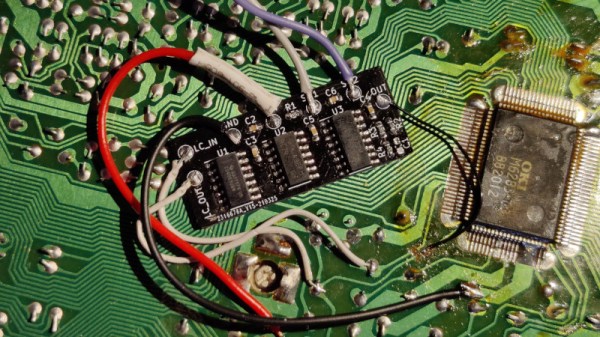
The build consists of fiddling with the SK-1’s microprocessor clock to change the pitch of the notes generated by the instrument. The original clock is generated by a simple LC circuit, which in this mod is fed to an inverter, and then a pair of flip-flops to divide the clock by four. The original clock and the divided version are then both sent to a mux chip. With the flick of the switch, either the original or downshifted clock can be sent to the microprocessor.

With the slower clock feeding the microprocessor, all the notes are downshifted an octave. The resulting sound, which you can listen to on Soundcloud, is similar to what you get when chopping down sample rates. It bears noting, however, that as this mod changes the master clock, other features such as rhythms are also effected.

It’s a great mod which gives the instrument a gloomier, grittier sound on demand. The Casio SK-1 has long been prized for its hackability; we’ve seen them completely worked over in previous mods. If you’ve got your own twisted audio experiments cooking up in the workshop, be sure to drop us a line.

Writing Dance Bangers Like It’s 1990 Again

Dance and house music exploded in a big way at the end of the 1980s. Typically the product of well-equipped studios with samplers and mixers worth thousands of dollars, it was difficult for the home gamer to get involved. That was, until the advent of the glorious Amiga, as [cTrix] ably demonstrates.

Sampling on your Amiga often meant sneaking off with the family hi-fi.

The video explains the history of both the music and the hardware, and highlights just why the Amiga was so special. Packing stereo audio and a four-channel sound chip, it had the grunt to pump out the tunes. All it was lacking was an audio input – which is where third-party hardware stepped in. Parallel-port analog-to-digital converters hit the market in a big way, letting users sample audio on their home computer without breaking the bank.

[cTrix] then proceeds to demonstrate how one would go about producing a dance track on an Amiga way back in 1990. A home stereo is used to play records, hooked up to a Stereo Master parallel port sampler. With a bunch of drum, piano, and synth samples recorded and saved on disk, a tracker is then used to assemble the track. It’s then compared with other music from the era as a great example of how things used to be done.

Overall, the Amiga will long have a legacy as the machine that brought real multimedia capabilities to the home computer. It’s one of our favourites, though keeping them going can be tough sometimes. Video after the break.

Continue reading “Writing Dance Bangers Like It’s 1990 Again”