

Hack Space Debris At Your Peril

Who has dibs on space debris? If getting to it were a solved problem, it sure would be fun to use dead orbital hardware as something of a hacker’s junk bin. Turns out there is some precedent for this, and regulations already in place in the international community.

To get you into the right frame of mind: it’s once again 2100 AD and hackers are living in mile-long space habitats in the Earth-Moon system. But from where do those hackers get their raw material, their hardware? The system abounds with space debris, defunct satellites from a century of technological progress. According to Earth maritime law, if space is to be treated like international waters then the right of salvage would permit them to take parts from any derelict. But is space like international waters? Or would hacking space debris result in doing hard time in the ice mines of Ceres?
Continue reading “Hack Space Debris At Your Peril”

Hackaday Prize Entry: MyComm Handheld Satellite Messenger

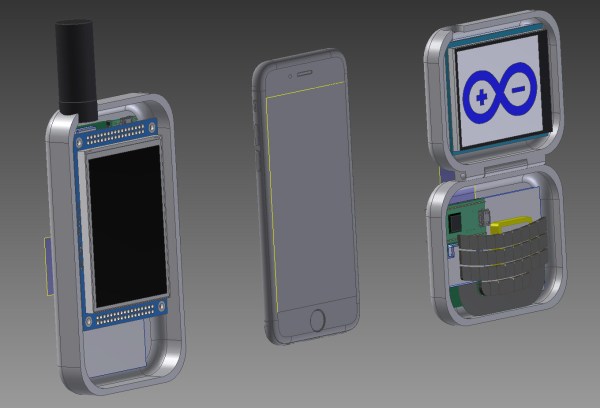
We live in a connected world, but that world ends not far beyond the outermost cell phone tower. [John Grant] wants to be connected everywhere, even in regions where no mobile network is available, so he is building a solar powered, handheld satellite messenger: The MyComm – his entry for the Hackaday Prize.

The MyComm is a handheld touch-screen device, much like a smartphone, that connects to the Iridium satellite network to send and receive text messages. At the heart of his build, [John] uses a RockBLOCK Mk2 Iridium SatComm Module hooked up to a Teensy 3.1. The firmware is built upon a FreeRTOS port for proper task management. Project contributor [Jack] crafted an intuitive GUI that includes an on-screen keyboard to write, send and receive messages. A micro SD card stores all messages and contact list entries. Eventually, the system will be equipped with a solar cell, charging regulator and LiPo battery for worldwide, unconditional connectivity.

2016 will be an interesting year for the Iridium network since the first satellites for the improved (and backward-compatible) “Iridium NEXT” network are expected to launch soon. At times the 66 Iridium satellites currently covering the entire globe were considered a $5B heap of space junk due to deficiencies in reliability and security. Yet, it’s still there, with maker-friendly modems being available at $250 and pay-per-use rates of about 7 ct/kB (free downstream for SDR-Hackers). Enjoy the video of [Jack] explaining the MyComm user interface:

Continue reading “Hackaday Prize Entry: MyComm Handheld Satellite Messenger”

Hackaday Dictionary: The Global Positioning System (GPS)

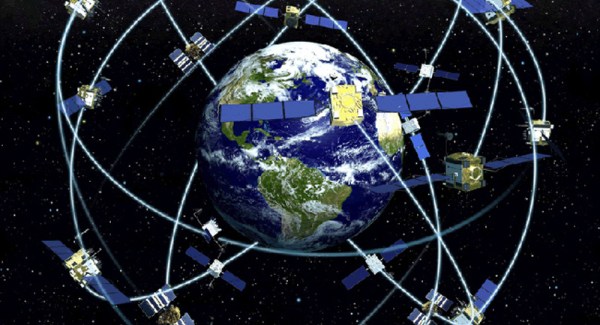
One of the fundamental technologies of modern gadgets is the Global Positioning System (GPS). Using signals from satellites orbiting the earth, a GPS receiver can pin down its location with remarkable accuracy: the latest generation of Civilian Navigation Signals (CNAV) sent by the US GPS system has an accuracy of less than half a meter (about 3 feet). These signals also contain the time, accurate to within milliseconds, which makes it perfect for off-line dataloggers and systems that require very accurate timing. That’s a powerful combination that has made GPS one of the main technologies behind the mobile revolution, because it lets gadgets know where (and when) they are.

Continue reading “Hackaday Dictionary: The Global Positioning System (GPS)”








