
Beginner Concepts: Cascading Shift Registers

There’s a million tutorials out there describing how to use shift registers. If you’re just getting into embedded systems you should know how to use them as they allow you to take three microcontroller pins and expand them virtually without limits. This is due to the serial-in parallel-out nature of these integrated circuits. A key feature of these chips is the ability to overflow, or cascade to the next chip which is what provides the expansibility.

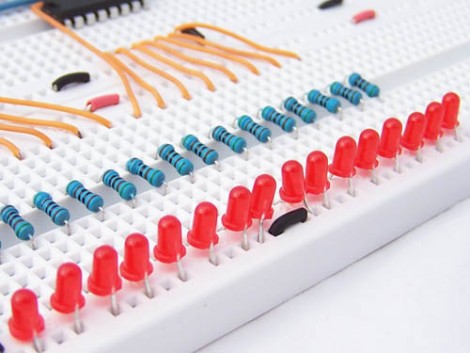
Protostack just published a tutorial that uses this hardware to interface sixteen LEDs using two shift registers. The explanation is short and to-the-point with easy to understand code examples. There’s also something to be said for their crisp and clean breadboarding work.

Take a look at how they do it and then use the concept to make a fancy clock or reduce the pins needed to drive a display.

Twitter Based Christmas Ornaments Update

When we introduced you to the Twitter Christmas tree ornaments, sadly we had very little information about the project. Luckily [Rob] made contact and clued us in on the inner workings. It even turns out we were wrong about the usage of Arduinos! We invite you to check out all the juicy inner workings after the break.
Continue reading “Twitter Based Christmas Ornaments Update”

BlokClok – Abstract Time Display

blokclok_abstract_time_display

Clocks made from blinking LEDs always make for fun projects. [Earthshine] built a clock that displays time abstractly using an 8×8 RGB LED matrix. The video embedded after the break illustrates how to read the time but here’s the gist of it: One LED is illuminated in the outside box of LEDs and moved in a clockwise motion to approximate seconds. Inside of this, there are four quadrants; upper left indicates hour-tens digit, upper right hour-ones, lower left minute-tens, and lower right minute-ones. This certainly makes for an interesting conversation piece!

There is no schematic and no code available but it’s really the concept that we’re interested in. If you must know, [Earthshine] bases this build around an Arduino. A DS1307 real time clock keeps the time, while four 74HC595 shift registers are utilized to control the three LED colors and the multiplexing.

Continue reading “BlokClok – Abstract Time Display”







