Hackaday Links: July 25, 2012

Ever wonder what CPU dev boards look like?

In the realm of highly confidential hardware, it doesn’t get much more secret than upcoming CPUs coming out of Intel. Somehow, a few CPU dev boards wound up on eBay, and [Leon] was cool enough to save all the pictures (Polish, Google translation, or translate in the sidebar). There are a few ongoing auctions right now, but we’d settle for this LGA 1156 breakout board. So cool.

No, we’re not linking directly to the free stuff
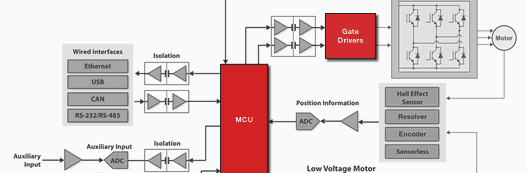
TI is giving away a brushless motor controller powered by a Stellaris ARM processor. [Chris] says he’s ordering one to figure out how to make a Stellaris dev board out of the giveaway. This controller is designed for e-bikes, so at the very least we see a few ginormous UAVs in someone’s future.

More rocket stuff!

One of [Bill]’s older hacks was taking a CVS disposable digital camera (remember that?) and stuffing it into the nose code of an Estes D-powered rocket. There’s a ton of videos of the flights [Bill] put up on YouTube.

On another note, [CyberPunk] built a half-scale model of a swing-wing rocket launched glider (pics: 1, 2, 3, 4). He’s currently building the full-size version capable of carrying RC and video gear and wants some feedback.

So, CAD on a tablet?
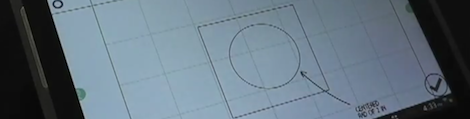
[spuder] caught wind of a tablet-based engineering notebook a few people are working on. They’re looking for some feedback on their demo video. We think it’s cool – especially the ability to share stuff between devices – but CAD on a tablet makes us extremely skeptical. Tell them what you think; we’d love to see this make it to our phone.

Now if they only made one for editing WordPress posts….

Test-driven development just got cooler. Here’s a Tamagotchi for Eclipse that you ‘feed’ by going from red to green and refactoring your code. Be careful, because having the same code test as red twice will kill your little code ninja.

And now I’ll rant about you.

A few days ago, I posted [Becky Stern]’s light-up handlebars project, and one comment surprised me. Who says guys can’t sew? It’s time to confront the gender roles that show up whenever sewing is used in a project. I’m doing a tutorial on how to sew a parachute, but I need your help. It’ll be a two-parter: one on how to actually use a sewing machine, and another for how to make a ‘chute. Is there anything else you’d like to see?

Android CNC Controller

[Matt] is the proud owner of a JGRO-based CNC router and he’s been working on a way to control it without a computer. What he came up with is a way to drive the CNC machine using this Android tablet.

A big part of the hack is the CNC controller that he’s using. The TinyG is a board that can take commands via USB and convert them to instructions for up to six axes. In the video after the break [Matt] shows off a direct USB connection as the control method. This is the most interesting part to us, but the system can also be run through the network with the assistance of a computer feeding commands to the TinyG. This second method means the Android controller would be wireless.

A trio of repositories host the code [Matt] is using. From the demo it looks like the Android app has no shortage of features.

Continue reading “Android CNC Controller” →

The MessagePad; A Thoroughly Hacked Macbook Turned Tablet

hacked macbook

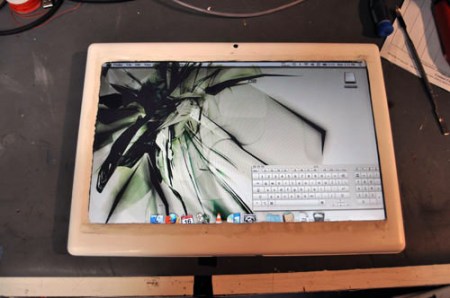
Remember the times before the iPad existed? When a tablet PC was actually a full computer in a tablet form factor? Yeah, those days we were all so very optimistic about the future of tablet computing. Don’t think we don’t appreciate the new amazing toys that we’ve got around with the plethora of tablets to choose from, but we still dream of fully functional tablet computers.

[Brian] wrote in to show us his build of a fully featured tablet macbook conversion dubbed the MessagePad. Though we’ve seen a wide selection of home spun tablets before, this one has an impressive list of added features. It boasts both front and rear facing cameras, an SSD drive, a built in Teensy, and a line-in. It doesn’t matter if you believe in the dream of a full blown pc in tablet format, or if your preference would have been a Windows or Linux machine. You’ll surely love the bevy of photos he took along the way as he was hacking and slashing on this thing.

Microsoft Shows Off Their Transparent 3D Desktop Prototype

We think most would agree that the Microsoft Kinect is a miraculous piece of hardware. The affordable availability of a high-quality depth camera was the genesis of a myriad of hacks. And now it seems that type of data is making an intriguing 3D display possible.

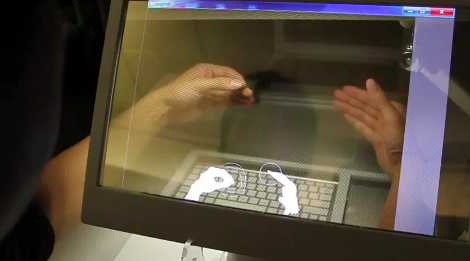
What you see above is a 3D monitor concept that Microsoft developed. It starts off looking much like a tablet PC, but the screen can be lifted up toward the user whose arms reach around it to get at the keyboard underneath. There is as depth camera that can see the hands and fingers of the user to allow manipulation of the virtual environment. But that’s only part of the problem. You need some way to align the user’s eyes with what’s on the screen. They seem to have solved that problem too, using another depth camera to track the location of the user’s head. This means that you can lean from one side to the other and the perspective of the virtual 3D desktop will change to preserve the apparent distance of each object.

Don’t miss the show-and-tell video after the break. As long as there’s only one viewer this looks like a perfect non-glasses alternative to current 3D hardware offerings. Continue reading “Microsoft Shows Off Their Transparent 3D Desktop Prototype” →

Tablet Cover From Old Hardcover Books

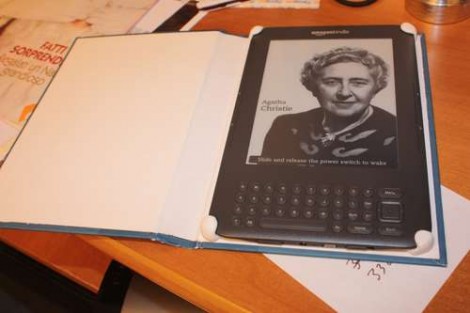
Here’s a way to look hip and destroy books at the same time. This table cover is made from an old hardcover book. It’s not difficult to do, an afternoon is all it takes, and if you follow all of the instructions we’d bet this will hold up for a long time.

It’s basically another version of the Moleskine cover for the Kindle Fire. You find a donor book (second-hand shops are packed with ’em) with a hardcover which you really enjoy. Kids books would be the most fun because of the artwork – if you can find one thick enough. With book in hand remove all of the pages. This will leave the binding a little flimsy, and since this is a project by the company which make Sugru, you can see why they used the moldable adhesive for that purpose. But check out the brackets in the picture above. They covered the Kindle in cling wrap, then molded Sugru around the corners. Once set, it can be peeled away from the plastic wrap, but will retain its shape. Nice.

Replacing An Overheating Tablet Power Supply

[Dave] has an ASUS tablet PC with a little problem. The device is charged via the docking connector’s USB cable when plugged into a special wall transformer. The problem is that the wall unit tends to overheat, and is shut down by a thermister inside to avoid permanent damage. The word on the Internet is to drop it in a zipper bag and chill it in the freezer for a bit. Although this works, it’s not the permanent solution that he was looking for. Instead, he hit the parts bin and built his own power supply replacement without buying anything.

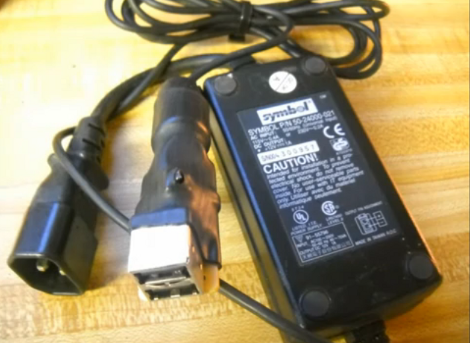
The device is simply looking for 12V on the power pin (pin 1) of the USB cable. [Dave] dug through his mountain of unused AC adapters and found one that fit the voltage and current specs of the stock unit. He also grabbed a dusty old motherboard and plucked the USB ports off of the back. A bit of protoboard makes for a good base to connect the AC adapter wires to the ports, which was then covered with one big shrink tube. The result is seen above, and demonstrated in the clip after the break.

Continue reading “Replacing An Overheating Tablet Power Supply” →

Kindle Fire Cover From A Moleskine Journal

[Kevin Haw] is the proud owner of a brand new Kindle Fire. But to protect the investment he wanted a nice looking case and decided that DIY was the way to go. He ended up repurposing a Moleskine journal as a table cover.

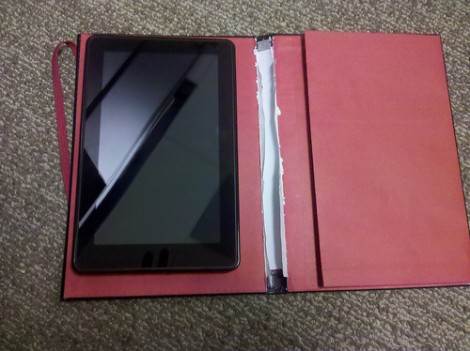
You can do this one yourself in under an hour. Most of the pages in these journals are sewn in place and [Kevin] started by cutting the strings with a hobby knife. Once removed, he used a utility knife to separate the pages that were glued to the cover; this leaves you in the state seen above.

Obviously this unfinished look just won’t do. [Kevin] used some red duct tape duct tape to cover the unsightly spine. This adds strength, and does the job of cleaning up the area, but we might have also applied felt (or microfiber cloth) to the entire inside area for a bit more finished look. The final part is mounting the tablet which was accomplished with adhesive Velcro strips. These can be removed from the back of the Kindle Fire later on if you decided to use a different enclosure.