No Quarters Required For This Sidescrolling Game In A Box

teagduino_game_in_a_box

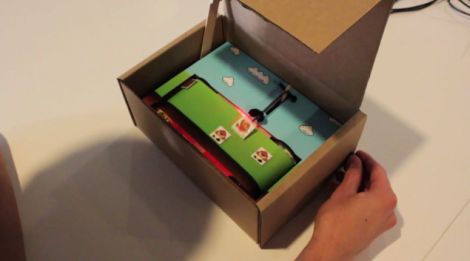
[Adam] from Teague Labs wrote in to share a new gadget they built to help demonstrate the capabilities of the Teagueduino. Their table top video game in a box was made with a bunch of electronic components they had sitting around, as well as soda straws, plenty of painter’s tape, and some popscicle sticks.

When someone pulls the string on the front of the box, a servo opens it automatically, and a second servo starts spinning the game reel. As the reel moves, the player is presented with a set of obstacles to dodge, guiding the “hero” via a knob-controlled servo. A hall sensor attached to the back of the character is tripped when passing over any of the obstacles, which are attached to the reel with magnetic tape. When the hero collides with an obstacle, the game ends and proceeds to close itself, much to the chagrin of the player.

As you can see in the video below, it’s a pretty entertaining and challenging game.

Looking to make one of your own? Swing by the Teagueduino site to grab the game’s code and be sure to share your creations with us in the comments.

Continue reading “No Quarters Required For This Sidescrolling Game In A Box”
Overclocked ATmega32 Gaming

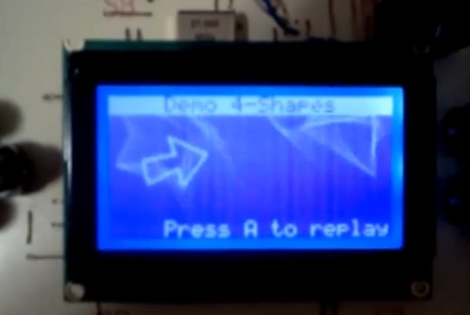
With more pixels and more objects to track you’re going to need to get that AVR running pretty fast to get the job done. But [Vladutz2000] figured why stop at 16 MHz when you can overclock an ATmega32 to 27 MHz for a faster gaming experience?

This build may not be as colorful as Super Pixel Bros, but choosing a KS0108 graphic LCD certainly brings a lot more definition to the images. You can see in the video after the break that the AVR does an excellent job of generating and animating multiple objects. It doesn’t take much to put this together yourself but if you want the board layout done for you, you’re out of luck. The hardware for the project is installed on a PCB that was hand-drawn with an etch resist marker. Continue reading “Overclocked ATmega32 Gaming”

Video Game Installations For Kids’ Parties

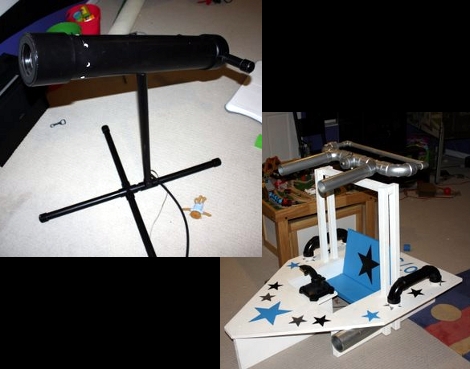
Why won’t someone think of the children?! Actually, some of the best hacks come from entertaining the little ones. Take [Piles of Spam’s] two video game builds. The first is a telescope-based controller that is used to shoot virtual cannon balls at a projection of a pirate ship. The second is a two-player cooperative game where one player drives and the other shoots. Both of them use a projector to display the playing field, an IR laser for targeting, and an NTSC camera to pick up the location of the laser dot. This works really well, thanks to the quality of the physical builds, and great audio and video on the game side of things. See for yourself in the clips after the break.

A couple of posts into the thread [Piles of Spam] talks about laser intensity. He wanted to make sure that there wouldn’t be a room full of half-blind five year olds thanks to the targeting system. Continue reading “Video Game Installations For Kids’ Parties”

Dungeon Crawler Game For IM-ME (and Linux)

[Joby Taffey] takes the prize for the first completed homebrew game for the IM-ME. Over the last few weeks we’ve seen [Travis Goodspeed] working with sprite graphics, and [Emmanuel Roussel] developing game music for the pink pager. But [Joby] didn’t really use either of those.

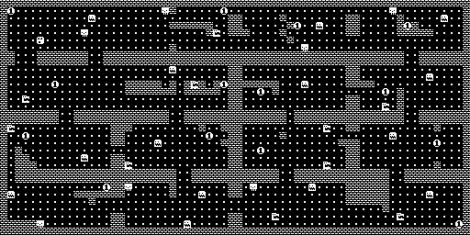
[Travis’] sprites were using a framebuffer that fills up a lot of valuable RAM. [Joby] decided to draw the room screens (all of them have been stitched together for the image above) as a one-time background image to keep the memory free. From there, the screen is updated in 8×8 blocks based on cursor movement. He also decided not to add music as he feels the high-pitched piezo is not capable making sound without driving everyone crazy.

Source code is available and for those of you who don’t own this pretty handheld, the game can also be compiled in Linux.

Live Action Fighting Games

Here’s a strange one. This fighting game uses a video game interface to instruct modern-age gladiators on how to bring the pain. The costumed fighters cannot see anything other than a set of lights in their helmets instructing them to move or punch. A camera films them and overlays the footage on a digital background along with simulated blood and a health bar for each. NES controllers are used to instruct them, and switches inside the costumes register the pummeling they receive and deduct health accordingly. This wouldn’t be any good without a demonstration, which we’ve embedded after the break.

Continue reading “Live Action Fighting Games”

yo dog, we heard you liked simulations

16 Bit ALU In Minecraft

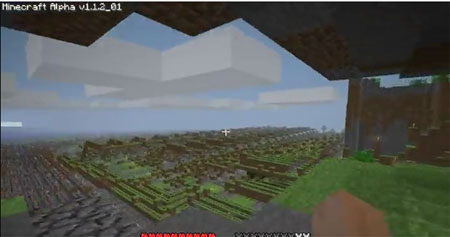
We love games here but we don’t often get a reason to write about them. This, however, is worth mentioning. The indie hit Minecraft is eating the entire internet right now. The game itself is hit and miss amongst our staff, but this project is unanimously accepted as awesome. [Theinternetftw} has created a simulation of the ALU section of a 16bit processor.  He can set it in motion and run around watching as the states change. This is part of an even bigger project to create the entire processor as shown in the book “The Elements of Computer Systems“.

For those that are wondering how long it took him to place all of those pieces, he actually imported most of it from another program. You can get more details on how they pulled this off in this forum thread. Be sure to catch the video after the break.

Continue reading “16 Bit ALU In Minecraft”

Racing Game Uses A Physical Race Track And Vehicle

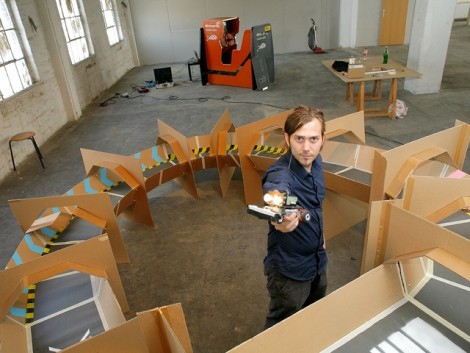
Racer is a racing video game with a very real element. The player sits in an arcade-style console; wheel, pedals, shifter, and television display. But in what must be an homage to Tron the game taking place is very real. You can see the track above, designed in CAD and cut from cardboard, which is navigated by that little vehicle the gentleman holds in his hand. It’s wireless and broadcasts video back to the control console. What we have here is a homemade drone but for now it’s confined to the gaming grid. Don’t miss the demos after the break. Continue reading “Racing Game Uses A Physical Race Track And Vehicle”