Google Hangout Laser Turret

The guys from the House4Hack hackerspace in Johannesburg won the 2011 Google+ Hackathon with their Friggin’ Laser Turret. The build started off as a remote-controlled webcam that can be controlled by anyone in a Google+ hangout. On a whim, the team decided to add a laser to the build because lasers are awesome.

The inspiration for the build was to have a Google+ hangout available whenever someone is at the hackerspace. If a guest can’t grace the team with their physical presence, at least they can be there virtually. The camera is controlled by an Arduino running a bog-standard servo library implementation. The Arduino is connected to a laptop over a serial connection and is able to move left and right. To spice things up a little, the team added a 25mA laser diode to the build controlled from a digital output on the Arduino.

For winning the Jo’burg Google+ Hackathon, the guys scored themselves a Samsung Galaxy S II phone. Not a bad prize for building something cool. Check out the demo of the friggin’ laser turret after the break.

Continue reading “Google Hangout Laser Turret”

Cheap Ikea Camera Boom Ensures Shake-free Video

ikea_webcam_jig

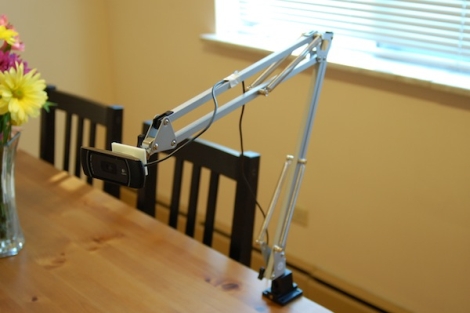
[Chris] recently got himself a nice web cam for documenting his Makerbot builds, and much like [Dino], he was looking for a way to get a bird’s-eye view of the action while keeping the camera nice and steady. While [Dino] ventured off to the hardware store, [Chris] tried a few different options that included tape, before heading off to Ikea to see what he could find.

$9 and a few Swedish meatballs later, he was on his way home with a “TERTIAL Work Lamp” that can be mounted on virtually any desk-like surface. He had to remove most of the web cam’s useless mounting hardware, doing the same with the lamp’s light fixture. He put together a small bracket in Google Sketchup, which he then printed out using his Makerbot.

It fit perfectly, and now he can get steady video of his Makerbot prints every single time.

Garage Door Monitoring And Control Using A Dedicated Android Phone

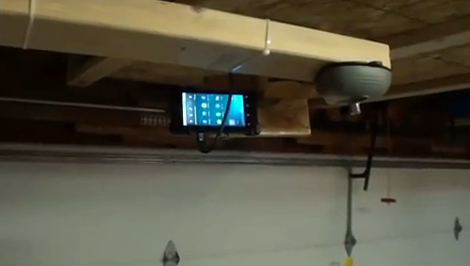
[Sean] happened to have an extra Android phone sitting around and wanted to see what type of home automation he could use it for. One simple hardware modification, and some apps from the Android Market let him monitor and control his garage door remotely.

The hardware modification is a hack we’ve already looked at. The BTmate uses a Bluetooth headset with an added transistor to short the connections on your garage door opener. The only issue is that you need to be within range for the Bluetooth to work. [Sean] adds a layer of abstraction by using two Android phones. One is permanently mounted in the garage and handles the Bluetooth connectivity, while the other uses VNC to tunnel in anywhere he has an Internet connection.

But why stop there? He knew that this one feature was overkill, and added a second which the phone was perfect for. Since it has its own camera, he used the tinyCam app to create a webcam server. This even allows him to turn the LED on and off for a better view in dim light conditions. See [Sean’s] demonstration after the break.

Overkill? Maybe, but if you’ve got a phone with a broken LCD, this might be just the thing to give it a new purpose.

Continue reading “Garage Door Monitoring And Control Using A Dedicated Android Phone”

We Don’t Need To Brainstorm Projects; Xkcd Does That For Us

[Randall Munroe], the guy behind our favorite web comic xkcd, gave us yet another great project idea that falls on the heels of securing our valuables and silencing loud car stereos. The xkcd forum has been talking about how to implement this, and we’d like to hear what Hack A Day readers think about this idea.

The project isn’t much different from 3D photography. [Carl Pisaturo] has done a lot of art and experimentation based on this idea that basically amounted to largish binoculars. A poster on the xkcd forum has already built this using mirrors, but we’re wondering how much the parallax can be increased with this method. Two cameras and a smart phone would also allow automatic pan and tilt that corresponds to head movement.

We’re not quite sure if this idea can be applied to astronomy. The angular resolution of the human eye is around one arc minute, every star except for the Sun has an annual parallax less than one arc second. If anyone wants to try this out with a longer baseline (From Earth to Pluto for example), we would suggest simulating this in Stellarium. Seeing the moon as a sphere would be possible with a few hundred miles between cameras, though.

Tell us how you would build this in the comments, and be sure to send in your write-up if you manage to build it. We’ll put it up right away.

Thanks to [Theon144] for sending this in.

EDIT: Because the comments are actually bearing fruit, check out the thread on the Hack A Day forums for this post: link.

Smile, Your Face Is On The Internet

[Kyle McDonald] is up to a bit of no-good with a little piece of software he wrote. He’s been installing it on public computers all over New York City. It uses the webcam found in pretty much every new computer out there to detect when a face is in frame, then takes a picture and uploads it to the Internet.

We’ve embedded a video after the break that describes the process. From [Kyle’s] comments about the video it seems that he asked a security guard at the Apple store if it was okay to take pictures and he encouraged it. We guess it could be worse, if this were a key logger you’d be sorry for checking your email (or, god forbid, banking) on a public machine. Instead of being malicious, [Kyle] took a string of the images, adjusted them so that the faces were all aligned and the same size, and then rolled them into the latter half of his video.

Continue reading “Smile, Your Face Is On The Internet”

Electronic Bird House Monitoring Goes A Few Steps Further

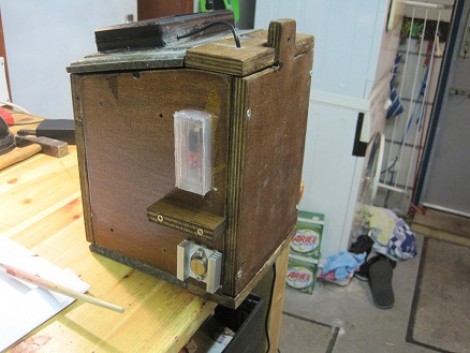
[Stephen Albers] offers his avian friends a lot of extras with this electronically monitored bird house. This will not only give you a look at what’s going on inside, but provide a source for several other bits of data as well.

First off, a camera has been mounted to the underside of the roof. This looks down on the nesting area and features night vision so that you can peek in any time day or night. He used a WiFi webcam that operates separately from the other electronics.

With the remainder of the setup he is able to harvest temperature and humidity data inside, temperature outside, force on the bottom of the house (although this turned out to be less useful than anticipated), and a in-and-out count for the doorway provided by an IR transmitter/receiver pair.

This offers quite a bit more than the last bird house project we saw. That one also left a lot to be desired as far as protecting the electronics. [Stephen] didn’t skip on that kind of protection. Most of the electronics are housed in an acrylic chamber in the base of the house. The sensors find themselves nestled in plastic enclosures, although some work needs to be done to ensure that the temperature and humidity sensors will still function correctly with this setup.

Displaying Video And Gifs On RGB LED Matrices

led_matrix

[Mathieu] was on holiday in China and picked up some fun toys while perusing the numerous electronics markets there. The most interesting things he discovered were a pair of RGB LED matrices. They came in two different flavors, one made for indoor and one for outdoor displays, sporting a 64×32 and 32×16 resolution, respectively.

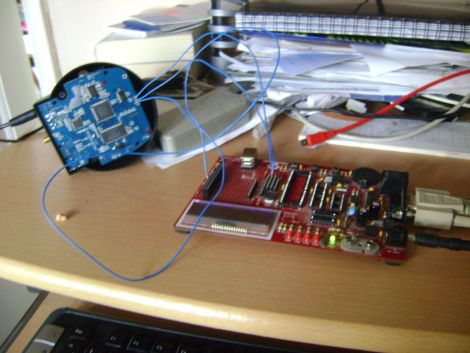
If you’ve read his blog before you know he is a big fan of LED matrices, so it’s only natural that bought a whole bunch of them and started experimenting once he got home. Using the same Atmel FPSLIC LED matrix control board he showed off in this previous hack, he was able to get the LED matrices up and running in no time. He adapted his webcam project to utilize the new panels, and he added a whole new feature as well. Via MatLab, he can now display any sort of animated gif on the panels, as you can see in the video below. The panels look great, and if we had a few of these around, there’s no doubt we would probably play this video on infinite repeat.

He says that the despite their somewhat questionable origins, the panels are of top notch quality, and he is willing to organize some sort of group buy if others are interested.

Continue reading “Displaying Video And Gifs On RGB LED Matrices”