Devote your life to replicating a lightsaber

posted Aug 27th 2010 8:00am by
filed under: toy hacks

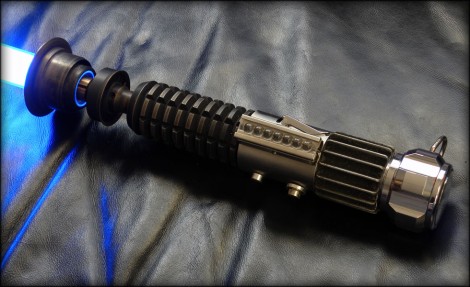
Life-sized Star Wars replica props, it’s one way to keep the ladies away. But if you’re going to make them, you should do it right. [Bradley W. Lewis] spent some serious time getting this [Obi-Wan Kenobi] lightsaber right. The seven-page build log provides plenty of eye-candy. We especially enjoyed the machine and coloring of he grenade-fin portion. The LED ladder that lights the blade is also quite interesting. For the icing on the cake he incorporated a high-performance speaker connected to the sound board from a Hasbro Force FX which provides that classic swashbuckling sound from a galaxy far, far away.

Spy Video TRAKR: first impressions

posted Aug 27th 2010 4:32am by
filed under: reviews, robots hacks, toy hacks

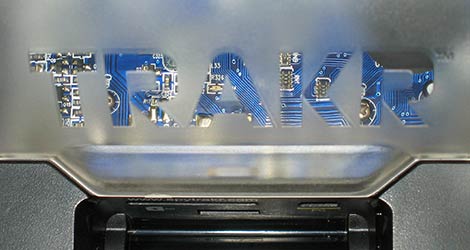
At the Bay Area Maker Faire this past May, we had our first glimpse of Wild Planet’s Spy Video TRAKR, a $130 radio-controlled toy with some surprises under the hood.

On the surface, the Spy Video TRAKR — the latest addition to the popular Spy Gear toy line — is an R/C tank with a video camera and night vision, with the added ability to download new “apps” from the internet for extra functions. With a little detective work, one uncovers the TRAKR’s secret double life: it’s also an eminently hackable robotics platform! Prior Spy Gear toys have been popular hack targets, providing inexpensive, mass-produced sources of unusual items such as head-mounted displays. Rather than throw up barriers, Wild Planet has chosen to embrace this secondary market, with plans to release development tools and documentation making it possible to extend the device’s capabilities.

Read on for our image-heavy unboxing and initial impressions.


LED goggles make you trip out?

posted Aug 26th 2010 1:30pm by
filed under: led hacks

Who knows if this works and should you really want to try to induce hallucinations by flashing colors in front of your eyes? But we do love the zaniness of the project. [Everett's] homemade hallucination goggles come in two flavors, the small swimming-goggle-type model and the heavy-duty trip visor made from welder’s goggles. Each brings together the same components; a half ping-pong ball for each eye to diffuse the light from an RGB LED. The system is controlled by an Arduino with some buttons and 7-segment displays for a user interface. Put this together with some homemade EL wire and you’re ready for Burning Man.
[Thanks Evan]

So you want to make a Command Line Interface

posted Aug 26th 2010 12:29pm by
filed under: how-to

[Keba] not only asked Answeres.HackaDay.com, but also sent us an email as follows.

“Can you make a basic guide to designing a good Command Line User Interface?”

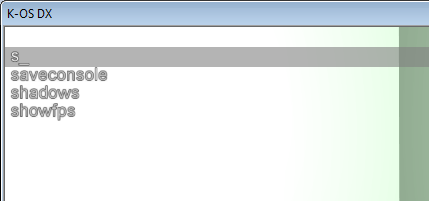
Wouldn’t you know the luck, I’m currently working on a Command Line type interface for a project of mine. While after the jump I’ll be walking through my explanation, it should be noted that the other replies to Answers.HackaDay.com are also great suggestions.

Read the rest of this entry »

Building a laser cutter from a weak laser

posted Aug 26th 2010 11:00am by
filed under: laser hacks

We covet laser cutters and this diy model with a 1 Watt IR diode may be well within our price range. Most commercially available laser cutters, and some homemade ones, work in the 20-100 Watt ranges, using a CO2 laser. They have more than enough power to cut right through a lot of materials so how can a 1W diode compare? It seems that the weaker laser is still quite powerful right at its focal length, so moving that point along the Z axis will let you burn away a larger depth of material. The test rig seen above uses optical drive components for the three axes and managed to cut a rectangular piece out of the black plastic from a CD case.

This isn’t [Peter's] first try with CNC lasers. He’s the one that’s be working on an open source selective laser sintering platform.

[Thanks Osgeld and Vesanies]


Hacking a code-protected hard disk

posted Aug 26th 2010 9:56am by
filed under: security hacks

Our friend [Sprite_TM] took a look at the security of a code-protected hard disk. The iStorage diskGenie is an encrypted USB hard drive that has a keypad for passcode entry. After cracking it open he found that the chip handling the keypad is a PIC 16F883 microcontroller. He poked and prodded at the internals and found some interesting stuff. Like the fact that there is an onboard LED that blinks differently based on the code entered; one way for the right code, another for the wrong code of the right number of digits, and a third for a wrong code with the wrong number of digits. This signal could be patched into for a brute force attacking but there’s a faster way. The microcontroller checks for the correct code one digit at a time. So by measuring the response time of the chip an attacker can determine when the leading digit is correct, and reduce the time needed to crack the code. There is brute force protection that watches for multiple incorrect passwords but [Sprite_TM] even found a way around that. He attached an AVR chip to monitor the PIC response time. If it was taking longer than it should for a correct password the AVR resets the PIC before it can write incorrect attempt data to its EEPROM. This can be a slow process, but he concluded it should work. We had fun watching the Flash_Destroyer hammer away and we’d like to see a setup working to acquire the the code from this device.

Burglar alarm in a zippo lighter

posted Aug 26th 2010 6:41am by
filed under: Microcontrollers, security hacks

surprisingly awesome

[Madmanmoe64] has really done a fantastic job with this burglar alarm built into a zippo.  He crammed a picaxe microcontroller, some IR LEDs, an IR sensor, a battery and various switches in there quite well. It almost closes perfectly, something we think he could remedy if it really bugged him that much.

It has several modes, all initiated by a different sequence of button presses. There is the proximity alarm, which sounds when something moves very close. The reverse proximity alarm which sounds when you remove something from its immediate vicinity.  A doorbell mode, and a silent alarm mode. Check out the video after the break to see it in action.

Read the rest of this entry »

Take better pictures of your projects

posted Aug 25th 2010 2:30pm by
filed under: digital cameras hacks

[PT] let us know about a fantastic guide to taking better photographs of your projects. It’s a hefty read but well worth the effort. Author [Johngineer] helps us understand how to use simple (and possibly inexpensive) tools like lights, mirrors, and a background material. He also gives some tips on how to recognize what your image processing software is telling your about your photography skills (get the correct camera setup and you won’t need correct your levels in The GIMP). There’s even some tips on photographing LEDs, a topic we’ve seen before, which you’re bound to find useful when trying to make that blinky thing you built into an Internet sensation.


Hack a Day serves up fresh hacks each day, every day from around the web as well as hacking related news.

Send us your hacks


Hacks

Resources