Turning music into a light show

posted Jan 22nd 2011 12:19pm by
filed under: arduino hacks, digital audio hacks

[nickinoki] Made a light show using some amplifiers and an arduino. First he created a microphone circuit based around a LM386 Audio Amplifier. After amplifying the output of the microphone a second time, he uses three bandpass filters to block all but a few desired frequencies from reaching the arduino.  By only letting a few frequencies through the arduino is able to determine if the song is louder at higher or lower frequencies.  Then using the three analogue inputs he created a scheme for generating the light show on an arduino. While he was unable to achieve the exact target frequencies with his bandpass filters they worked well enough to allow him to successfully generate the light show.

Reverse Engineering a PCB

posted Jan 22nd 2011 10:17am by
filed under: repair hacks

Occasionally when a device breaks, the defect is obvious. Whether it is a blown fuse or a defective capacitor, generally the easy to see stuff is easy to fix. When a problem is more subtle, or when doing some more advanced tasks like adding functionality to a device, greater knowledge about a circuit board is required. While there might be details hidden in lower levels of PCB, often just knowing the mounted components and layout of the outside layers can be enough to create a rough schematic of a device. [Throbscottle] has put together an excellent guide for procedurally breaking down a photo of a board and turning it in to something useful. The guide utilizes some open source image processing software such as the GIMP, Inkscape, and Dia, all of which are widely available. Keep in mind this reverse engineering can be a time consuming process, but will almost definitely reward those patient enough to work through it.

[Thanks to everyone who sent this in!]


High Voltage Etch a Sketch

posted Jan 22nd 2011 8:16am by
filed under: cnc hacks

What do you get when you mix a simple X/Y plotter, a Flyback transformer, and an unhealthy disregard for safety? Possibly the worlds most dangerous jumbo Etch a Sketch! [Kalboon] started off by making an imprecise X/Y movement device, similar to a CNC machine setup, but with less emphasis on precision. This rig is powered by some commonly salvagable materials, including an old scanner, a remote control car, and some hobby servos. We like this approach because most of these materials could be scrounged from a parts bin, surplus sale, or craigslist for little to no actual cost. The flyback transformer comes from an old TV or monitor, though if you have common sense safety concerns, we would recommend just mounting a dry erase marker and a dry erase board to substitute out the high voltage bits. For people wanting a low cost introduction project to making a CNC or Makerbot style build, this isn’t a bad place to start.

No more blurry pictures

posted Jan 22nd 2011 7:15am by
filed under: digital cameras hacks

Say goodbye to ruined images thanks to this add-on hardware. It measures the movement of the camera when a picture is taken and corrects the image to get rid of motion blur. Above you see a high-speed camera which is just there for testing and fine-tuning the algorithm that fixes the photos. Once they got it right, the setup that the camera is attached to only includes an Arduino board, Bluetooth modem, 3-axis accelerometer, gyroscope, and a trigger for the camera. You use the new hardware to snap each image and it takes care of triggering the SLR’s shutter in order to ensure that the inertial data and the image are synchronized correctly.

[Thanks Rob]

Fertilizing a planted aquarium using air freshener hardware

posted Jan 21st 2011 1:50pm by
filed under: green hacks, home hacks

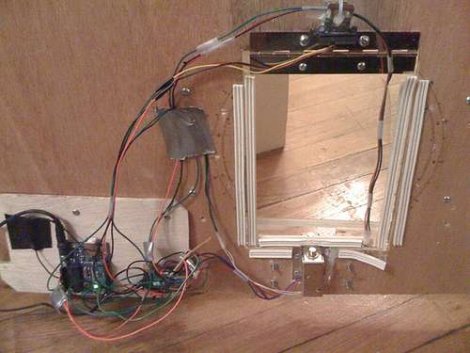
Keeping live plants in an aquarium happy can be quite a chore. One of the frequent rituals is adding fertilizer, which is called dosing. [Majstor76] came up with a creative way to automatically dose using an air freshener. He got rid of the canister that holds the scent and re-purposed a hand soap pump to move the nutrient-rich liquid. After the break you can see that there’s no shortage of power to actuate the pump and the powered air freshener base has a delay circuit, allowing for a few different time-release options. As long as the volumetric output is fairly consistent we figure you can dilute your fertilizer to fine-tune the dose.

Read the rest of this entry »


Magnetic digital scale

posted Jan 21st 2011 11:29am by
filed under: tool hacks

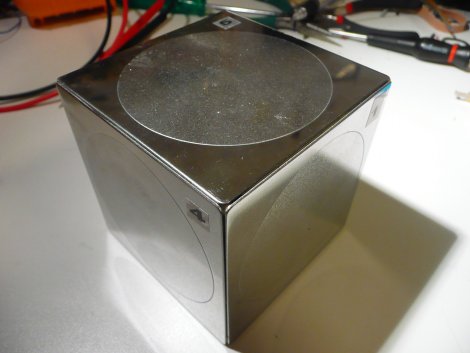
Above you see a solenoid being used as a digital scale. The magnetic field from the coil in the base levitates the platform above, where a load to be measured is place. This floating platform has a permanent magnet in it, hovering above a hall effect sensor in the base. As the distance between that magnet and the sensor changes, the measurable magnetic field changes as well. The hall effect sensor is linear so the measured value can easily be correlated with a weight. In the video after the break [Vsergeev] demonstrates the device using test weights to show off its 0.5 gram resolution. He thinks that with a few hardware improvements he could easily achieve 0.1g accuracy.

Read the rest of this entry »

Our beloved XBMC hits iOS devices

posted Jan 21st 2011 9:30am by
filed under: home entertainment hacks, iphone hacks

For those who have been longing to unlock the power of the Apple TV 2 the wait is over. XBMC is now available for iOS devices. This isn’t limited to the tiny ARM-based set-top box, but extends to the entire family including iPad and iPhone 4. Included is the ability to play high def video up to 1080p without transcoding. But we think the best feature might be XBMC’s ability to easily stream media over the network from just about any operating system. Goodbye iTunes tethering.

If you’re comfortably using SSH to work with a Jailbroken device, ATV2 installation will be a snap as there’s already a source repository to install from. iPad and iPhone 4 are even easier, just add the repository in Cydia and install. Wow, when we first looked in on the new generation of ATV we really thought it would take longer than it has to see a port of our favorite open source media client. Thanks Team XBMC!

Dance for a Dollar with the YayTM

posted Jan 21st 2011 7:51am by
filed under: misc hacks

The YayTM is a device that records a person dancing and judges whether or not the dancing is “Good”. If the YayTM likes the dance, it will dispense a dollar for the dancers troubles. However, unless the dancer takes the time to read the fine print, they won’t realize that their silly dance is being uploaded to YouTube for the whole world to see. Cobbled together with not much more than a PC and a webcam,  the box uses facial recognition to track and rate the dancer.

The YayTM was made by [Zach Schwartz], a student at NYU, as a display piece for the schools Interactive Telecommunication Program. Unfortunately there aren’t any schematics or source code, but to be honest, having one of these evil embarrassing boxes around is probably enough. What song does the YayTM provide for dancing, you ask? Well, be sure to check it out here.

EDIT: [Zack] has followed up with an expanded writeup of the YayTM. Be sure to check out his new page with source code and more info. Thanks [Zack]!


Hack a Day serves up fresh hacks each day, every day from around the web as well as hacking related news.

Send us your hacks


Hacks

Resources