posted Mar 6th 2012 4:02pm by
Mike Szczys
filed under:
Kinect hacks

The gang over at Waterloo Labs decided to add a team-building aspect to a plain old Etch a Sketch. Instead of just twisting the two knobs with your own mitts, they’re converting this giant pencil’s movements into Etch a Sketch art.
The challenge here is figuring out a reliable way to track the tip of the pencil as it moves through the air. You may have already guess that they are using a Microsoft Kinect depth camera for this task. The Windows SDK for the device actually has a wrapper that helps it to play nicely with LabView, where the data is converted to position commands for the display.
On the Etch a Sketch side of things they’ve chosen the time-tested technique of adding gears and stepper motors to each of the toy’s knobs. As you can see from the video after the break, the results are mixed. We’d say from the CNC ‘W’ demo that is shown there’s room for improvement when it comes to the motor driver. We can’t really tell if the Kinect data translation is working as intended or not. But we say load it up and bring to a conference. We’re sure it’ll attract a lot of attention just like this giant version did.
Read the rest of this entry »
posted Mar 3rd 2012 11:22am by
Brian Benchoff
filed under:
Kinect hacks

[Maxzillian] sent in a pretty amazing project he’s been beta testing called ReconstructMe. Even though this project is just the result of software developers getting bored at their job, there’s a lot of potential in the 3D scanning abilities of ReconstructMe.
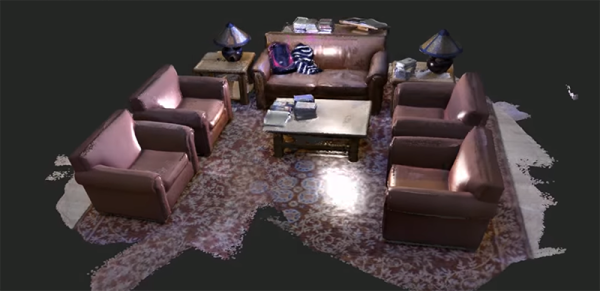
ReconstructMe is a software interface that allows anyone with a Kinect (or other 3D depth camera) in front of a scene and generate a 3D object on a computer in an .STL or .OBJ file. There are countless applications of this technology, such as scanning objects to duplicate with a 3D printer, or importing yourself into a video game.
There are a few downsides to ReconstructMe: The only 3D sensors supported are the xBox 360 Kinect and the ASUS Xtion. The Kinect for Windows isn’t supported yet. Right now, ReconstructMe is limited to scanning objects that fit into a one-meter cube and can only operate from the command line, but it looks like the ReconstructMe team is working on supporting larger scans.
While it’s not quite ready for prime time, ReconstructMe could serve as the basis for a few amazing 3D scanner builds. Check out the video demos after the break.
Read the rest of this entry »
posted Feb 20th 2012 8:01am by
Brian Benchoff
filed under:
android hacks,
Kinect hacks

After getting his hands on an Android-enabled wristwatch, [Paul] wanted to test the limits of his new hardware. We’ll assume he’s happy with his purchase because his finished build sends data from a Microsoft Kinect to his wristwatch, making it a night vision spy watch.
[Paul]‘s new toy is a WIMM One Android wristwatch that comes complete with wi-fi and a copy of Android 2.1. To get night vision onto his watch, a Kinect on [Paul]‘s desk streams depth data to his watch using OpenCV. The result is a camera that gathers depth data in the dark and sends it to [Paul]‘s watch.
Whenever the movement of an intruder is detected, [Paul]‘s watch vibrates and displays the depth image taken from the Kinect. If the intruder gets close to the Kinect, the face is picked up and also sent to the watch. To get the intruder out of the room, [Paul] can tap the face of his watch to turn on a remote alarm and sound an intruder alert. It’s a very neat project that would have been unimaginable a few years ago.
posted Feb 6th 2012 12:49pm by
Brian Benchoff
filed under:
Kinect hacks,
Medical hacks

Nearly everyone has heard of phantom limb syndrome. It occurs sometimes after a limb is amputated, but the mind of the patient still thinks that the limb is attached. Generally regarded as a mix-up in the wiring of the damaged nerves, a phantom limb can be very painful. [Ben] has been working on a way to alleviate some of the pain and frustration associated with a phantom limb and fortunately for us he went for a Kinect, VR goggles, and gyroscope build.
Today, most therapies for phantom limb syndrome use a Ramachandran Mirror Box. The theory behind the mirror box is pretty simple – if someone recently lost a hand, just insert one hand in one side of the box and the arm stump on the other side. Looking into the box from the side with the good hand will trick the patient’s brain into thinking the amputated hand is still there. It’s a good therapy that has been very successful, but [Ben] thought he could do something that is a little more immersive.
[Ben]‘s project uses a Kinect and VR goggles to put the patient in a virtual environment. With the help of a few gyroscopes, the patient gets a virtual representation of their whole self projected into their goggles. The technique isn’t terribly different from VR phobia treatment, although there’s much more electronics and math involved in [Ben]‘s build. The first test subject said his pain was going down, so it looks like he might have a success on his hand (no pun intended).
Check out the demos of [Ben]‘s treatment plan after the break.
Read the rest of this entry »
posted Feb 2nd 2012 9:14am by
Brian Benchoff
filed under:
Kinect hacks,
news

Even though we’ve seen dozens of Kinect hacks over the years, there are a few problems with the Kinect hardware itself. The range of the Kinect sensor starts at three feet, a fact not conducive to 3D scanner builds. Also, it’s not possible to connect more than one Kinect to a single computer – something that would lead to builds we can barely imagine right now.
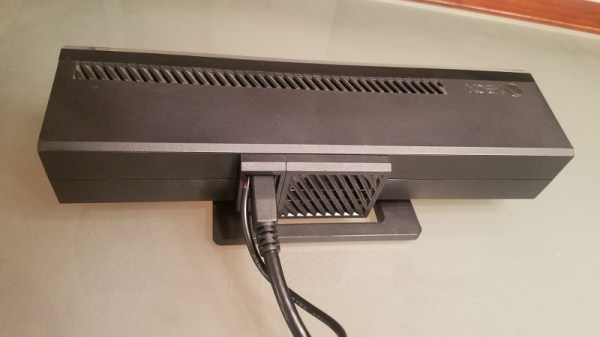
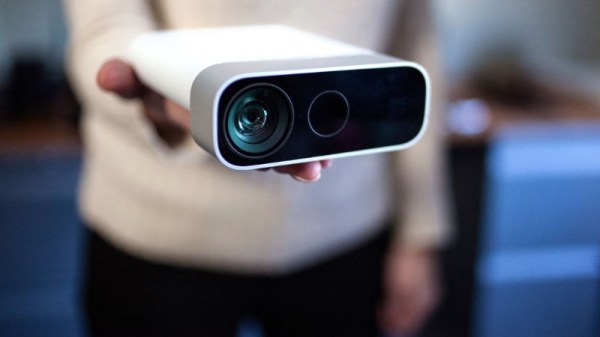
Fear not, because Microsoft just released the Kinect for Windows. Basically, it’s designed expressly for hacking. The Kinect for Windows can reliably ‘see’ objects 40 cm (16 in) away, and supports up to four Kinects connected to the same computer.
Microsoft set the price of Kinect for Windows at $250. This is a deal breaker for us – a new Kinect for XBox sells for around half that. If you’re able to convince Microsoft you’re a student, the price of the Kinect for Windows comes down to $150. That’s not too shabby if you compare the price to that of a new XBox Kinect.
We expect most of the builders out there have already picked up a Kinect or two from their local Craigslist or Gamestop. If you haven’t (and have the all-important educational discount), this might be the one to buy.
posted Jan 25th 2012 10:01am by
Brian Benchoff
filed under:
android hacks,
Kinect hacks

If you’re going to build a giant touch screen, why not use an OS that is designed for touch interfaces, like Android? [Colin] had the same idea, so he connected his phone to a projector and a Kinect.
Video is carried from [Colin]‘s Galaxy Nexus to the projector via an MHL connection. Getting the Kinect to work was a little more challenging, though. The Kinect is connected to a PC running Simple Kinect Touch. The PC converts the data from the Kinect into TUIO commands that are received using TUIO for Android.
In order for the TUIO commands to be recognized as user input, [Colin] had to compile his own version of Android. It was a lot of work, but using an OS designed for touch interface seems much better than all the other touch screen hacks that start from the ground up.
You can check out [Colin]‘s demo after the break. Sadly, there are no Angry Birds.
Read the rest of this entry »
posted Jan 15th 2012 1:26pm by
Brian Benchoff
filed under:
misc hacks,
Kinect hacks

Even though giant multouch display tables have been around for a few years now we have yet to see them being used in the wild. While the barrier to entry for a Microsoft Surface is very high, one of the biggest problems in implementing a touch table is one of interaction; how exactly should the display interpret multiple commands from multiple users? [Stephan], [Christian], and [Patrick] came up with an interesting solution to sorting out who is touching where by having a computer look at shoes.
The system uses a Kinect mounted on the edge of a table to extract users from the depth images. From there, interaction on the display can be pinned to a specific user based on hand and arm orientation. As an added bonus the computer can also recognize users from their shoes. If a user is wearing a pair of shoes the computer recognizes, they’ll just walk up to the table and the software will recognize them.
Read the rest of this entry »
posted Dec 6th 2011 4:31pm by
Brian Benchoff
filed under:
Kinect hacks

There are Kinect hacks out there for robot vision, 3D scanners, and even pseudo-LIDAR setups. Until now, one limiting factor to these builds is the requirement for a full-blown computer on the device to deal with the depth maps and do all the necessary processing and computation. This doesn’t seem like much of a problem since [wizgrav] published Intrael, an HTTP interface for the Kinect.
[Eleftherios] caught up to [wizgrav] at his local hackerspace where he did a short tutorial on Intrael. [wizgrav]‘s project provides each frame from the Kinect over HTTP wrapped up in JSON arrays. Everything a Kinect outputs aside from sound is now easily available over the Internet.
The project is meant to put computer vision outside the realm of desktops and robotic laptops and into the web. [wizgrav] has a few ideas on what his project can be used for, such as smart security cameras and all kinds of interactive surfaces.
After the break, check out the Intrael primer [wizgrav] demonstrated (it’s Greek to us, but there are subtitles), and a few demos of what Intrael ‘sees.’
Read the rest of this entry »