Building a discrete digital-analog-converter

posted Aug 17th 2010 12:38pm by
filed under: digital audio hacks

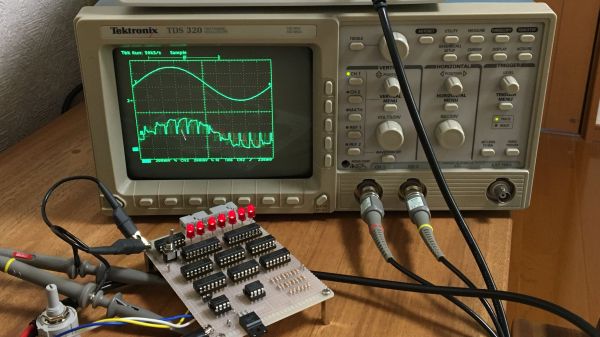
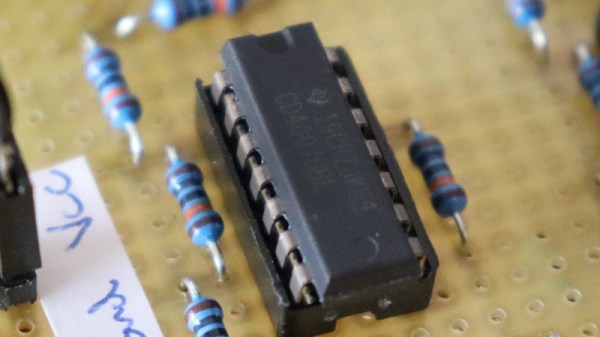
Want to take back control of how your digital audio files become sound? One thing you can do is to build your own digital to analog converter. This one is made from discrete components, centered around a resistive ladder. Yes, there are a couple of integrated circuits in there which are used for demultiplexing the incoming signal but the magic happens in that R-2R network. The project is an interesting read and makes a point of looking at the issues raised when trying to precision match resistors. Apparently it can be done with 0.1% components if you have a lot of them and a multimeter that can measure down to seven decimal places.

[Thanks Bigbob]

One-handed GameCube controller

posted Aug 12th 2010 6:09am by
filed under: peripherals hacks

[Hasse] built a one-handed video game controller for his brother. He fit everything he needed into the body of an existing controller and came up with a very usable system. The controller will be right-hand only, so the left shoulder button was moved underneath the right side where your middle finger can get at it. This leaves the d-pad and the left analog stick to account for. By combining an ATtiny44A, an accelerometer, and a digital to analog converter the controller can sense motion. The microcontroller reads in the accelerometer data, gives user feedback via four added LEDs on the d-pad, and the DAC feeds the appropriate signals back into the controller as if you were using the stick. There is even a switch to select whether the motion data is mapped to the analog stick or to the d-pad. We’ve included a demo video after the break.

Find that you also need some one-armed typing assistance? Check out this half-qwerty keyboard hack. Read the rest of this entry »


Arduino based synthesizer

posted Aug 25th 2009 4:00pm by
filed under: arduino hacks, digital audio hacks

cheap_fat_open

[Jacob] is working on his final project for the Copenhagen Institute of Interaction Design.  Based around Arduino, the quality and quantity of his build notes make this a fascinating read and there are several examples to listen to.

The project features a brilliant idea for input:  He uses a 1/8″ TRS connector (mini-jack) whose tip is the input to the DAC of the Arduino. There are conductive pads in the shape of a keyboard that you touch the tip of the connector to in order to complete the circuit. Alternatively, the other two conductors on the connector deliver power and ground for easy interface with external controllers. He built an example controller that uses an LED and photoresistor to alter the signal returning to the Arduino. Put your hand in front of the light and the sound changes.

[via Arduino: blog]

Parts: LTC2631A I2C digital to analog converter

posted Feb 9th 2009 2:00pm by
filed under: parts, tool hacks

ltc2640

Linear Technology’s LTC2631A-LZ8 is an 8bit digital to analog converter (DAC) with an I2C interface. This DAC can output 255 different voltages, spaced evenly between 0 and 2.5volts. We previously demonstrated the LTC2640 with a three-wire SPI interface, but this version is controlled with only two signal wires.

Read the rest of this entry »

Bug Labs releases BUGvonHippel universal module

posted Dec 21st 2008 5:50pm by
filed under: handhelds hacks, misc hacks

vonhippel

Bug Labs makes hardware modules that can be combined to create your own custom gadgets. They’ve just released what we consider the most useful module: BUGvonHippel. Unlike the previous single purpose modules, the BUGvoHippel is a universal interface. The bus features USB, power/ground, DAC/ADC, I2C, GPIO, SPI, serial, and more. BUG applications are written in Java using a custom IDE.

The $79 module is named after MIT professor Eric von Hippel, who wrote Democratizing Innovation. You can find an interview with him below.

Read the rest of this entry »


Hack a Day serves up fresh hacks each day, every day from around the web as well as hacking related news.

Send us your hacks


Hacks

Resources