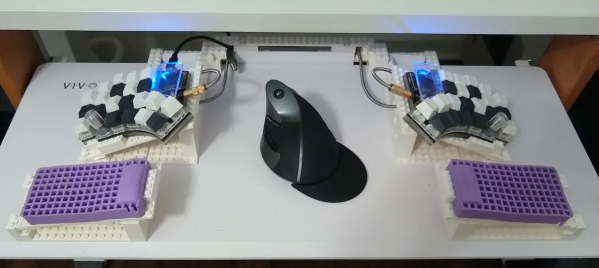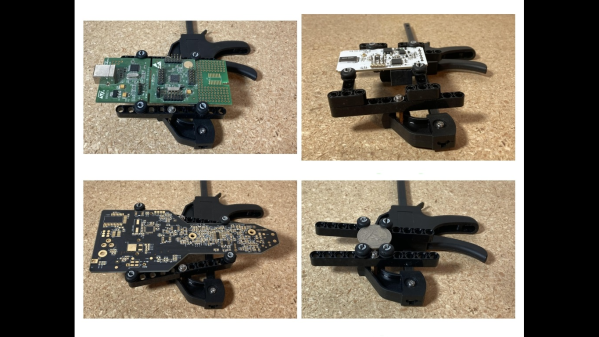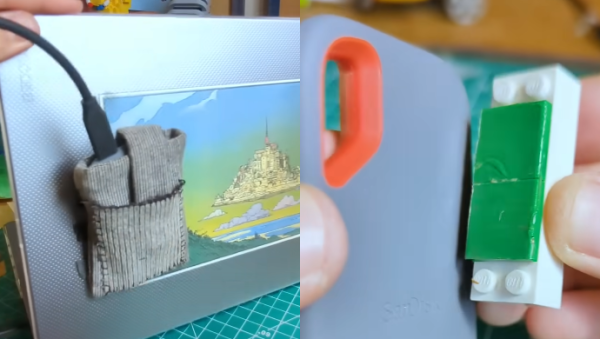
Here’s a collection of simple hacks you can do in between larger projects. After the break we’ll look at converting an iPod from hard drive storage to Compact Flash, build an LED desk lamp using LEGO and USB power for charging, and use an Arduino shield to add network control at the touch of a button.
After letting it sit around for about 3 years, [Blake] decided it was time to fix his broken 15″ television. A little trouble shooting showed the problem was with the inverter. The backlight would come on for a few seconds, off for a few seconds, then repeat. By freeing the Magnavox 15MF400T from its metal case he got it working again, but couldn’t find the source of the short. His solution: build a new case out of non-conductive material. Voilà! We have the 15″ LEGO monitor.
Halloween is a scary time for the little ones. It’s dark, they can barely see through their injection molded Spiderman masks, but it’s all worth it for the candy.
Our friends over at Evil Mad Scientist Labs have produced a pumpkin that moves on its own. The little pumpkin was disemboweled from the bottom and its guts were replaced by a simple robot. Three Lego wheels provide this base with one attached to a continuous rotation servo that provides the motion. The device is powered by 3 AAA batteries and powered by an Atmel ATtiny2313 microcontroller. For added terror there are two green LEDs that act as ghoulish eyes.
We’ve embedded the video of the Rovin Pumpkin in action after the break. This is a wonderfully simple way to spice up your front porch decorations on All Hallows’ Eve. Read the rest of this entry »
[Ned] tipped us off about his project for a class at Carnegie Mellon. Utilizing a Denso 6-AOF robotic arm they have built a rapid prototyping machine that uses Lego as the building material. LDraw, the open standard Lego CAD program, is used to build a model which is then translated into MATLAB files that the robotic arm can use for placement commands. Right now pieces need to be placed on a template for the robot to find and pick up.
It’s great that Lego pieces are used because they are readily available and inexpensive, but this type of precision robot makes the project unattainable for most tinkerers. Still, the concept is interesting and we could see an end goal being a more widely available machine. It’s not too much of a leap to image a RepRap type machine that takes internal measurements of a circuit board and the components, calculates inside case dimensions, then builds a prototype enclosure from common Lego pieces.
Last week we saw a rotating iPhone dock built from Lego. This week we’re happy to put up another example of a dock made of these popular building blocks. Thank goodness this one takes into account all of the sudden jolts that our desk is prone to by incorporating shock absorbing springs. The design is very sleek with a jazzy red scheme and a less-is-more attitude. We are a bit concerned about our expensive hand held falling out but then again that’s what the springs are for. Who can be the first to put together a step-by-step guide for building this one?
Hot on the heels of the aluminum dock and the Lego camera mount, [Steve] sent in his iPhone/iPod Touch dock made out of Lego bricks. It’s very stylish with a black and grey theme but we think the function makes this DIY spectacular. In the design [Steve] has included the ability to rotate the cradle so that the iPhone can be presented either vertically or horizontally. A step-by-step guide is not yet available but resourceful Lego lovers should be able to build this using his flickr set.
A simple panning motion can add impact to the already-dramatic effect of time lapse photography. To accomplish this, frugal cinematographers sometimes build [Rube Goldberg] contraptions from clock motors, VCR parts or telescope tracking mounts. Hack a Day reader [Stephan Martin] has assembled a clever bargain-basement system using an Arduino-driven stepper motor and a reduction gear system built up from LEGO Technic parts, along with some Processing code on a host PC to direct the show.
While the photography is a bit crude (using just a webcam), [Stephan’s] underlying motion control setup might interest budding filmmakers with [Ron Fricke] aspirations but Top Ramen budgets. What’s more, unlike rigid clock motor approaches, software control of the camera mount has the potential for some interesting non-linear, fluid movements.
The Linux4nano project has been working to port the Linux kernel onto the iPod Nano along with other iPods in general. Although the iPodLinux project has had luck with some older iPods, newer models protect firmware updates with encryption. One of the ways they plan on running code on the device is through a vulnerability in the notes program; it causes the processor to jump to a specific instruction and execute arbitrary code. To take advantage of this, they first need to figure out where their injected code ends up in the memory. Currently, they are testing every memory location by painstakingly loading in a bogus note and recording its effect. Each note takes about a minute to test and they have tens of thousands of addresses to check over several devices.
Swedish hacker [Hans Andersson] is no stranger to puzzle-solving robots. His prior work, A Rubik’s cube-solving robot called Tilted Twister, made waves through the internet last year. [Hans’] latest project only has to work in two dimensions, but is no less clever. This new robot, built around the LEGO Mindstorms NXT system, “reads” a printed sudoku page, solves the puzzle, then fills out the solution right on the same page, confidently and in ink. It’s a well-rounded project that brings together an unexpected image scanner, image processing algorithms, and precise motor control, all using standard NXT elements.
The building instructions have not yet been posted, but if the video above and the directions for his prior ’bot are any indication, then we’re in for a treat; he simply has a knack for explaining things concisely and with visual clarity. The source code and the detailed PDF diagrams for Tilted Twister are as gorgeous as his new robot’s penmanship.
This antenna tuner is controlled remotely using geared motors and legos. The tuner needed to be closer to the antenna for performance reasons. This created a problem; most of the radio gear is inside while the tuner is outside. The gear motors and Legos combine to form a closed loop servo, operating two air core caps and an inductor switch. A control box placed near the radio is hard wired to the modded tuner outside. We would like to see something like this under gesture control using the Wii MotionPlus + Arduino.