posted Mar 18th 2011 8:01am by
Mike Szczys
filed under:
HackIt

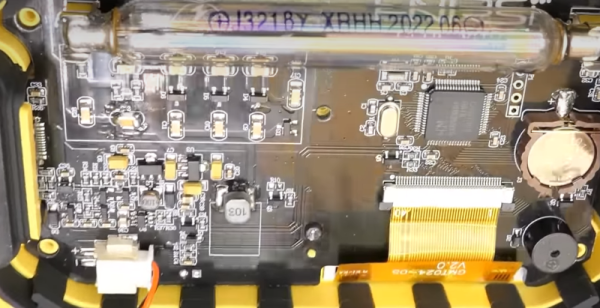
Seeed Studios, makers of the Seeeduino and fabricators of small-run PCB orders have put out a call to help develop an open source radiation detector. Will it be of any help to people in the area of Japan that is at risk? We really can’t say. But if you can lend some expertise with this, it can’t hurt. We’ve already seen a simple dosimeter project but this one sounds like it’s more on the level of a DIY Geiger counter. We know it’s possible, but the hacked together unit we saw back in 2007 had very little documentation and used parts that may be hard to come by.
The specific information needed is what type of sensor to use, what supporting circuits should be included, and what method is best to calibrate each unit. There’s a discussion going in the comment thread of that post which should be interesting to read even if you think you don’t have anything to add.
[Thanks Michael]
posted May 12th 2010 10:06am by
Mike Szczys
filed under:
wearable hacks

Tired of those awful sunburns? [Nikko Knappe's] UV sensing glasses will warn you before you become crisp and red as a lobster. The bump added to the bridge support hides a TSL230R light frequency sensor. The device automatically switches on when the arms are unfolded and starts tracking cumulative exposure. If it detects a rising UV level, or you are about to burn based on skin type, an LED inside one arm of the frames will flash to inform you.
This has some potential if you think David Brin’s Earth outlines how climate change is really going to play out. Either way it’s still fun and we give bonus points to [Nikko] for disguising the lilypad that controls this as a flowery hair-pin.
posted Oct 21st 2009 3:00pm by
Devlin Thyne
filed under:
hardware

[Aaron] A.K.A. [A1ronzo] at SparkFun has put together a hackable USB Geiger Counter. In his tutorial, he gets the Geiger counter to work as a random number generator. Later, he analyzes and discusses how well it works as a random number generator. In the past, we have seen a number of radiation detectors hacks such as the Mr. Fission digital Geiger counter, a count accumulator, and a Polonium detecting pen, Besides our inital thoughts of speeding up the number generation, and using it as a special character device, what else can you come up with to do with this device?
posted Sep 3rd 2009 4:50pm by
Zach Banks
filed under:
arduino hacks

[Sebastian Tomczak] was borrowing a homeade muon detector from his friend, and managed to hook it up to his computer through an Arduino. The detector itself uses 3 fluorescent tubes to detect radiation. Three separate tubes are used in order to filter out terrestrial radiation; cosmic radiation will fall in-line with the tubes and pass through at least two of them, whereas terrestrial radiation will only hit one. There is some basic circuitry to amplify the signal and then perform the OR operation.
[Tomczak] used an Arduino to take the raw data and feed it into his computer. He then used Max/MSP to analyze the data and filter out background noise, leaving only the cosmic ray data. He didn’t mention what he was going to use the data for, though. Maybe he’ll hook it up to a synthesizer.
Related: Digital Geiger counter
[via @littlebirdceo]